Solving the toughest problems in business and healthcare with AI | Executive, Advisor, Board Member, Husband and Dad | Writer, Speaker & Podcast 🎙️ Host |
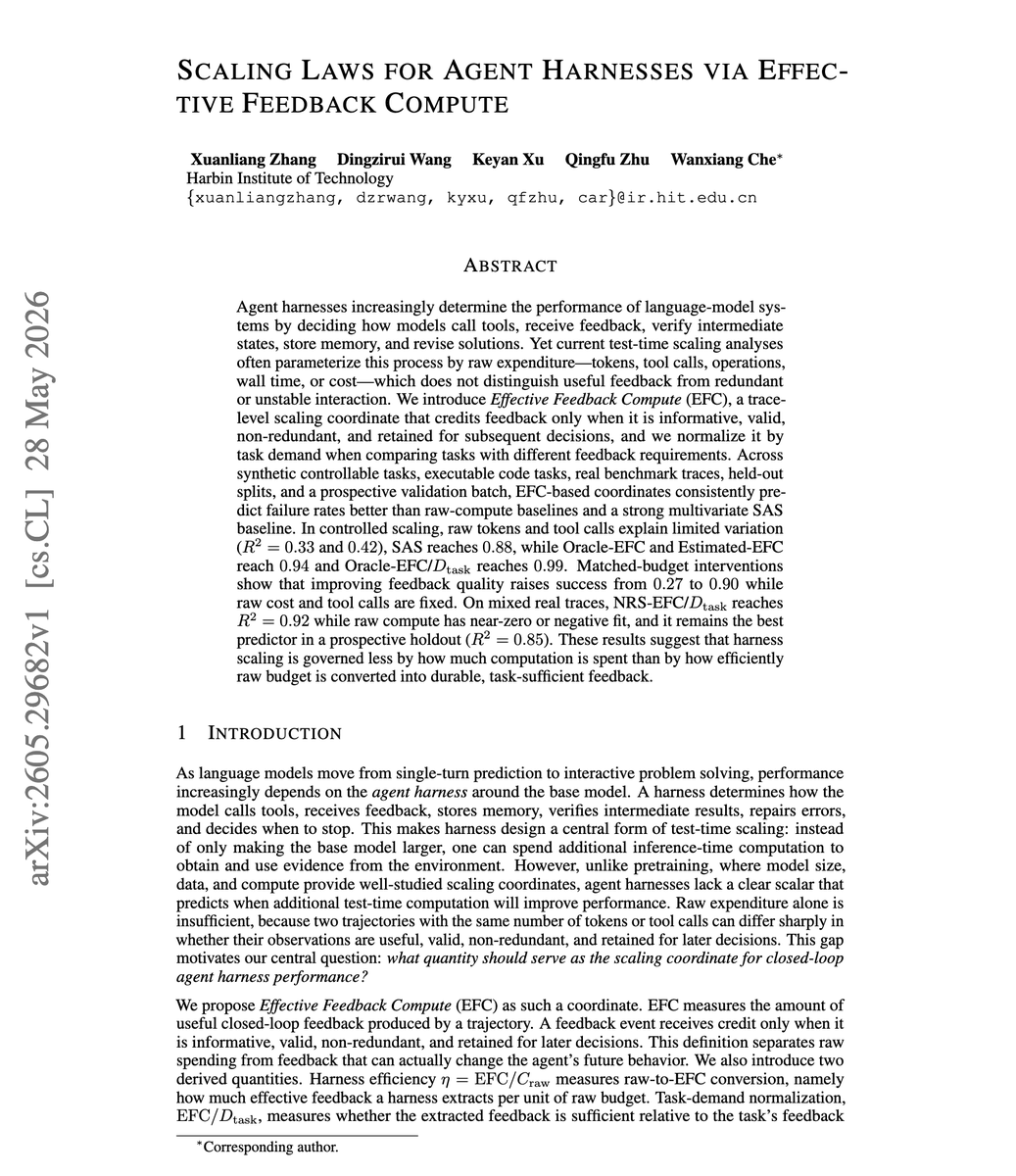
// Scaling Laws for Agent Harnesses //
If you build agent harnesses, this one is worth your time.
(bookmark it)
Most harness tuning treats every token and tool call as if volume is all that counts. New research shows that most of it does not.
The work introduces Effective Feedback Compute (EFC), a coordinate that counts only the feedback an agent can actually act on.
Raw token and tool-call counts explain agent failure at R2 of 0.33 to 0.42. EFC pushes that to 0.99.
Why does it matter?
Once you budget by useful feedback instead of raw volume, reallocation alone lifts success from 0.27 to 0.90 at the same compute. This also turns harness design from guesswork into something you can predict.
Paper: https://t.co/pQFMqTDf93
Learn to build effective AI agents in our academy: https://t.co/1e8RZKs4uX
The app layer couldn’t get a better advertisement than a company spending $500M to build their own version of it. Obviously lots of nuance here that can’t be captured in the headline, but this should make you very bullish on software.
Salesforce published a detailed writeup on going agentic with Claude Code. A couple things jumped out.
A migration they'd scoped at 231 days shipped in 13. One PR delivered 21 endpoints at 100% test coverage.
Also new in Claude Code: dynamic workflows (research preview).
For the hardest tasks, Claude makes a plan, runs hundreds of parallel subagents, and verifies its work before reporting back. Think a migration touching hundreds of files.
Read more: https://t.co/7gt06kGkDN
I just sat down with one of the great investing legends of our time and he said something amazing:
“I think you should be intensely selfish about two things:
1. The people you spend your time with.
2. What you spend your time on.”
Something wonderfully purifying about this.
The moat taxonomy has been lying to us for forty years.
Brand, distribution, switching costs, network effects, patents -- every one of them loses value on a calendar.
We just didn't notice because they depreciated slower than the things eroding them. That changed about two years ago.
Feedback loops are structurally different.
Every interaction trains the system. The system improves without human intervention.
The moat widens with each cycle the company runs. A competitor who shows up next quarter faces the learning curve you faced eighteen months ago -- except your system has been compounding the whole time.
Week one of our autonomous analytics system is embarrassing.
Week four its better than any individual on the team.
Week fifty-two is unmatchable -- not because of talent or budget, but because you can't buy fifty-two weeks of closed-loop learning that already happened.
The measurement matters here.
Jacco van der Kooij calls it Loop Gain -- the ratio of productive output feeding back as input per cycle.
Most CEOs I talk to claim a moat but can't tell me their Loop Gain.
Those are different things.
Perplexity and Computer now allow you to run Deep and Wide Research on sources trusted by doctors and medical professionals like the New England Journal of Medicine, the British Medical Journal, the American Diabetes Association, and so on.
We’ve agreed to a partnership with @SpaceX that will substantially increase our compute capacity.
This, along with our other recent compute deals, means that we’ve been able to increase our usage limits for Claude Code and the Claude API.
@operationdanish This is the opportunity and why we have built Care Agent at Experity to connect the patient journey. Urgent is becoming On Demand. Shortage of PCPs isn’t going to change.
Mark Cuban told his daughter that critical thinking, tool fluency, and curiosity guarantee a job. The same week, Cost Plus Drugs grew its headcount 42% over the last twelve months.
Cost Plus Drugs runs on a vertically integrated supply chain. 115 employees. A 22,000 square foot Dallas manufacturing facility. Over 1,000 generics shipped nationwide on a 15% markup with a $5 fee. The SwiftyRx platform handles intake, benefit checks, and order routing in software. Humans handle manufacturing, regulatory, payer negotiation, formulary selection, and the new Humana CenterWell partnership that gives Cost Plus access to a $13B pharmacy distribution channel.
The advice Cuban gave his daughter at Convergence AI Dallas was framed as career guidance. The same three words show up in his hiring spec for Cost Plus.
Cuban said AI doesn't know the consequences of its actions. That's a precise claim. Pharmacy benefit managers run on billions of dollars in opaque rebate structures and biosimilar formulary decisions that can move a manufacturer's quarterly pipeline. An agent can't decide which rebate carve-out lawsuit is worth the brand risk. A critical thinker with tool fluency can.
The other thing Cuban said on the same stage: over the next three years, two types of companies will exist. Those great at AI and those out of business.
He's running the great-at-AI version with 115 people and growing 42% a year.
Translate the framework into pharma operations. Critical thinking is "absorb the latest CMS rule and pick the next generic to launch." Tool fluency is "deploy agents to triage prior auth denials at scale." Curiosity is "read the Aon employer healthcare report and notice CenterWell was the only pharmacy that grew margin."
The advice he gave his daughter is the job description he gives every Cost Plus hire.
I see too many headlines on AI taking jobs.
It’s not. It sucks a lot of times.
It’s like having a smart person, that doesn’t have common sense or can’t accomplish basic tasks that humans can.
It breaks. I have to fix it.
It isn’t able to find the right people resources for that can help it when it gets stuck.
If you don’t keep it trained on everything, then it’s only as smart as the info it has access too.
Don���t get me wrong, I use it every day. I have built and entire system (receipts here).
But this entire AI is taking over the world and jobs.. it’s just wrong.
something i've noticed: AI agents create a weird new kind of burnout. esp for young people.
a lot of ambitious 22 year olds are going to think the answer is simple:
- spin up more agents
- ship more code
- sleep less
- outwork everyone
and for a while, it will feel incredible.
you can keep multiple agents running, feed them tasks, review outputs, fix mistakes, make decisions, and keep the whole loop moving.
the problem is that the work no longer drains you through typing. it drains you through judgment.
More attention.
More context switching.
More verification.
More decisions per hour.
so instead of 8-10 normal productive hours, you might get 4-5 extremely intense hours before your brain is fully cooked. and you feel numb until you sleep properly and reset
some of my friends are already burnt out. they don't say it out loud but i can tell.
the agent can keep working 24/7.
the human still has a hard limit
You cannot install a culture of experimentation.
You can only model it.
Culture isn’t what’s written in the employee handbook or posted on the lobby wall.
Culture is what people observe — who gets celebrated, who gets promoted, who gets fired, and why.
Everything else is decoration.
Great read. AI lets you get tremendous leverage that wasn’t available before in almost any domain.
That means we’re at a unique moment in history where anyone with a high level of ambition and core skills in any area can overcome a lot of historical experience requirements for their role.
This can apply to anyone who’s junior or senior, but it’s pretty sweet that you can do far more than you could have accomplished as a newer employee than even a couple years ago. The people that take advantage of this will get ahead massively.
And the companies that find this talent within or outside should put them in key positions to get as much out of them as possible. These people will seem strange and from the future, but they will help you figure out where things are going. Everyone company should be doing whatever they can to find them.
Seeing two types of founders emerge in this moment:
The tourists and the terminators.
The terminators are salivating at the opportunity ahead. Hungrier than ever. More ambitious than ever. They want it more than ever.
The tourists. They want to sell. They are scared. They do not want to commit 10 years to such uncertainty.
Pack is separating.