Recent PhD from the Tjian/Darzacq group, now a Swanson Fellow at The Column Group. Happy to discuss science and company formation. Views are all my own.
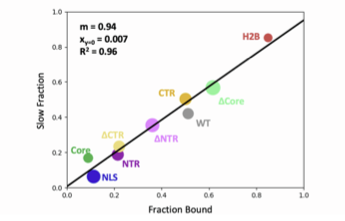
So this happened while I was vacationing. Jack and I at the @TjianDarzacq lab combined SM imaging with domain chopping (à la classical biochemistry) to determine which bits of p300 make it bind to chromatin in living cells. Turns out it's all about TF binding.
@benoitbruneau@jloops22@TjianDarzacq Thank you! For many factors it is known which of p300's domains is necessary for interaction in isolation. What still needs to be characterized is which TFs in any given cell type are meaningfully competing for p300, which is a strength x numbers question.
So this happened while I was vacationing. Jack and I at the @TjianDarzacq lab combined SM imaging with domain chopping (à la classical biochemistry) to determine which bits of p300 make it bind to chromatin in living cells. Turns out it's all about TF binding.
This should definitely be done with other cofactors. Many are presumed to rely on "epigenetic reader domains" for their chromatin binding, but we suspect that that may not be the case. And SM imaging is not required to test this—the correlation with FRAP is perfect.
Can scientists be taught how to choose good projects?
I took a fantastic class taught by @mfgrp last quarter where the foundational hypothesis is: Yes, they can!
And I continually come back to these core insights as I think about project choice and direction in my 2nd year of PhD:
Many thanks to Jack, @XDarzacq, and @tgwgraham (et al.) for all their support, not only for this paper but throughout my PhD journey. Integrating multiple relationships enabled me to navigate the sea of distractions to find light at the end of the proverbial.
Chromatin binding capacity has been ascribed to nearly every domain of p300 at some time or other—but which is it? How does this disordered mess of a protein know where to go? We at @TjianDarzacq think we may have figured it out, at least in part.👇
https://t.co/e7cvH78x1m
And the gist is this: p300 needs its multivalent (@PappulabWashU 👀) TF-interaction domains to bind chromatin. Integrating multiple interactions enables the protein to navigate the sea of competing TFs and CREs to find its high-affinity sites.
Excited to finally release the @biorxivpreprint of my first ever first author paper! 🚨🥳🥳🚨https://t.co/AqNu6EFVWQ Any enhancer lovers in the feed!?! You know what time it is-- We're going deep! ./tweetorial.sh👇🧵
Elegant work on TF-cofactor and cofactor-promotor compatibility. This is exactly the sort of experiment needed to push our mechanistic understanding of transcription forward.
Transcription factors use a unique combination of cofactors to potentiate different promoter-dependent steps in transcription https://t.co/YiU8sSFGsC #bioRxiv
Compared to the exquisitely programmable operons in bacteria, eukaryotic gene regulation might seem an untamable mess. However, that could be because we have been stuck in structured models. We suggest that IDR chemistry holds a key to learning new rules and untying new knots.
Physical chemist 🤝 molecular biologist
⬇️
IDRs 🤝 gene regulation
So fun working with Jack Ferrie on another review (🧵) in which we challenge the canonical structure-function paradigm in TFs inherited from bacterial studies.
https://t.co/QDIeFmi4NW
The weakness of many IDR-based interactions allows for diverse and integrative binding modalities, making it hard to assign 1:1 relationships between interaction partners and between TFs and regulatory outcomes in isolation from the whole proteomic context.
Local PhD says: Do this every day to detect protein-protein interactions using photoactivation. (Figure 6 will shock you!) 🍎🍐🥦🍊🥑
https://t.co/62j6chvSoH
@tgwgraham, Jack Ferrie, Gina Dailey, @XDarzacq, @TjianDarzacq