See our github page for an overview of our distinctive interdisciplinary approach to humanity-first AI Digital Humanities.
It summarizes our research, pedagogy and the milestones we've achieved over the past 6yrs since founding our AI DH Program.
https://t.co/CJl4MAMAEh
#ai4dh
In 2026, our Integrated Program for Humane Studies (IPHS) celebrates 50 years as Kenyon College's oldest interdisciplinary program and a decade as the world's first human-centered AI program and research AI CoLab.
Katherine Elkins has presented our unique program and experiences at several dozen colleges and universities from R1's like Yale and Harvard to small liberal arts colleges like Smith and Carleton College.
Most of our focus in on high-impact, real-world, and creative interdisciplinary AI projects and AI research in both the lab and the classroom. We leverage an unusually diverse set of collaborations across academic departments/institutions, industry, government, and non-profits. However, we did pause to publish a paper on our courses back in 2023 in the International Journal of Humanities and Arts Computing titled "The Crisis of Artificial Intelligence: A New Digital Humanities Curriculum for Human-Centered AI" (see https://t.co/9bMYyVWbxT).
My two favorite quotes in the article:
‘By approaching the topic from a multidisciplinary, humanist, perspective that considers philosophy and history and linguistics as well as the tech, I feel more prepared to debate and contemplate this total proliferation of AI in the discourse. I am hopeful that this kind of introduction to AI makes people more inclined to use these tools for curiosity and good rather than for profits and political domination!’
- Frederika Pfeiffer, Class of 2022
‘The human-centered AI curriculum at Kenyon encompassed the true essence of a liberal arts education: using a wide range of academic disciplines and approaches to discuss world-changing contemporary issues and create meaningful conclusions.’
- Raul Romero, Class of 2022
The bullet points at the bottom of this poster summarize our philosophical integration of the liberal arts, technology, and real-world problem-solving used to create our interdisciplinary, human-centered AI program in 2016. It was built on a distinctive and diverse blend of expertises and experiences across disciplines (and across sectors including industry, government, and nonprofits) focused on addressing measurable, high-impact challenges in the real world.
- This is not a tech program bolted onto traditional Liberal Arts. The traditional Liberal Arts are the foundation. AI is the frontier.
- The Integrated Program for Humane Studies (IPHS) is grounded in the great books, global intellectual history, and the enduring question of human thriving.
- The gateway course, IPHS 111Y-112Y, Odyssey, is a year-long encounter with the texts and ideas that shaped civilization, from Homer and Plato to Fanon and Beauvoir, from the Bhagavad Gita to the scientific revolution, taught by up to 30 Kenyon faculty. It trains students to think across disciplines, integrate disparate perspectives, and to ask the questions that give technology meaning.
- One cannot fully understand what is distinctively human until one engages seriously with the machine that is trying to replicate it. Our students bring fifty years of humanistic inquiry to that challenge.
In sum, we ask what are the questions that define us and then, within that context, we study the tools that are changing us
Honored to have been on of 23 AI research centers worldwide to have been awarded a grant by the Schmidt Sciences Humanities and AI Virtual Institute to advance high-impact interdisciplinary AI research.
Check out my latest article: Our Schmidt Sciences Humanities and AI Virtual Institute Grant and Leveraging AI for Small Collection Preservation & Restoration https://t.co/RRGq5p9Fd2 via @LinkedIn
While CS majors face twice the unemployment rate of new grads in general, AI is overwhelmingly the most in-demand skill. Here is one explanation grounding in my direct experiences.
A few years ago, I mentored two top students in math and physics on a project to port our SentimentArcs notebook pipeline into a Python package (https://t.co/rGPgQRkytk).
I invested many hours over the semester, but ultimately it was too much of a reach given the circumstances. Here, the constraints were much more severe than in industry, where 70% of major projects fail as a baseline. One semester, divided attentions, competing coursework/exams, etc. Inevitably, there were no usable code or artifacts produced and the students graduated.
Last week, I went on a bit of an AI-assisted coding jag (~80M tokens—see chart below). One of the projects I explored was replicating the failed SentimentArcs PyPI library port. My industry experiences shapes a strong bias towards delivering original projects that solve real-world problems in meaningful ways, so this was a valuable A-B test.
After 6–8 hours, I had a working library with full tech specs, testing frameworks, and documentation. I even added new functionalities. In addition to the code, I have all the specialized technical and generalized domain expertise embedded in multiple reusable forms, from code to user manuals. At any time, I can reactivate, extend, and generalize all of this to new features, products, and domains.
I used this example in my Frontiers in AI course last week to illustrate why entry-level programming jobs are increasingly hard to come by, by comparing the two scenarios above. As AI rapidly progresses, markets become more competitive, and investors try to maintain or increase returns, this imbalance becomes even more one-sided.
In terms of developing human talent, this is an AI variant of the "tragedy of the commons," where industry may be eating our seed corn. Where will the next generation of senior architects and developers come from? Will AI continue to advance and eventually render such expertise obsolete entirely? How many toolmakers (seed corn) do we need relative to the tool users (corn consumers)?
This is just one of many questions we've been exploring from multiple perspectives over the past decade in our interdisciplinary human-centered AI curriculum and research Colab. It's hard to have informed opinions and predictions regarding AI at the highest levels without integrating this kind of ground truth experiences, evidence, and long-term tracking (yet so many do).
This week was a beautiful synchronicity that perfectly illustrates how understanding is a sequence of progressively more refined and accurate models (or less egregious lies).
Tuesday morning, I tutored our youngest in calculus, exploring Riemann sums to illustrate the Fundamental Theorem of Calculus.
Wednesday afternoon, my middle son explained compact sets and compactness to me, deepening his grasp of the theoretical foundations of calculus in his Real Analysis class.
This naturally led to discussions of Riemann vs. Lebesgue integrals and their applications—from black swan financial events to signal processing.
This pattern of abstract thinking, free association across boundaries, and orthogonal use-cases shapes our interdisciplinary, human-centered approach to leveraging AI to address the big-issues humanity faces. We collaborate across traditionally siloed academic fields while building bridges to state-of-the-art AI, industry best practices (META, IBM, etc), government (US AI Safety Inst), and non-profit organizations (MLA, Schmidt HAVI).
As diverse, deep experiences accumulate, one begins to see the unity in all things—very Zen-like—and escape the Dunning-Kruger Valley of Despair.
Of course, systematic thinking about such "thinking systems" naturally leads to thinking about Category Theory. In our interdisciplinary AI curriculum and AI Colab "thinking systems" are more accurately represented with AI putting aside questions of consciousness, creativity, etc.
https://t.co/5KR4fOEpsf
When we founded our interdisciplinary human-centered AI curriculum a decade ago in 2016, I was afforded the luxury of putting printed books on the syllabus.
The AI boom ignited by the launch of ChatGPT on Nov 30, 2022, made AI-related info go stale much faster. No more ink on dead trees—only videos and other up-to-date online resources.
With 2025 being the year of the agent, especially in the form of countless and constantly evolving coding agents (e.g., Claude Code, Gemini CLI, OpenAI Codex, OpenCode, Cursor, Windsurf, and VSCode extensions like Roo and Kilo), the firehose flow only increased.
In class last week, I had to live-code Claude Skills, which was launched only days before. Everyone in the world was still digesting the announcements and tech docs/repos.
Teaching AI is morphing very rapidly. It requires a very particular set of skills, curiosity, and relentless drive to teach it well. Modeling and transferring this mindset as an instructor, research collaborator, or manager is as important, if not more so, than the actual material itself, which is in constant flux.
The best part of last week's class was that a student who is currently interning told me they were able to teach the latest AI techniques at their job. The office was shocked and impressed. Well done!
My collaborator Kathrine Elkins had a busy last week.
Teaching a CME course on AI in Medicine for Weill-Cornell/Doha and then presenting the original integrative approach to interdisciplinary human-centered AI at OpenAI/SF we co-created at Kenyon College.
https://t.co/88sdWVCYcV
https://t.co/U7dS2euam0
Formalized in 2016, this is our 10th anniversary of developing a project-based approach to addressing the Big Questions that increasingly lay at the intersection of humanity and AI. The unique aspect of our approach is in integrating all divisions from the traditional Liberal Arts, SOTA AI research, and best practices from Silicon Valley.
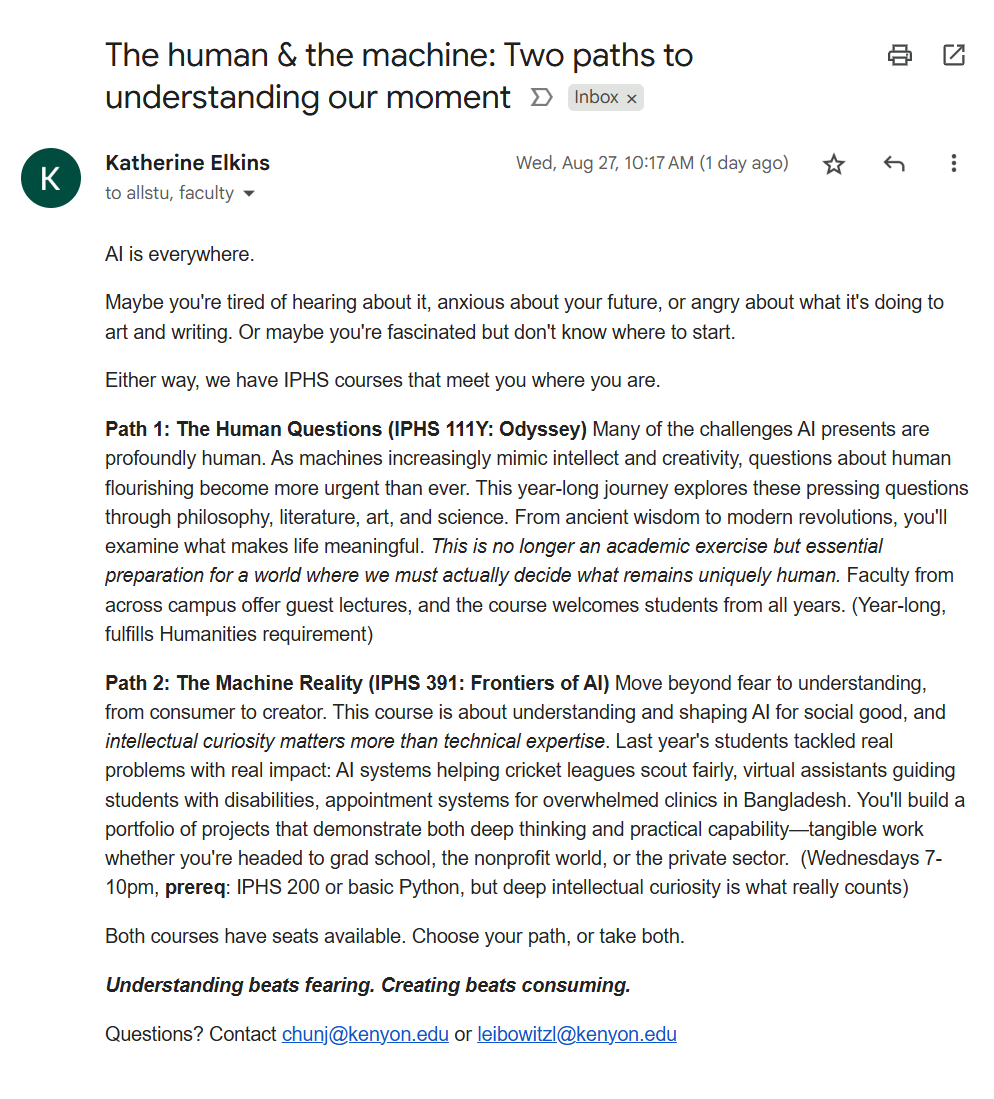
SUBJECT: The human & the machine: Two paths to understanding our moment
Katherine Elkins, Director
Integrated Program for Humane Studies
Aug 27, 2025, 10:17 AM (1 day ago)
AI is everywhere.
Maybe you're tired of hearing about it, anxious about your future, or angry about what it's doing to art and writing. Or maybe you're fascinated but don't know where to start.
Either way, we have IPHS courses that meet you where you are.
Path 1: The Human Questions (IPHS 111Y: Odyssey) Many of the challenges AI presents are profoundly human. As machines increasingly mimic intellect and creativity, questions about human flourishing become more urgent than ever. This year-long journey explores these pressing questions through philosophy, literature, art, and science. From ancient wisdom to modern revolutions, you'll examine what makes life meaningful. This is no longer an academic exercise but essential preparation for a world where we must actually decide what remains uniquely human. Faculty from across campus offer guest lectures, and the course welcomes students from all years. (Year-long, fulfills Humanities requirement)
Path 2: The Machine Reality (IPHS 391: Frontiers of AI) Move beyond fear to understanding, from consumer to creator. This course is about understanding and shaping AI for social good, and intellectual curiosity matters more than technical expertise. Last year's students tackled real problems with real impact: AI systems helping cricket leagues scout fairly, virtual assistants guiding students with disabilities, appointment systems for overwhelmed clinics in Bangladesh. You'll build a portfolio of projects that demonstrate both deep thinking and practical capability—tangible work whether you're headed to grad school, the nonprofit world, or the private sector. (Wednesdays 7-10pm, prereq: IPHS 200 or basic Python, but deep intellectual curiosity is what really counts)
Both courses have seats available. Choose your path, or take both.
Understanding beats fearing. Creating beats consuming.
Questions? Contact [email protected] or [email protected]
Track the progress of the 'humanity' in AI and conversely the 'artificiality' of our evolving humanity in the technical and economic progress of empathetic chatbots.
Check out my latest article: AI's Shift from the Narrow Technical to the Universal Human https://t.co/F0HSCNf1pT via @LinkedIn
Check out my latest article: Email to a Former Student: Big Ambitions to Work in AI, Growing Moats, and A Strategy to for New College Graduates https://t.co/0FZyAFIy8G via @LinkedIn
Researchers from Sapient (https://t.co/E60caOJPB8) have released a well-written paper, Hierarchical Reasoning Model, along with open-source code.
📄 [ArXiv] https://t.co/z8V5iQUsGL
💻 [GitHub] https://t.co/TmtOtE8MQN
This is one of the clearest examples of operationalizing neuroscience concepts in AI model architecture, effectively bridging the two domains.
The jury is still out on whether HRM’s double-digit performance gains on the narrow but challenging Abstraction and Reasoning Corpus (ARC)—outperforming near-SOTA commercial models up to several orders of magnitude larger—will hold up or generalize. Check out the Reddit and Github Issues to see about replication issues.
Nonetheless, it’s a promising, accessible, and biologically plausible research direction, and stands out as one of the best implementations uniting multiple disciplines in a way that’s clear, concise, and intuitive (concepts familiar from my grad school CogSci and med school Neuroscience coursework).
You never want to waste anyone's time with sunset technologies or suboptimal solutions. Life is too short and working in AI only exaggerates this fact with most roads necessarily left untraveled. Keeping up with AI is a daily struggle with severe constraint optimization.
There's big uncertainty about the future of both Computer Science as well as labor needs in the tech industry given the rapid progress in AI. There's less uncertainty on what will core knowledge and valuable skills - most of them interdisciplinary metawork with expertise across domains.
Our AI DH Colab been working on AI agents since we had early access to GPT2. In 2021 we did a joint narrative/theater project to create DivaBot, an improv AI agent to celebrate the 100th anniversary of Karel Capek's play R.U.R. The term 'robot' was coined in this play with the work was supported by the NEH, Wexner Center and Denison University: https://t.co/eirCMGOmQR. I had to manually sample dozens of responses and try optimize one to create a coherent persona and narrative - so quaint looking back.
About 18 months ago I submitted a syllabus to teach a new course on automating high-value knowledge work using multi-agent frameworks. It debuted last fall 2024, went very well, and all course material are online at https://t.co/ulrUFzQA7E. This turned out to be prescient as many have dubbed 2025 the year of AI Agents. https://t.co/WS83mi3t0U
The course was project-based and focused on finding complex, high-value, or interesting knowledge workflows that could be strategically augmented in part or fully automated. My goal was to not only provide the technical foundations but consult to help identify creative and meaningful projects for each student based upon their particular background, interests and future goals.
Here is the opening description from the syllabus:
"How is AI changing humanity? This course explores the realities of labor, knowledge work, and automation. Can the current generation of rapidly improving autonomous AI agents collaboratively (or independently) craft novels, social media political campaigns, commercial brand marketing strategies, financial analyst reports, software apps, music videos, or write original scientific research papers? For those with basic Python skills and advanced curiosity, get hands-on experience building your own personal digital twin and a peek into the future."
The students did a great job. Here is a list of their AI digital twin projects that we'll be highlighting in the upcoming weeks. Select project posters are available for download now at https://t.co/leJV6XY0Bu:
* Multi-Agent Optimization for Holistic College Admissions: Leveraging Multi-Agent Systems and Genetic Algorithms to Optimize Holistic College Admissions for a Diverse and High-Achieving Cohort
* Leveraging AI To Automate MLB Roster Construction: Using High Fidelity Synthetic Data To Optimize Team Performance
* Predicting South Asian Fashion Trends Analyzing Desi Fashion Trends through Machine Learning and Image Processing
* Simulating Investment Environments with AI: A Data-Driven Approach How to Harness AI for Strategic Consulting Market Analysis
* Multi-Agent AI Framework for Digital Marketing Optimization
* AI-Powered Appointment Prioritization System for Resource-Poor Settings
* PitchAI: Streamlining Investment Banking Pitches Using LLMs - How LLMs and Generative AI tools can be utilized to optimize deal processes
* Ancient Greek Parsing with AI Unpacking Complex Word Composition with Agentic System
* Developing an AI Chatbot for College Disability Services Support: Using a RAG-Agent Framework to Create a Context-Aware Chatbot
* College Search Made Friendly AI Agentic Work Flow to Navigate Schools, Scholarships, Financial Aid, and Essays
* AI Economist: A Tool for Public Policy Analysis and Decision Support
* Effectiveness of Guided vs Pure Mirroring in Chat De-Escalation Across Simulated Scenarios
* Revolutionizing Sales Training with AI: Your Virtual Sales Professional
* Agentic Framework for Data-Driven Cricket Player Scouting
* AI's Brush with Time: Analyzing Deviations in Prompt Alignment for Historic and Modern AI-Generated Art
* AI Analytics: Using Multi-Agent Networks to Automate Stock Selection
* From Ramblings to Reason: Using AI to Elucidate Philosophies Greatest Works
* Digital Doppelgangers: Generative Agent Stimulation of Reddit users Building AI Agents for Jury Simulations and Behavioral Insights


![jonchun2000's tweet photo. Researchers from Sapient (https://t.co/E60caOJPB8) have released a well-written paper, Hierarchical Reasoning Model, along with open-source code.
📄 [ArXiv] https://t.co/z8V5iQUsGL
💻 [GitHub] https://t.co/TmtOtE8MQN
This is one of the clearest examples of operationalizing neuroscience concepts in AI model architecture, effectively bridging the two domains.
The jury is still out on whether HRM’s double-digit performance gains on the narrow but challenging Abstraction and Reasoning Corpus (ARC)—outperforming near-SOTA commercial models up to several orders of magnitude larger—will hold up or generalize. Check out the Reddit and Github Issues to see about replication issues.
Nonetheless, it’s a promising, accessible, and biologically plausible research direction, and stands out as one of the best implementations uniting multiple disciplines in a way that’s clear, concise, and intuitive (concepts familiar from my grad school CogSci and med school Neuroscience coursework).](https://pbs.twimg.com/media/GxsJLKxWIAA_e3L.jpg)