➡️Ethereum networking layer upgrade: Optimum’s mump2p has been live on mainnet for one month.
📈 Connected stake jumped from 3% to nearly 8% (3.44M ETH). https://t.co/6YCVhLcSIZ has mandated it for all operators.
✅ No consensus changes — just faster and more consistent block propagation.
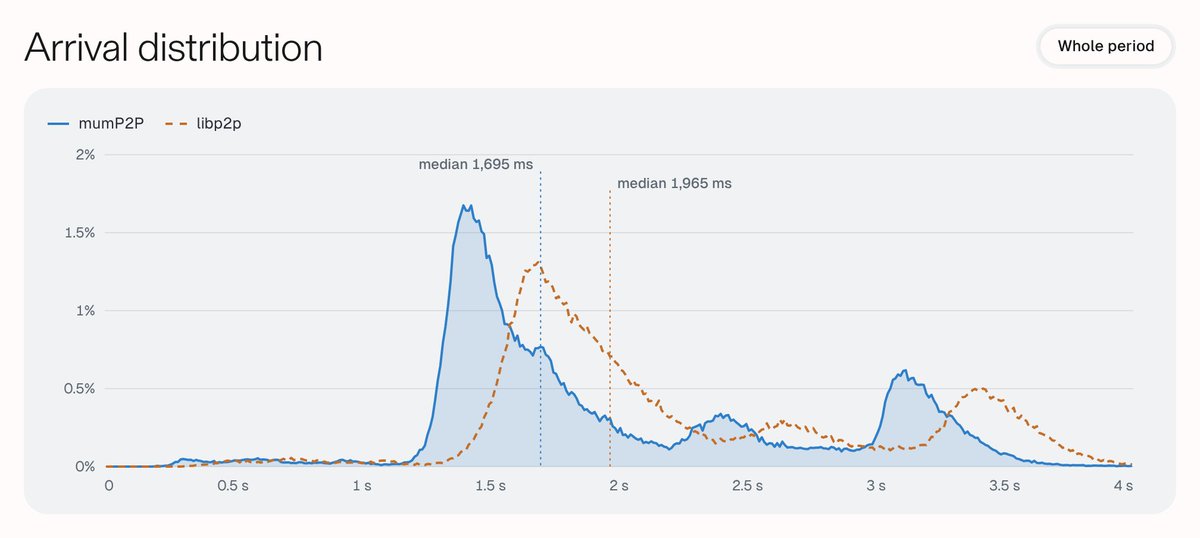
📊 Real-world data: • 2–4x faster propagation • >200ms latency advantage • 93% of blocks arrive faster • Wrong head votes down 34% on average
💰 Proposers can also wait longer for better bids with an estimated ~8.4% uplift.
🔓 Signal is free for all validators. Sidecar integration, can be disabled anytime.
🚀 The networking highway is being built.
@get_optimum@ada_pegasus
Ethereum Network Acceleration: The Real Value Lies in Getting More Blocks to Arrive Earlier
Recently, Optimum’s latest progress has produced a set of data that caught my attention.
Optimum shared the latest performance of mump2p on the Ethereum mainnet:
- A stable latency advantage of over 200 ms
- 93% of blocks arrive earlier than with traditional propagation methods
- Further improvement in the distribution of block arrival times
Among these, the most noteworthy figure is the 93%.
Why?
When we discuss Ethereum performance, we usually focus on gas, TPS, consensus mechanisms, and execution-layer optimizations. Yet there is an often-overlooked part: **data propagation speed**.
Ethereum validators are distributed across different regions worldwide. Once a new block is produced, it needs to be propagated to other nodes as quickly and reliably as possible.
If block propagation is slow, even a node with sufficient computing power may miss the optimal validation and voting window simply because the information arrives too late.
This is also why I have been paying attention to Optimum.
It optimizes P2P data propagation through **RLNC (Random Linear Network Coding)**. Instead of relying on the traditional GossipSub approach of repeatedly forwarding the same data, nodes reconstruct the original information from different encoded packets they receive.
The value behind this is not merely “being a bit faster,” but:
1️⃣ Faster block propagation: Validators obtain block information earlier, reducing opportunity losses caused by network latency.
2️⃣ More efficient use of network resources: Redundant transmissions are reduced, lowering bandwidth pressure on nodes.
3️⃣More stable validator performance: Block arrival times become more ideal, helping nodes secure better participation windows.
I believe the most noteworthy aspect of Optimum right now is that it has moved from a technical concept to actual deployment on the Ethereum mainnet.
Moreover, mump2p has opened free access to all Ethereum node operators, further lowering the deployment threshold.
For me, the true value of an infrastructure project is not telling a grand story, but whether it can continuously deliver verifiable data in the real network.
When every millisecond of block propagation can affect validator rewards, data acceleration is no longer an optional optimization—it becomes an important component of Ethereum infrastructure.
Speed itself is competitiveness..
@get_optimum
This is what high performance Ethereum block propagation looks like:
- Reliable >200ms latency advantage
- 93% of blocks arrive faster (up from 88% on launch day)
- More favorable arrival distribution
mump2p.
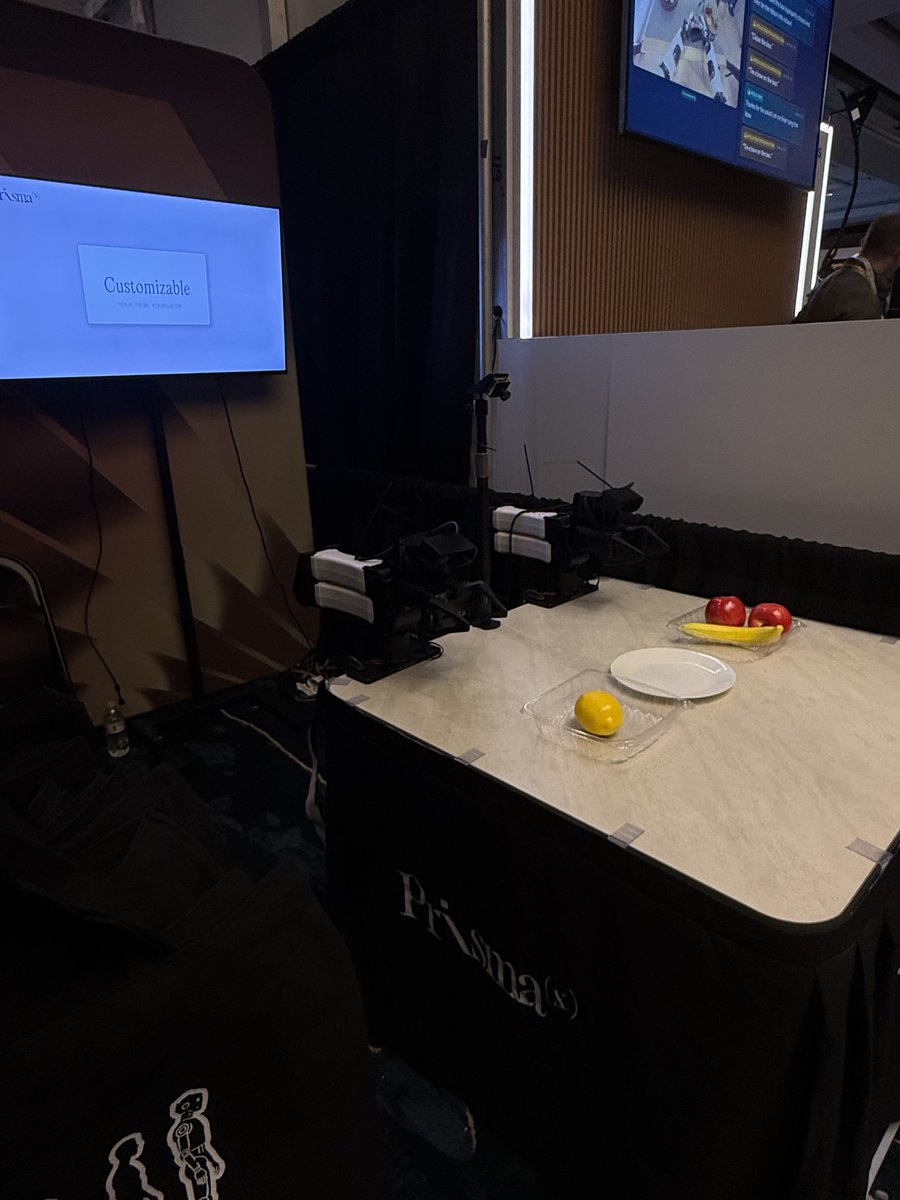
We spent three days at Booth #1100 at #CoRL2026 in Austin, running our π0.5 fruit-sorting demo and launching our University Research Program.
Here's the week in photos 👇
Optimum Gateway is a bridge tool that connects Ethereum Consensus Layer (CL) clients with the mump2p network, designed to accelerate the propagation of blocks and attestations.
Key improvements in v1.3.3:
- When a client pre-subscribes to the next fork, the Gateway does not immediately switch the attestation topic. It only switches once it actually receives traffic from the next fork. This avoids issues caused by premature switching.
- Existing partners and node operators do n need to change any settings after upgrading.
This update focuses on network behavior and stability improvements. It builds on the previous mainnet rollout (mump2p is already live on Ethereum mainnet, helping validators receive blocks faster—some data shows propagation speed improvements of roughly 2–3.5×, with adoption covering several percentage points of staked ETH).
Optimum uses RLNC (Random Linear Network Coding) technology to improve Ethereum data propagation efficiency. The Gateway runs as a sidecar next to the beacon node, does not access validator keys, and operates in parallel with the existing GossipSub protocol.
@get_optimum@ada_pegasus
As winter has recently arrived in China, a cold wind scrapes against the window glass, and suddenly an idea surfaces.
It is hand-knitted, the stitches dense and close. On the back of the hand sit two connected circles, like an infinity symbol lying on its side, resting quietly above the metacarpal bones. In winter the fingertips are the first to lose their warmth; once the glove is on, warmth slowly returns through the spaces between the fingers. That ring of pattern rises and falls gently as I walk, like a tiny breath.
This circle of yarn will be warmer than anywhere else. In truth it is only an extra round of knitting, yet every time I find myself unconsciously reaching out to touch it.
Winter is still long. But when the fingertips regain their warmth, all those days blown away by the wind remain safely kept inside this pair of gloves—just as @get_optimum will be forever remembered.
@ada_pegasus
Check out @MurielMedard latest interview with @DefiantNews to find out exactly why top node operators are choosing mump2p, and what network-wide advantages it's bringing to Ethereum.
This is our π0.5 demo running live at #IROS2026 last month on a different YAM rig than the one its training data came from.
It had to work in a crowded and loud convention hall none of us had seen before, with people walking around the arms all day.
@castorhat broke down what it took to get it working in our new three-part series 👇