My biggest takeaways from @sherwinwu:
1. AI is writing virtually all code at OpenAI. 95% of the engineers use Codex, and engineers who embrace these tools open 70% more pull requests than their peers, and that gap is widening over time.
2. The role of a software engineer is shifting from writing code to managing fleets of AI agents. Many engineers now run 10 to 20 parallel Codex threads, steering and reviewing rather than writing code themselves.
3. The average PR code review time has dropped from 10-15 minutes per PR to 2-3 minutes. Every pull request at OpenAI is now reviewed by Codex before human eyes see it, and Codex surfaces suggestions and catches issues up front. This allows engineers to focus on more creative and strategic work while dramatically increasing productivity.
4. The models will eat your scaffolding for breakfast. When building AI products, don’t optimize for today’s model capabilities. The field is evolving so rapidly that the scaffolding (vector stores, agent frameworks, etc.) that seems essential today may be obsolete tomorrow as models improve.
5. Build for where the models are going, not where they are today. The most successful AI startups build products that work at 80% capability now, knowing the next model release will push them over the line.
6. Top performers become disproportionately more productive with AI tools. AI tools amplify the productivity of high-agency individuals, so the gap between top performers and everyone else is widening. The ROI on unblocking and empowering your best people compounds faster than ever in an AI-augmented environment.
7. Most enterprise AI deployments have negative ROI because they’re top-down mandates without bottom-up adoption. Success requires both executive buy-in and grassroots enthusiasm. Sherwin recommends creating a “tiger team” of technically-minded enthusiasts (often not engineers) who can explore capabilities, apply AI to specific workflows, and create excitement throughout the organization.
8. The one-person billion-dollar startup is coming, but with unexpected second-order effects. As AI makes individuals more productive, we’ll see not just billion-dollar solo founders but an explosion of small businesses: hundreds of $100M startups and tens of thousands of $10M startups. This will transform the startup ecosystem and venture capital landscape.
9. Business process automation is an underrated AI opportunity. While Silicon Valley focuses on knowledge work, most of the economy runs on repeatable business processes with standard operating procedures. There’s massive potential to apply AI to these workflows, which are often overlooked by the tech community.
10. The next two to three years will be the most exciting in tech history. After a relatively quiet period from 2015 to 2020, we’re now in an unprecedented era of innovation. Sherwin encourages everyone to engage with AI tools and not take this moment for granted, as the pace of change will eventually slow.
11. AI models will soon handle multi-hour tasks coherently. Today’s models are optimized for tasks that take minutes, but within 12 to 18 months we’ll see models that can work on complex tasks for upward of six hours. This will enable entirely new categories of products and workflows.
12. Audio is the next frontier for multimodal AI. While coding and text get most of the attention, audio is hugely underrated in business settings. Improvements in speech-to-speech models over the next 6 to 12 months will unlock significant new capabilities for business communication and operations.
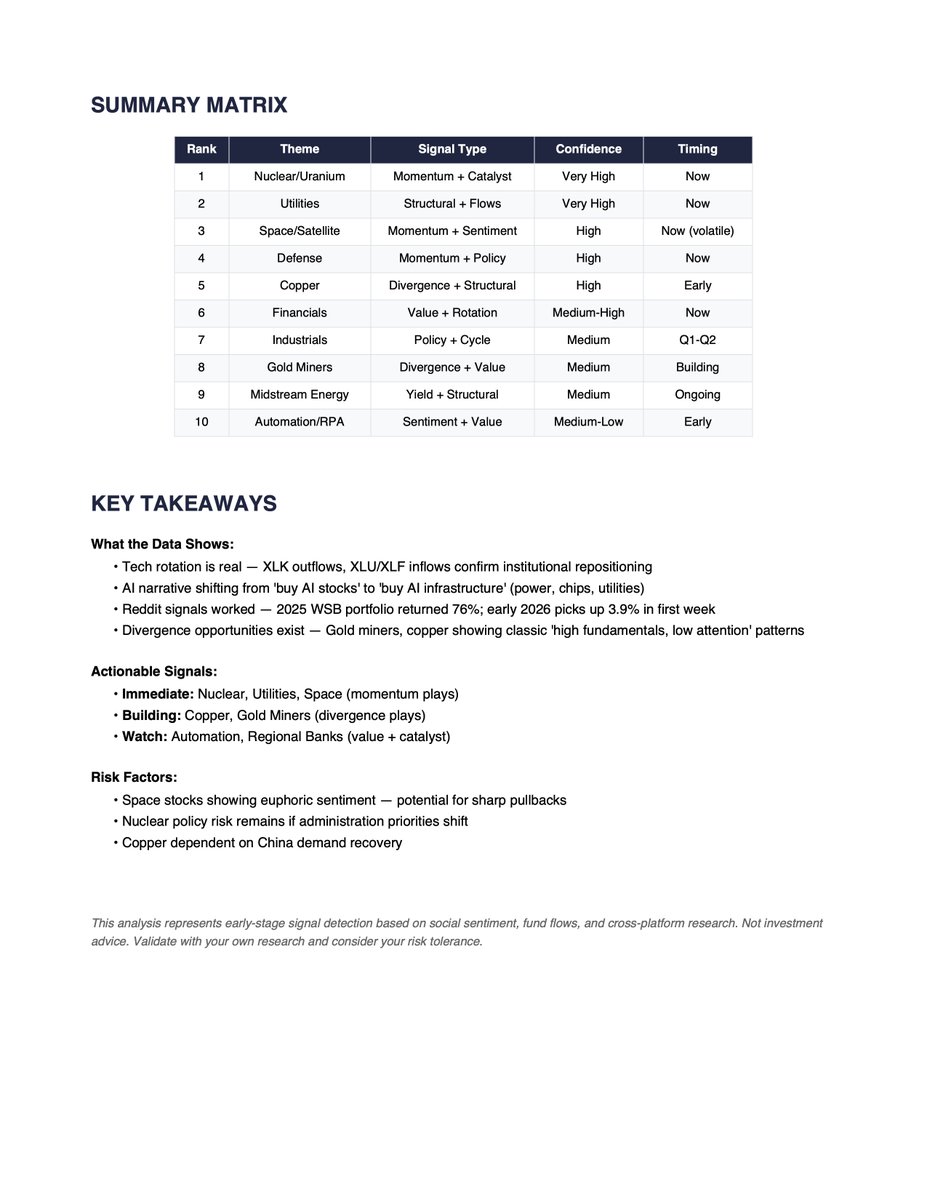
Claude, create a strategy that monitors subreddits to identify capital rotation signals derived from social media chatter before Wall Street and mainstream media fully embrace. Then run the strategy and show me the top ten themes, along with high potential tickers.
You need to understand the fact of TSMC's historically conservative culture and their skepticism toward tech firm's tendency to overpromise. When a company that treats its capital as a matter of national security decides to deploy massive capex after rigorous due diligence, betting on an 'AI bubble' essentially implies you believe your judgment supersedes the strategic foresight of TSMC's management.
re: Tether FUD
From latest attestation announcement (Q3 2025):
"Tether will continue to maintain a multi-billion-dollar excess reserve buffer and an overall proprietary Group equity approaching $30 billion."
Tether had (at end of Q3 2025) ~7B in excess equity (on top of the ~184.5B stablecoin reserves) + another ~23B in retained earnings as part of our Tether Group equity.
Tether Group total assets: ~215B
Stablecoin liabilities: ~184.5B
S&P made the same mistake of not considering the additional Group Equity nor the ~500M in monthly base profits generated by U.S Treasury yields alone.
Some influencers are either bad at math or have the incentive to push our competitors.
Forever trusting who we are
No, nothing else matters
“Geniuses only.”
Nivi: To me, the missing ingredient in most people’s recruiting is intolerance. You should really just treat every employee in the company, including yourself, as an enemy agent that’s trying to destroy the company by bringing mediocre talent into the business. It’s unfortunately just the nature of human nature.
Naval: My co-founder and I have a new criterion in our company: “Geniuses only.”
It’s a harsh word, but it sets a very high bar. You can just look around for who’s not a genius. The only way you’re going to attract geniuses—whatever that term means to you—is by having a company full of geniuses.
And if someone’s not a genius, then either you’re transitioning into the phase where you can no longer hire geniuses and you just need to scale up for whatever reason, or you can just show that person the door because you hired them prematurely for the kind of company you’re trying to build.
Now, this is very difficult.
You’re lucky if you can hire one genius a month. You as a founder have to identify them and do whatever it takes to recruit them and motivate them. So it’s inherently self-limiting. Given that a person probably isn’t going to stick around your company for more than three, four, five years—although in some great companies, people stick around for decades—at that attrition rate you’re talking about a 30 to 50 person company.
But if you can even assemble a team of 10 geniuses, you’re way ahead of everybody else. At most companies—the successful ones—the founders, and maybe a few early people are at the genius level. But in the urge and the rush to scale, that gets drowned out too quickly.
This is absolutely massive news for UK Bitcoiners.
The leader of the party currently leading the polls by a good margin in the UK is promising to slash CGT on Bitcoin from 24% to 10%.
It should be 0% but this is a huge improvement.
Other announcements include there will be no caps on individual holdings of stablecoins.
This is unbelievable, he goes further...
"We will also create a Bitcoin digital reserve at the Bank of England. Bitcoin is scarce, secure and impossible to inflate away. Unlike paper money, Bitcoin cannot be printed into worthlessness.
Every transaction is permanent, every token verifiable. It is liquid, divisible, global and unstoppable. It is the ultimate store of value for the digital age".
Don't be surprised to see the Bitcoin lobby do everything in its power to ensure Reform victory in the next General Election.
Equity perps run head first into the holy trinity of regulation:
> they’re regulated by the SEC as security-based swaps and/or securities futures products
> they’re regulated by the CFTC as futures contracts
> they are prohibited from touching US persons unless traded on BOTH an SEC-registered national securities exchange AND a CFTC-registered designated contract market
> they require approval for each contract’s terms (including margin, position limits, and settlement) and compliance with joint margin, reporting, and antifraud requirements
> and they must be cleared through a registered clearing agency/DCO
> Oh, and finally: even if you navigated all that, perpetual futures remain non-compliant under current law because all approved futures must have a defined expiration date.
So, yeah, uphill compliance battle, IMO.
@Punk9277 This is what pre 2023 perp DEXs were doing (apart from vault subsidies), although agree that token holders do take up headspace for teams.
The only thing that matters is traders. Anything else is directionally like flying a kite in the wind.