@A_May_MD There is pretty much nothing that can be said to sls or capr share holders to convince them to sell. However the same cannot be said of abvx & rvmd holders. That's all you need to know.
Laws should be judged by their results, not their intentions.
The City Council wants to investigate how many rent-stabilized apartments are sitting vacant. Good. Count them. But whether the number is 57,000 or something smaller, empty apartments are only part of the cost to society.
Start with the financial damage.
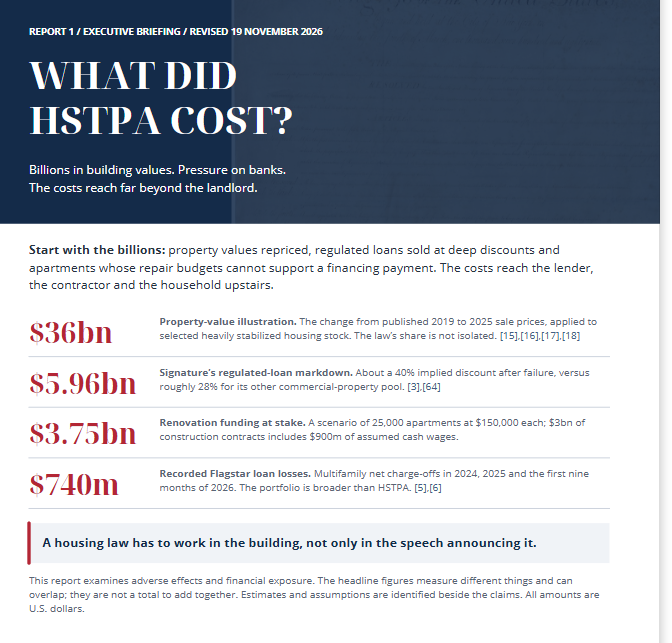
Our report’s comparison of 2019 and 2025 sale prices illustrates roughly $36 BILLION in property devaluation across the selected stabilized housing stock.
After Signature Bank failed in a run on deposits, transactions involving its rent-regulated mortgage pools implied a nearly $6 BILLION markdown.
Those figures overlap, and they cannot all be attributed to HSTPA. But they describe serious financial distress in the buildings New Yorkers depend on for housing.
Now look at what it takes to bring one apartment back.
Take a vacant apartment with an $800 legal monthly rent and a $150,000 renovation bill. Under today’s general small-building improvement allowance, the permitted increase is about $179 a month.
New rent: $979.
Borrowing $150,000 at an assumed 7% over 20 years costs about $1,163 a month.
The ENTIRE rent does not cover the renovation loan—before property taxes, insurance, heat, water or maintenance.
How is that apartment supposed to reopen?
At $150,000 each, renovating even 25,000 apartments would represent $3.75 BILLION in potential work. That is money for electricians, plumbers, carpenters, architects and suppliers. When projects cannot be financed, the consequences reach workers’ paychecks, public revenues and families looking for a home.
And the damage reaches inside occupied apartments.
A November 2026 working paper estimates that HSTPA increased immediately hazardous violations by 25.3% and reduced apartment-renovation filings by 47.3%, relative to comparison buildings.
For tenants, deterioration can mean leaking ceilings, mold, unreliable heat and missed work waiting for repairs. These are costs paid in discomfort, time and the daily indignity of living with problems that never seem to get fixed.
Tenant protection has to include a safe, livable home.
Owners face losses and foreclosure. Lenders pull back. Repairs wait. Prospective renters compete for the homes that remain available. The consequences spread far beyond the person who owns the building.
Albany’s 2019 fiscal memorandum described the state and local fiscal consequences as “To be determined.”
Seven years later, New Yorkers deserve an accounting.
Protecting tenants requires buildings that can afford to function. Good intentions do not replace a boiler, repair a roof or pay a construction crew.
Count the vacant apartments. Count the costs to society. Fix the law.
Full report: https://t.co/UtDG9XkZhC
@NYSHCR@GovKathyHochul@AndreaSCousins @CarlHeastie @BrianKavanaghNY@LindaBRosenthal@NYSComptroller@NYDFS@NYCMayor@ZohranKMamdani@NYCCouncil@SpeakerMenin@CMFarahLouis@CMPiSanchez@NYCHousing@NYC_Buildings@NYCFinance@NYCComptroller@NewYorkStateAG@NYSenate@NYSA_Majority@NYGov@NYCGov@NYCMayorsOffice@NYCBudget@NYCIBO@Jamie_LeFrak@amkorchak@eccles_lincoln