Agency > Intelligence
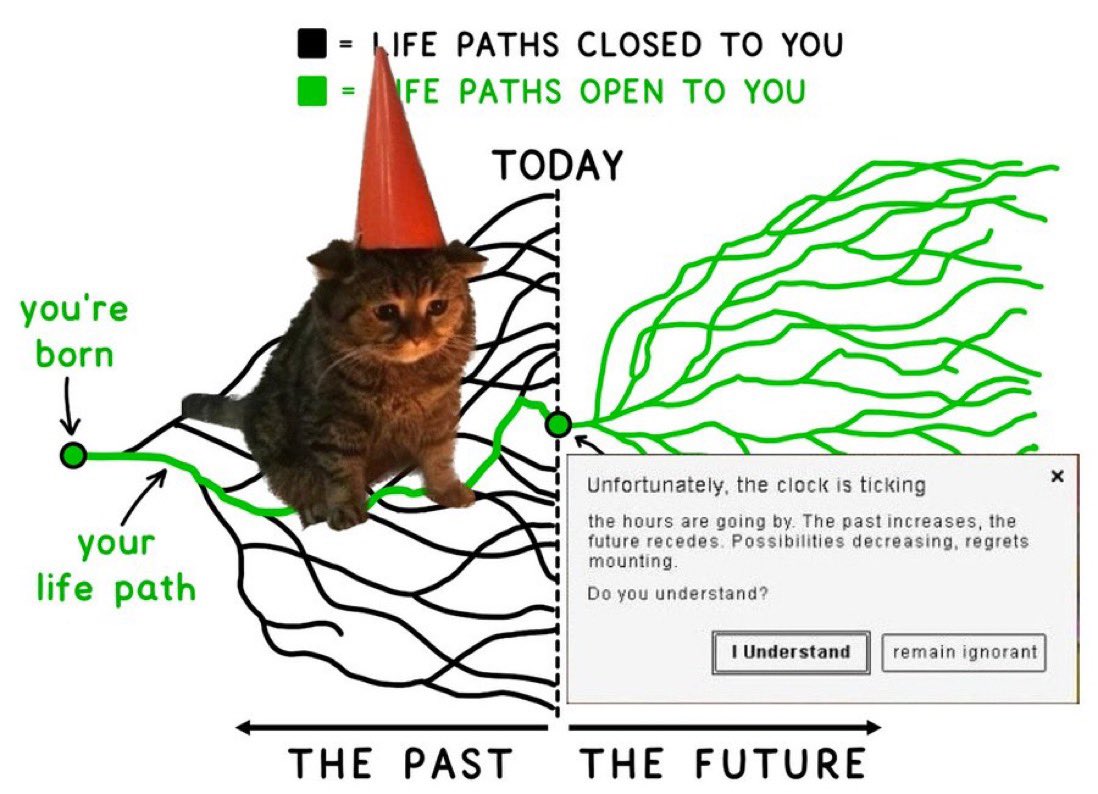
I had this intuitively wrong for decades, I think due to a pervasive cultural veneration of intelligence, various entertainment/media, obsession with IQ etc. Agency is significantly more powerful and significantly more scarce. Are you hiring for agency? Are we educating for agency? Are you acting as if you had 10X agency?
Grok explanation is ~close:
“Agency, as a personality trait, refers to an individual's capacity to take initiative, make decisions, and exert control over their actions and environment. It’s about being proactive rather than reactive—someone with high agency doesn’t just let life happen to them; they shape it. Think of it as a blend of self-efficacy, determination, and a sense of ownership over one’s path.
People with strong agency tend to set goals and pursue them with confidence, even in the face of obstacles. They’re the type to say, “I’ll figure it out,” and then actually do it. On the flip side, someone low in agency might feel more like a passenger in their own life, waiting for external forces—like luck, other people, or circumstances—to dictate what happens next.
It’s not quite the same as assertiveness or ambition, though it can overlap. Agency is quieter, more internal—it’s the belief that you *can* act, paired with the will to follow through. Psychologists often tie it to concepts like locus of control: high-agency folks lean toward an internal locus, feeling they steer their fate, while low-agency folks might lean external, seeing life as something that happens *to* them.”
Of ~200 books I've read, the few that stayed with me over time and I find myself often thinking back to or referring to, in ~random order:
All short stories by Ted Chiang, especially Exhalation, Division By Zero, Understand, The Story of Your Life, Liking What You See, The Lifecycle of Software Objects, What's Expected of us, just excellent themes ideas and reading all around.
The Selfish Gene (nonfiction) - a classic for understanding evolution and natural selection, especially the realization that the gene is closer to the real unit of selection more than an individual, explaining altruism and colonies and a lot more.
The Lord of the Rings (fantasy) - I return to LoTR all the time for comfort. I don't think anyone else has created a high fantasy Universe this complex, with so much mythology, symbolism, new languages, mysterious system of magic, ancient and powerful beings and artifacts, beautiful writing and dialog, themes of courage, friendship and heroism, the list goes on and on... You're thrown into a world with characters and references to so many things that are part of this ancient world and never really introduced. There's always more to find on each reading.
The Martian (~scifi) - top tier science porn, competence porn, fast paced and fun.
The Vital Question (nonfiction) - First time I intuitively grokked the bridge from geology to biology, the origin of life, and likelihood of life in the Universe at large at various stages of complexity and development. Also all other Nick Lane books.
How To Live by Derek Sivers (nonfiction) - 27 conflicting answers to how to live life. Emphasizing the diversity of consistent and possible answers to the meaning and goals of life.
1984 (nonfiction) - Classic. Newspeak, Ministry of Truth, Doublethink, Thoughtcrime, Facecrime, Unperson, the list just keeps on going. Chilling world-building and the realization that weaker equivalents of everything exist.
In Defense of Food by Pollan (nonfiction/food) - Eat food. Not too much. Mostly plants. The book that first taught me to avoid the entire center of every grocery store and only shop on the outer ring. The realization that the food industry is out of control and the things they do with your food, what they put into it, what they are allowed to do, and how they are allowed to market it to you is quite a lot worse than I thought.
The Accidental Superpower by Zeihan (nonfiction/geopolitcs) - I've found Zeihan to be a bit of a mixed bag over time but I still remember his books (esp this one) to be elucidating on geopolitics.
Countdown to Zero Day (nonfiction/cyberwarfare) - Goes into detail on Stuxnet, imo very important and highly elucidating reading on cybersecurity, the future of warfare, and AGI.
A Fire Upon the Deep (scifi) - Chapter one only, incredible portrayal of what superintelligence will be like that has stayed with me since.
Guns Germs and Steel (nonfiction/history) - I'd probably recommend a summary of this book more than the book itself. I remember it being very dry, but it was very interesting because it is a comprehensive analysis of the resources grid (food, animals, freshwater, climate, ...) in our real-world game of Civilization, and the implications there of.
Flowers of Algernon (scifi) - Just a totally crushing masterpiece on intelligence.
Atlas Shrugged (scifi) - No one finishes this I think but the first few chapters and its worldbuilding are enough and, once seen in an exaggerated form in fiction, elements of it cannot be fully unseen in reality.
An Immense World (nonfiction/bio, by Yong, among others of his) - Nice book on so many different sensors used by various animals, you repeatedly realize human senses are super inadequate and that we only measure such a tiny sliver of reality.
The Master Switch (nonfiction/tech history, by Wu) - history of information technologies telegraph, telephony, radio, television, film, cable television, internet and the pattern of "The Cycle", where each medium starts decentralized, open and idealistic and then progresses towards centralization, control and oligopoly, for the very similar reasons, by very similar means, and usually at the expense of diversity, innovation and technological progress. Quite a few connections to draw on for LLMs, which are after all an information technology too.
(I take recommendations for more that are likely to make this list!)
1/ If your friends associate you with Bitcoin, Ethereum, or any part of crypto, you’re probably getting Qs about what to do. It’s tricky to guide someone from where we are currently ($BTC ~$100K), especially if they’re an inexperienced investor. Some learnings from 10+ years of watching this dynamic play out...
You have a one in a few generations movement and you’re shaking because price isn’t moving as fast as you’d like
Last time an asset class this big got created was private equity in the 1980s and you can argue that’s pure financial engineering (sounds familiar?)
Crypto is far bigger than PE because it touches everything. It’s a new operating standard. It improves coordination at scale. It’s is the new stack of the internet to transfer value faster, better, cheaper
Don’t lose the forest for the trees
How the Internet Happened by Brian McCullough
Alchemy of Finance by George Soros
The Most Important Thing by Howard Marks
Any podcast with Howard Marks, Seth Klarman, Stan Druckenmiller, or Peter Theil
That in summary has taught me core principles of thinking in probabilities, reflexivity and psychology of markets, protecting downside and discerning what makes companies succeed and fail
Hope this helps 🫡
In no particular order, these books have given me insight into crypto -- markets, money, risk, psychology, sociology, emotions, and more -- over the last few cycles. Books with ** were particularly riveting for me, the greats are underlined for emphasis.
Bull market regrets take 2 main forms:
1. Not betting enough
2. Not keeping enough
To fix (1), you size up and bet more (including more overall portfolio leverage, less liquid bets, and holding through ‘unreasonable’ price moves + valuations). The cost is higher portfolio volatility, higher risk of ruin, and likely a significant haircut to your portfolio ATH. If done well, you make a lot more but keep less.
To fix (2), you take profit on the way up and generally become more conservative the longer the trend continues (fewer illiquid bets, less leverage, more TPing and trade management). The cost is less upside and potentially ‘wasting’ a cycle of opportunities. If done well, you make a lot less but keep more.
Crucially: you are unlikely to fix both at the same time.
Pick your poison.
the significance of tokens allowing ordinary investors access to Venture technologies cannot be overstated. where else can you get in so early without being gate kept by accredited investor standards
1/n: There are some academic papers that are so brilliantly and so accessibly written and so universal in scope that they transcend disciplines and stand as timeless testaments to both great thinking and great writing. Here's a short personal selection:
@TheStalwart@EricBalchunas I'm sure you've seen this, but here's Clifford Stoll's classic 1995 piece lamenting all the internet hype & how the internet sucks & will always be useless: https://t.co/ypJL0r4lAB
He'd been hearing hype for years. Arguably it took *another* 20yrs for the hype to be proven right
Best trader I know once said:
"A coin dies two deaths.
The first is when its reply guys become an endangered species.
The second is that moment, sometime in the future, when its name is spoken for the last time."
dot eths doing a tremendous job of ensuring solanas survival
I survived the bear market and claimed my $FRAME tokens!
@frame_xyz is the Layer 2 for creators and collectors. If you've traded NFTs on Ethereum and paid royalties in the past two years you're eligible! 🖼️🎄
You can check here 👇 https://t.co/fg8j5MKgLy
Best VC funds get away with <3x DPI. That places you in the bottom quartile of crypto VCs…
You then understand why allocators will enter crypto right?
Crypto is a 1.5 trillion asset class- a spec of dust relative to other asset classes (alternatives - real estate, PE, VC, HFs).
At best ±1% of allocators have exposure to crypto today. Believe that figure grows to ±10% in the next 10 years. Sometimes that’s all the math you need to do to understand where crypto is headed.
It’s rare to get an opportunity to participate in the creation of a new asset class. The best performing VC and PE funds were the first vintages when those asset classes were in their infancy in the early 80s and 90s.
That’s where crypto is today. At some point every allocator will realize that and enter the space. If you’re here and reading this, you’re early.
“We are going to die, and that makes us the lucky ones. Most people are never going to die because they are never going to be born. The potential people who could have been here in my place but who will in fact never see the light of day outnumber the sand grains of Arabia. Certainly those unborn ghosts include greater poets than Keats, scientists greater than Newton. We know this because the set of possible people allowed by our DNA so massively exceeds the set of actual people. In the teeth of these stupefying odds it is you and I, in our ordinariness, that are here.We privileged few, who won the lottery of birth against all odds, how dare we whine at our inevitable return to that prior state from which the vast majority have never stirred?”
~Richard Dawkins
Take a lot of pictures & videos of friends and family. Don’t worry about composition or whether they’re “perfect”. Just get the shots.
Browsing them is a journey to a different time. They are the key to memories.