🧠 Why Don’t Students Like School? by Daniel Willingham is one of the most influential books for teachers on cognitive science. It explores how students’ minds work and how to use this knowledge to be a better teacher.
TOP 5 TAKEAWAYS!
1/ 🧠 Working memory has limited space, and thinking becomes increasingly difficult as it gets crowded. ‘Unless the cognitive conditions are right, we avoid thinking.’ Promote challenging cognitive work by reviewing each lesson in terms of what students will THINK about.
2/ 📚 ‘Background knowledge from our long-term memory helps us to make sense of new information.’ Knowledge is best learned when it is conceptual and facts are interrelated. Guide students to learn the unifying ideas of each discipline—the most common concepts.
3/ 💭 Students remember what they THINK about—‘memory is the residue of thought.’ Effective teachers connect personally with students and organise material to make it interesting and easy to understand. E.g. through storytelling... Stories have a familiar and memorable structure!
4/ 🧱 ‘Understanding is disguised remembering,’ because every new idea is built on existing ones. Develop deep knowledge by working with the same idea in different ways. Support learning with multiple examples and guide students to categorise, compare and contrast ideas.
5/ 🏋️ ‘It is virtually impossible to become proficient at a mental task without extended practice.’ Practice helps make mental processes automatic, reducing the demand on working memory capacity. Prioritise giving students ample practice with the knowledge and skills they need to master.
🙌 Thanks for reading! Support my work by tapping REPOST and grab a FREE high-quality copy here:
https://t.co/eMNcfgx9Cd
I've been hacked and shut out of my old Twitter/X account @P_A_Kirschner. Please stop following that account and follow the real grumpy old man @New_Old_Paul
PLEASE spread the word on your social media and retweet this message.
Here's some proof that I'm me😂
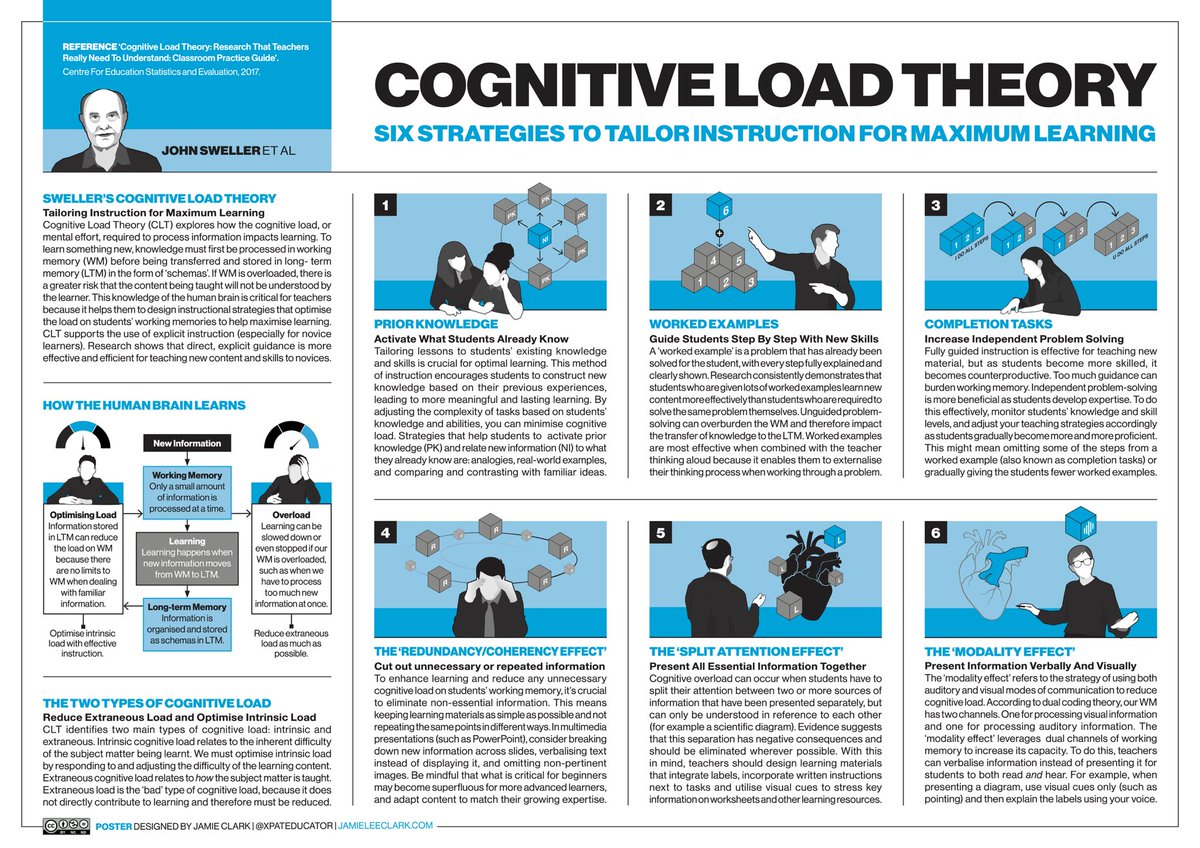
Dylan Wiliam calls Cognitive Load Theory “the single most important thing for teachers to know.” This guide summarises core CLT ideas and highlights six high-impact strategies for reducing overload.
It focuses on the classroom levers teachers can pull right away. CLT goes much deeper, of course — transient information included — but these strategies offer some of the fastest gains. 💪
Free HQ copy if you want it: https://t.co/Xj2XpPGvnu
"Children learn most effectively when instruction follows an evidence‑based cycle: grounding facts in conceptual understanding, using brief timed practice to make those facts automatic, then returning to discussion and reflection to deepen that knowledge." https://t.co/igZkjFG05s
It's here! "Developing Curriculum for Deep Thinking: The knowledge revival" is an open-access book that explains why knowledge needs to be at the heart of the curriculum: https://t.co/aBKILT0SyR
📕Proud to announce our forthcoming open access book @SpringerNature on developing curriculum for deep thinking. Even prouder of the global coalition of education experts who made this 'knowledge revival' a reality. https://t.co/02beko4hhx @ExCELThomasMore @StijnCoenen77
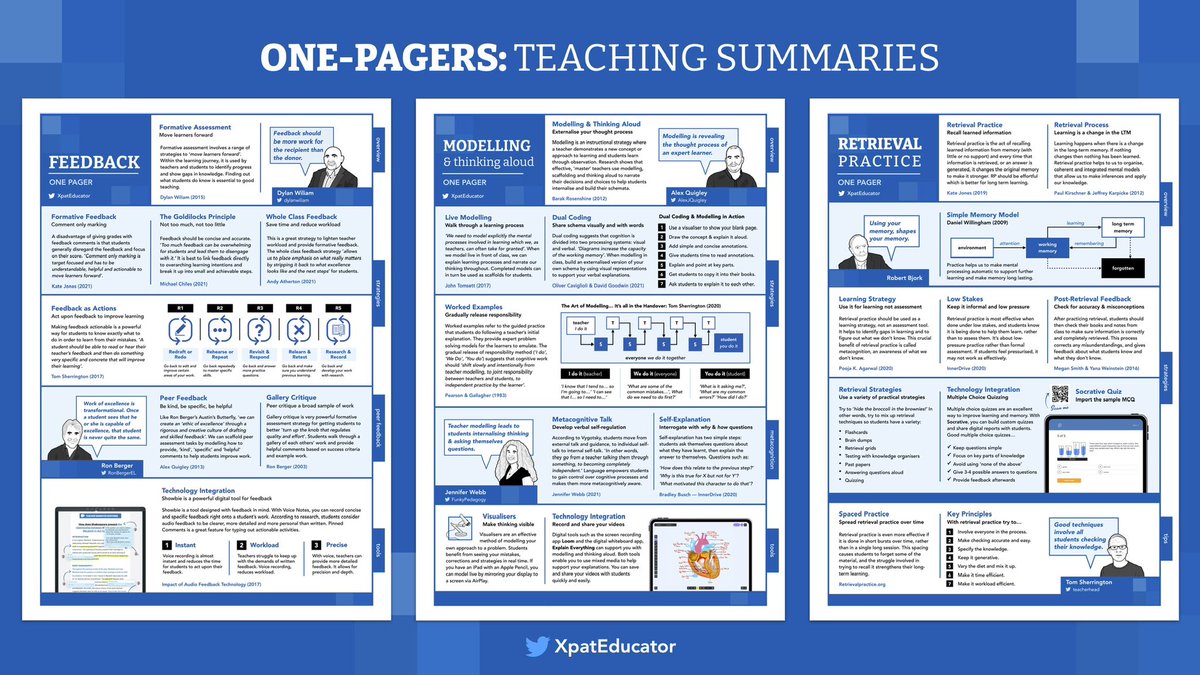
👇 Since introducing these one-pagers in my school in 2022, I’ve seen teachers’ engagement with evidence informed ideas sky-rocket.
Like in any school, our teachers are time-poor, so distilling important ideas into an easily digestible format offers a practical solution.
Here are 7 ways one-pagers have supported our teachers:
'Vat dit hoofdstuk samen in rijmpjes': studentenuitgever Acco ontwikkelt AI-samenvattingstool
Samenvattingen maken heeft al weinig effect als studiemethode. Ze door AI laten maken al helemaal niet. Zelf denken en (gespreide) herhaling leidt tot onthouden. https://t.co/wsPMJiXBf1
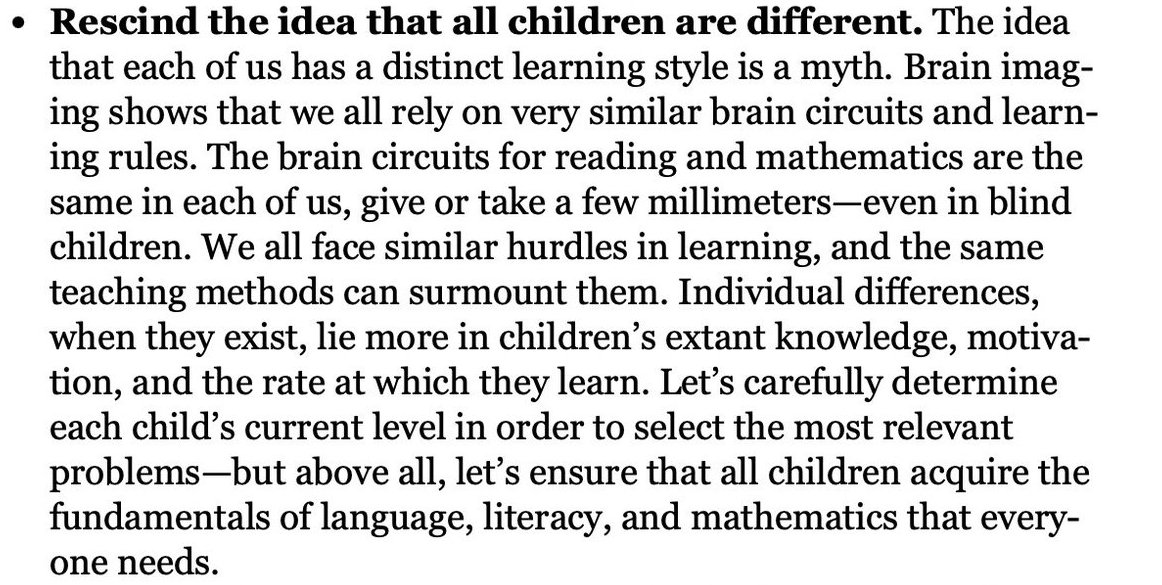
I feel these are three things every teacher and school leader should know:
1. We are more similar than dissimilar in how we learn.
2. This has major implications for designing curriculum, instruction and assessment.
3. Expecting teachers to differentiate their teaching for 30 different kids who all 'learn differently' is one reason the job has been completely unsustainable for so many.
(Quote from Stanislas Dehaene's book 'How We Learn')