I am looking for a postdoc to join the lab!
Come study the evolution of sexually selected weapons and shields with us!
$60,000 annual salary, plus benefits.
Start date will ideally be between January and May, but the exact start date is flexible.
https://t.co/a3h1H1Ay9O
Our critical review linking microplastics’ environmental fate to their intrinsic properties is published. It was a pleasure to work with Maryam Salehi, Baolin Deng, and @123catherinep on this publication! https://t.co/nwWmNNH10L
Excited to see our recent paper trending with other top #EnvironmentalSciences publications!
We combined a nontargeted workflow with a novel hazard comparison tool to detect and prioritize unregulated organic contaminants present in biosolids: https://t.co/0dkiJ7p6YY
I'm very excited to share that my research group received the NSF CAREER Award. I am very grateful for the support of students, mentors, colleagues, and family to make this happen. We will study "Reactivity and mobility of micro- and nanoplastics from open burning of solid waste"
Happy to see this paper out. We show that wet-dry cycles may increase the vulnerability of newly-formed mineral-associated organic matter. Interesting differences between the two MAOM types that we're excited to explore in follow-up work!
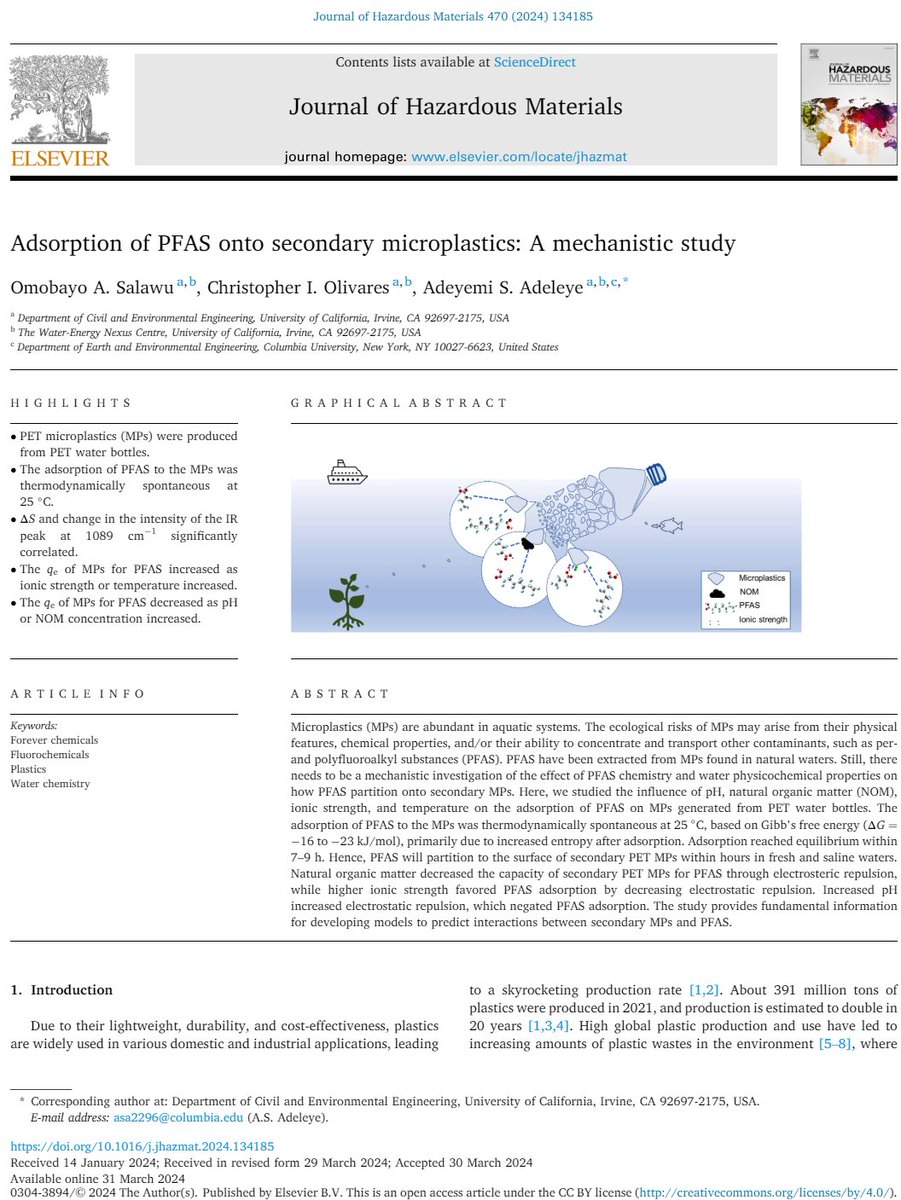
PFAS and microplastics are important environmental contaminants. In this study, led by @alayo_salawu07 and published in @HAZMAT_journal, we studied interactions between secondary microplastics and PFAS. https://t.co/XY6vmxWXyO Nice to collaborate with @chrisolivare.
Another big step forward #microplastic research: @Win_OpenData /w @MicroplasticLab derived #OpenCode equations to determine minimum sample size. Rule of thumb: >= 96, <= 620. However, error budget is not fully quantified yet. So slightly higher sample sizes might be needed.
We are looking for PhD students with interest in nanomaterial chemistry and engineering, water and wastewater treatment, and fate of emerging contaminants (pharmaceuticals, engineered nanomaterials, and microplastics): https://t.co/2u8bywTXKb @Chemjobber@NirupamAich @AEESProfs
Quantitation and identification of microplastics accumulation in human placental specimens using pyrolysis gas chromatography mass spectrometry #ToxicolSci https://t.co/GQIhXolE5r
New publication in @ACSEarthSpace led by Noémie Janot "Reducing Conditions Influence U(IV) Accumulation in Sediments during In Situ Bioremediation". Always fun to collaborate with these dear co-authors, thanks @doescience@SLAClab for the support!
https://t.co/B8P3XGFgvp