on October 1 arXiv imposed new limits on how many papers each person can submit, 2 per month
despite this, October was still a record breaking month
arXiv saw 1) the most monthly papers ever at 42k, and 2) the fastest YoY growth rate since 1995 at +54%
‼️ CISA Confirms Active Exploitation of Outlook User Interaction 0-Day Vulnerability
Details: https://t.co/9hqn7XHeqI
The U.S. Cybersecurity and Infrastructure Security Agency has confirmed active exploitation of a Microsoft Outlook zero-day vulnerability, CVE-2026-124194, that can expose user authentication data.
According to Microsoft’s security advisory, an attacker can send a specially crafted message file and persuade a victim to open it in Outlook.
The application may then connect to an attacker-controlled network location without showing its usual warning about external content. Microsoft released security updates for an actively exploited Outlook network-spoofing flaw (CVSS 6.5) that allows unauthenticated attackers to spoof networks.
#CybersecurityNews
🚨 Trezor confirms hardware implants in crypto wallets were secretly stealing recovery phrases and sending them to attackers
Trezor has confirmed that three Safe 5 hardware wallets purchased through reseller CryptoBilis contained malicious implants capable of capturing recovery phrases and passphrases, then transmitting the stolen information to attacker-controlled servers over mobile networks.
The implants were hidden between the device's main board and screen, allowing attackers to monitor sensitive information without modifying the wallet's firmware or Secure Element.
Trezor released firmware version 2.13.1 on November 11 to neutralize the discovered implants and has reduced its reseller network by approximately 80%. No customer funds have been reported stolen.
Customers who purchased devices from CryptoBilis are urged to transfer funds to a new wallet with a new recovery phrase. Trezor is also offering eligible customers replacement devices.
@cwmyers This product looks amazing though - I’ve also been hacking on private inference at https://t.co/YN2qOp9Pwo just to see what strictly are the technical limitations if any
Turns out - there aren’t really any
this word used to just mean "garrison" until the spanish spent 100 years sending convicts to remote "presidio" to do forced labour. now it just means prison.
makes you think -- maybe in 100 years "san francisco" will just mean "place where dweebs invent saas".
@rexsalisbury that word only came to mean jail after the spanish continually sent convicts to serve out garrison duty (forced labour) in remote corners of the earth
kind of like how we force dweebs to invent saas in exile today (san francisco)
time is a flat circle
Fun Fact: Basically none of the initial railroad companies made money. They overbuilt, took on way too much debt, and ended up in brutal pricing competition with each other, and nearly all went bankrupt.
Swarm riders and Swarm-native companies
AI-use even among highly AI-native people is power-law distributed.
There seems to be a new class of people — call them “swarm riders” — who are capable of consistently commanding large swarms of agents to productive ends.
This is a new kind of managerial skill, analogous to the skill it takes to manage large organizations of people, but wholly different in nature and of course more technical.
Based on the swarm riders we know (including many at @Tempo and @Paradigm), these people are capable of productive token spend that is 1000x-10000x higher than median software engineers, and 100x higher than top 5% Claude Code users.
The art of swarm riding is different from software engineering and more akin to machine learning, where practitioners grapple with black box systems: defining reward functions and evals, transmuting non-verifiable problems into verifiable problems, running experiments, etc.
Swarm-native companies are a new class of company founded by and populated by swarm riders. These companies are organized around swarms in a way that conventional companies will struggle to replicate, as the cost of internal human coordination is sand in the gears of an effective swarm. Effective swarm-native companies will define the right reward functions and evals, remove functional and bureaucratic barriers, and then let the swarms cook.
We’ve gotten to see a few swarm-native companies up close — reshaping financial rails @Tempo, building a new gaming platform @Spawn, cyber swarms at Cathedral Systems — and it’s clear these teams wield a significant advantage over pre-AI teams.
Some questions I’ve been wondering about:
1) How fast will swarm riding diffuse through the economy? The implications for token spend could be significant.
2) Can swarms be effectively adopted by existing companies or will it generally track the formation of new swarm-native companies?
3) What becomes scarce as swarm capabilities themselves commoditize (through frontier models becoming better at swarming, swarm capabilities built into harnesses, etc)? Cultures and teams that can define reward functions well and otherwise get out of the way?
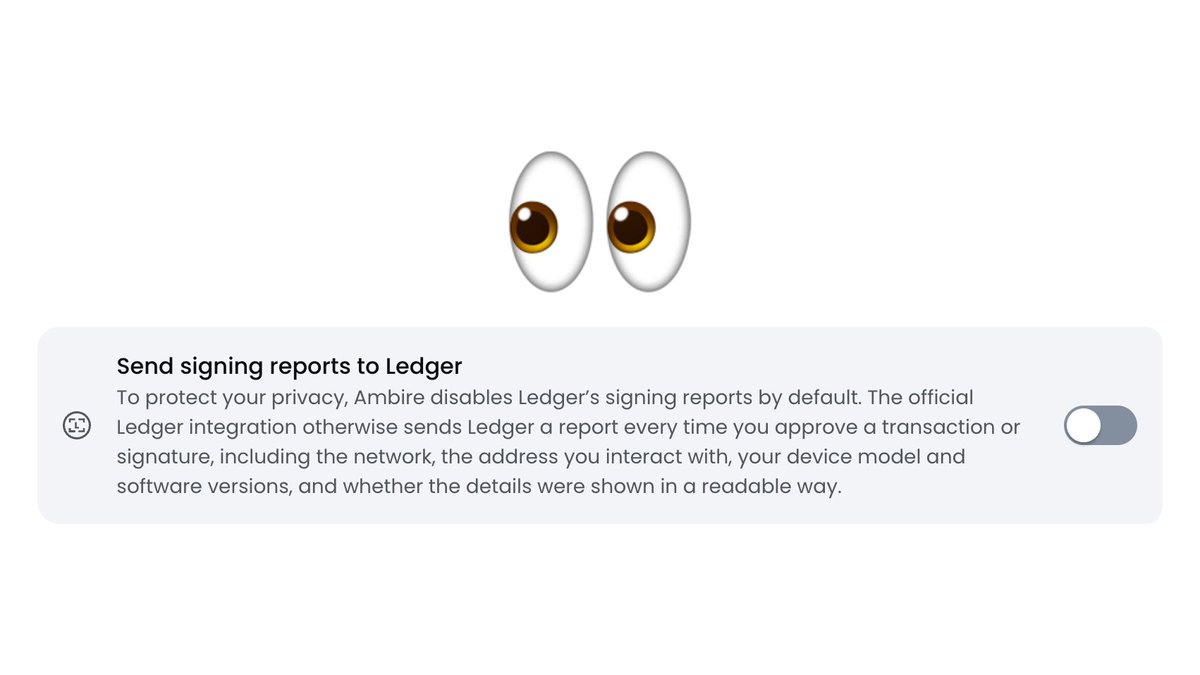
If your wallet of choice isn’t @ambire and it runs Ledger’s latest signing kit, chances are every signature you make gets reported back to Ledger.
I noticed it early while bumping Ledger packages to debug an issue! No affected version ever reached Аmbire production, and we’re shipping it disabled by default, with an opt-in toggle in the privacy settings 🛡️
However, the devil was that it was sneakily enabled by default in the Ledger SDK since their ledgerhq/context-module v1.16... So right after the lib update - every transaction you sign with a Ledger device started sending to https://t.co/wtXKaYbqGf the network, the contract or recipient address, device model and firmware, app versions and whether you signed blind.
I'd argue that privacy should be the default, @Ledger 💪
Happy to see more and more people becoming aware of the privacy implications and picking Ambire for our ongoing privacy focus.
Catching things like this 👀 is part of the job for us!