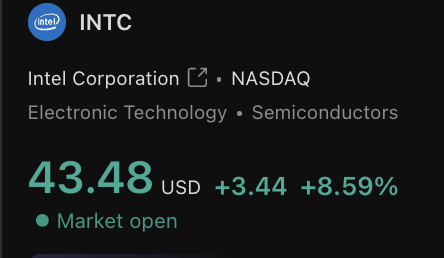
Been trading @intel for over a year on the thesis of a mango eating monkey. Bought calls + spot $18 book value and sold calls at $38.
Rebought some spot at $36 and $38 in the last 2 weeks...but not as much as Id have liked. Targeting $70.
On days like today....there's always a bull market somewhere. Up 8% and heading to $50 LTF as market begins to re-rate Trump nepotism + near shoring + 14a 2nm growth. Higher.
Often wonder what it would take for another dex to dethrone HL/Lighter
Not at all claiming one is better than the other or that is will ever even happen, but it’s features like this that make me confident Extended has a place among those two and will truly stick post-TGE
Episode 1: Nvidia "Acquires" Groq
From @vikramskr and @austinlyons
Core Takeaways:
- GPUs are not dead. HBM is not dead.
- LPUs solve a different problem: deterministic, ultra-low-latency inference for small models.
- Large frontier models still require HBM-based systems.
- Nvidia’s move expands its inference portfolio surface area rather than replacing GPUs.
- The future of AI infrastructure is workload-specific optimization and TCO-driven deployment.
Key Topics:
- What Nvidia actually bought from Groq and why it is not a traditional acquisition
- Why the deal triggered claims that GPUs and HBM are obsolete
- Architectural trade-offs between GPUs, TPUs, XPUs, and LPUs
- SRAM vs HBM. Speed, capacity, cost, and supply chain realities
- Groq LPU fundamentals: VLIW, compiler-scheduled execution, determinism, ultra-low latency
- Why LPUs struggle with large models and where they excel instead
- Practical use cases for hyper-low-latency inference:
-- Ad copy personalization at search latency budgets
-- Model routing and agent orchestration
-- Conversational interfaces and real-time translation
-- Robotics and physical AI at the edge
-- Potential applications in AI-RAN and telecom infrastructure
- Memory as a design spectrum: SRAM-only, SRAM plus DDR, SRAM plus HBM
- Nvidia’s growing portfolio approach to inference hardware rather than one-size-fits-all
What will be the hard signs of China losing influence in Chile?
State Grid has nearly 50% market share in Chile’s electricity distribution network after it bought Sempra’s Chilean businesses (including 100% of Chilquinta Energia) in June 2020 and Naturgy’s 96.04% stake in CGE (Nov 2020).
If the Chilean gov forces State Grid to divest some or all of its distribution assets, then it will be a pretty big sign.
China Three Gorges owns the Rucalhue hydropower project over the Biobio River. ($350M, 90MW)
SPIC, through Pacific Blue, owns multiple hydropower plants and a wind farm in Chile.
Chinese players don't own any major copper mines or have stakes in the copper producers.
Tianqi Lithium holds ~20–22% of SQM. (Lithium carbonate producer)
2/3rds of lithium/copper mined is sent to China for processing, and Chile has been trying to move up the stack by building its own smelters.
why is Lighter's revenue only about one tenth of Hyperliquid's despite its high volume/out of life ratio?
is it the fee structure or the trader type that makes the difference?
i am curious to hear @crypto_condom opinion