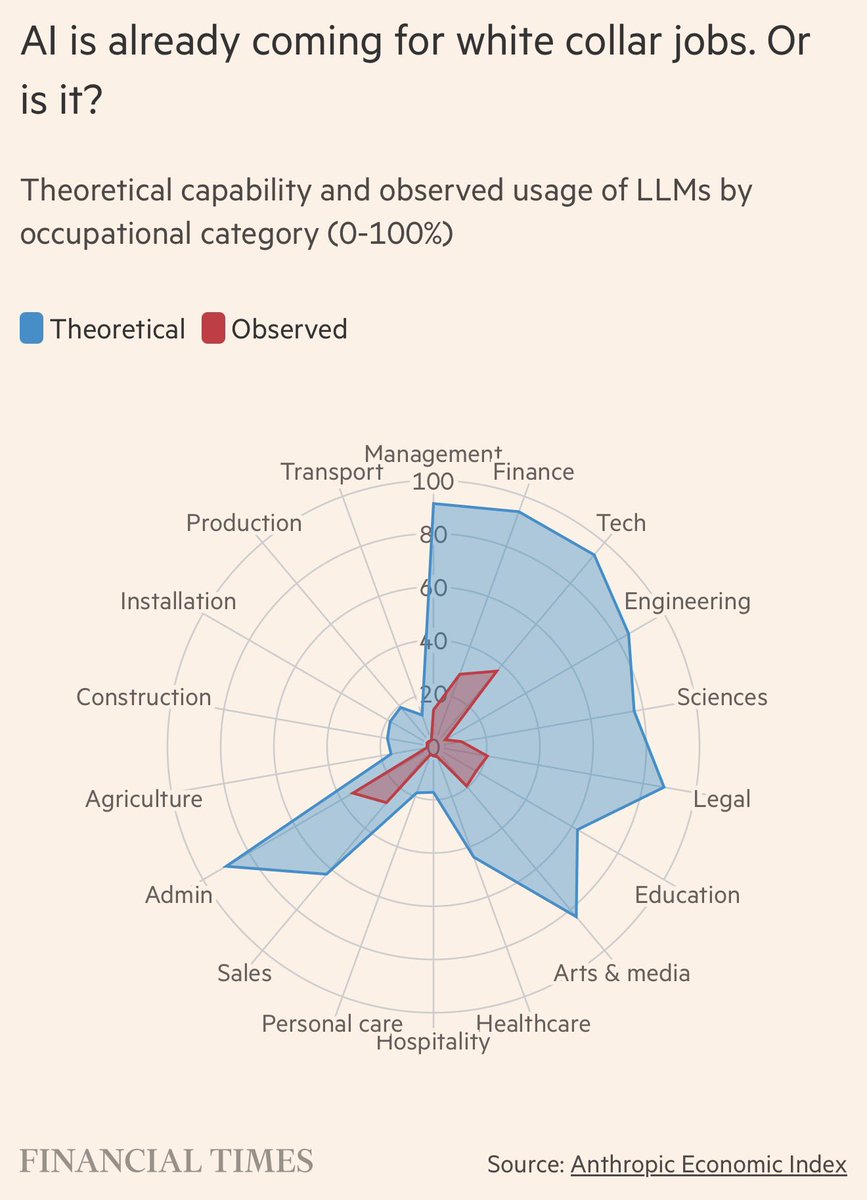
What that viral Anthropic jobs chart really means, by @jburnmurdoch and @sarahoconnor_
• Task vs. Job Automation: The chart distinguishes between theoretical AI exposure and actual real-world usage. It emphasizes that LLMs typically automate specific tasks rather than entire occupations; if AI handles low-value tasks while humans focus on high-value ones, the technology may augment and enhance a profession rather than displace it.
• Subjectivity of the Data: The metrics used are inherently "fuzzy." The theoretical exposure is based on subjective assessments by researchers and GPT-4, which often ignore regulatory, legal, and organizational hurdles. Meanwhile, Anthropic’s real-world data reflects Claude's usage logs, which don't always clearly distinguish between AI helping a worker (augmentation) and AI replacing a workflow (automation).
• The "Rorschach Test" Effect: Despite high theoretical exposure in fields like computing, there is currently no evidence in labor market data of increased unemployment in those sectors. Consequently, the chart acts as an inkblot test: optimists see it as "hype-busting" proof of AI's limited reach, while pessimists see the vast gap between theoretical and actual use as a sign of massive disruption yet to come.
https://t.co/kd2frBo6MQ vía @ft
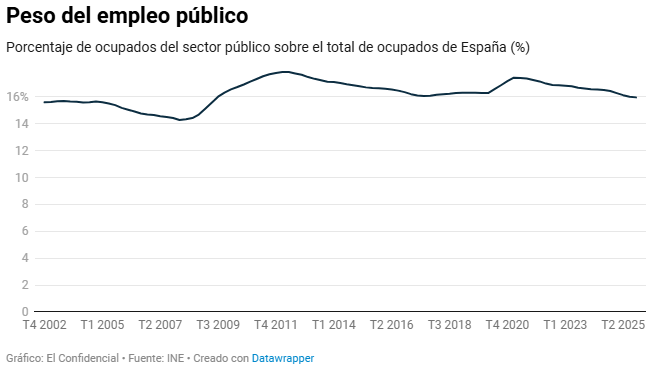
En contra de una opinión muy extendida, el crecimiento del empleo NO se debe a las contrataciones del sector público.
El porcentaje de ocupados del sector público sobre el total ha bajado del 16% por primera vez en 16 años.
Veamos algunos datos de la EPA:
https://t.co/mFdfgfe6tT
Yo estudié la licenciatura de Derecho. Aunque nunca he ejercido, recuerdo con absoluta nitidez algunas clases y las lecciones de varios profesores.
En Derecho penal, parte especial, de tercero, nos dio clase una fiscal (lo siento, no recuerdo su nombre). Un día, hablando de las garantías procesales, nos explicó algo que se me quedó grabado a fuego: las garantías procesales son la piedra angular del Estado de derecho precisamente porque protegen más a los culpables que a los inocentes.
La grandeza del Estado de derecho reside en que el poder último del Estado, la coacción, solo puede ejercerse tras el debido proceso.
Me impresionó tanto aquella afirmación que, al acabar la clase, salí corriendo a la biblioteca a leer sobre el tema. Aún tengo por casa montones de obras de Luigi Ferrajoli (la persona en la foto de esta entrada), quien ha desarrollado esta idea con enorme profundidad.
Por eso pocas cosas me han entristecido más en España que escuchar, en mil sitios, que lo que hizo el Fiscal General del Estado quedaba “justificado” por el delito fiscal de Alberto González Amador.
Es justo al revés. Si Alberto González Amador era culpable (algo en lo que no entro, porque es irrelevante para este post), había aún más motivo para defender su derecho al debido proceso que si hubiera sido inocente.
Esto no deberíamos tener que explicarlo, pero en España no nos queda más remedio que hacerlo.
Cancer patients who got a COVID shot lived significantly longer.
No, that’s not a typo.
A new study found that a simple mRNA vaccine - originally made for COVID - nearly doubled survival in patients with advanced lung and skin cancer.
Let’s break it down 👇 🧵 1/
Una reforma en el acceso a los grupos A1 y A2 de la Administración Pública a espaldas de los funcionarios y sin tener en cuenta la perspectiva que estos pueden ofrecer. ¿Qué puede salir mal?
Ante la propuesta de reforma de las oposiciones para los A1 y A2
Reiteramos este comunicado de hace casi un año: nuestras prioridades son la defensa de las especialidades y del esfuerzo para garantizar el mejor servicio público
Nos reuniremos la semana que viene con el Gobierno
Acaba de empezar este curso gratuito sobre historia del pensamiento económico. Os paso enlace a la primera lecture. Es un lujo poder acceder a las clases gratis. Si os registráis podéis además ver los seminarios en directo y preguntar al final de las sesiones a los ponentes.
Hace no tanto tener acceso a este tipo de cosas era muy complicado. Aprovechad la oportunidad!!
https://t.co/GXVzTX15PG
“La Presidencia no es un mero cargo administrativo. Eso es lo de menos. Es más que un trabajo de ingeniería, eficiente o ineficiente. Es eminentemente un lugar de liderazgo moral”.
Convendría rectificar cuando ya se ha demostrado que la “argumentación” se basa en una falsedad y no seguir haciendo rodar el bulo desde cargos públicos tan importantes.
The webpage for the Geopolitical Fragmentation Index (GFI), which Tomohide Mineyama, Dongho Song, and I estimated, is now live:
https://t.co/9oop9QJVDQ
The GFI captures the degree of global economic integration. A higher value signals rising fragmentation—countries drifting apart—while a lower value reflects deeper integration and growing interdependence.
Few issues today seem more pressing than measuring the pace at which the global economy is fragmenting.
The GFI is freely available for download (1975:Q1–2024:Q1):
https://t.co/SFSho04c68
If you use the GFI in your work, please cite:
Are We Fragmented Yet? Measuring Geopolitical Fragmentation and Its Causal Effect, 2024, Jesús Fernández-Villaverde, Tomohide Mineyama, Dongho Song.
Paper available here:
https://t.co/FRc9btARKg
We intend to update the index as new data become available—although, as always, life may get in the way! So, no promises.
right now, if I import the parts to make a computer, I pay a massive tariff, but if I import the fully assembled computer, I get no tariff. truly a genius plan to reshore manufacturing
Ahora Trump presume de subidas bursátiles históricas. Me vayan desfilando por aquí los que defendían que lo de hundir las bolsas para abaratar la deuda era un plan perfectamente planificado. De jugada maestra en jugada maestra hasta el ridículo final.
With apologies, a long tweet, about the likely macroeconomic outcomes of Liberation Day.
Tariffs can be imposed for understandable if not necessarily good reasons: Protect a sector, right or wrong. Extract rents from foreign producers if there are rents to be extracted. Sure, if there is retaliation, everybody will be worse off, but it maybe worth taking the risk.
Across the board tariffs, which sounds like what we are going to get, are however the worse possible tariffs. They are bad for the country that imposes them, even without retaliation.
Standard scenario: The initial effect of higher tariffs may look good: Lower imports. Higher demand for domestic goods. Smaller trade deficit.
But, with the smaller deficits, and the higher interest rates needed to keep demand under control, appreciation of the dollar (say), less competitive exports. Until trade deficit is back to square one.
So: Useless? Worse. Costly reallocation from exports to import competing sectors. Misallocation. And for the revenues from tariffs: They are there, but in the end, they are paid mostly by US consumers.
A relevant twist, which changes the standard scenario: The enormous uncertainty about Trumps’s tariff policy: Are the tariffs transactional or permanent? Will they remain/increase/decrease?
In that environment, if I am a firm, what do I do? Build a plant in Mexico or in the US, in Vietnam or in China, etc. I do not know, and so I wait. We all wait. Investment comes down, aggregate demand falls, and the effect is a recession.
Now the trade balance improves, for two reasons. The direct effect of tariffs, and lower activity means lower imports. As the Fed tries to maintain activity, lower interest rates and a lower dollar mean more exports. Looks great. Claim of success on the trade front (if you can make people forget the recession)
But only for a while. Over time, as the economy recovers, you go back to the first scenario. The depreciation eventually turns into an appreciation, activity recovers, the trade deficit returns to square one Overall result: a recession, no gain. A general mess.
We shall see how it all turns out.
Ya está disponible en el canal de @cesce_es el vídeo del panel sobre seguridad económica en el que tuve el placer de participar con Maite Arcos, @g_escribano y SIlvia Iranzo durante la XVII #ConferenciaCesce 2025.
https://t.co/tOFOIjvdHw