for anyone asking where to learn this stuff:
• RAG → https://t.co/4bzbUIwV5g
• Agentic RAG → https://t.co/IotOiGmV1Y
• AI Agents → https://t.co/nEeMnVJQbk
• Multi-Agent Systems → https://t.co/pavDPVJEFj
• LangGraph → https://t.co/3miEqqFzF0
• LangGraph (code) → https://t.co/v7kxHZXqba
• MCP → https://t.co/lKawRb4etX
• Memory Systems → https://t.co/LSaT2UaPAS
• Evals → https://t.co/vxChxa1kqQ
• Context Engineering → search "Context Engineering Survey" on arXiv
and please skip the "build an ai agent in 10 minutes" videos
build something, watch it fail, then figure out why.
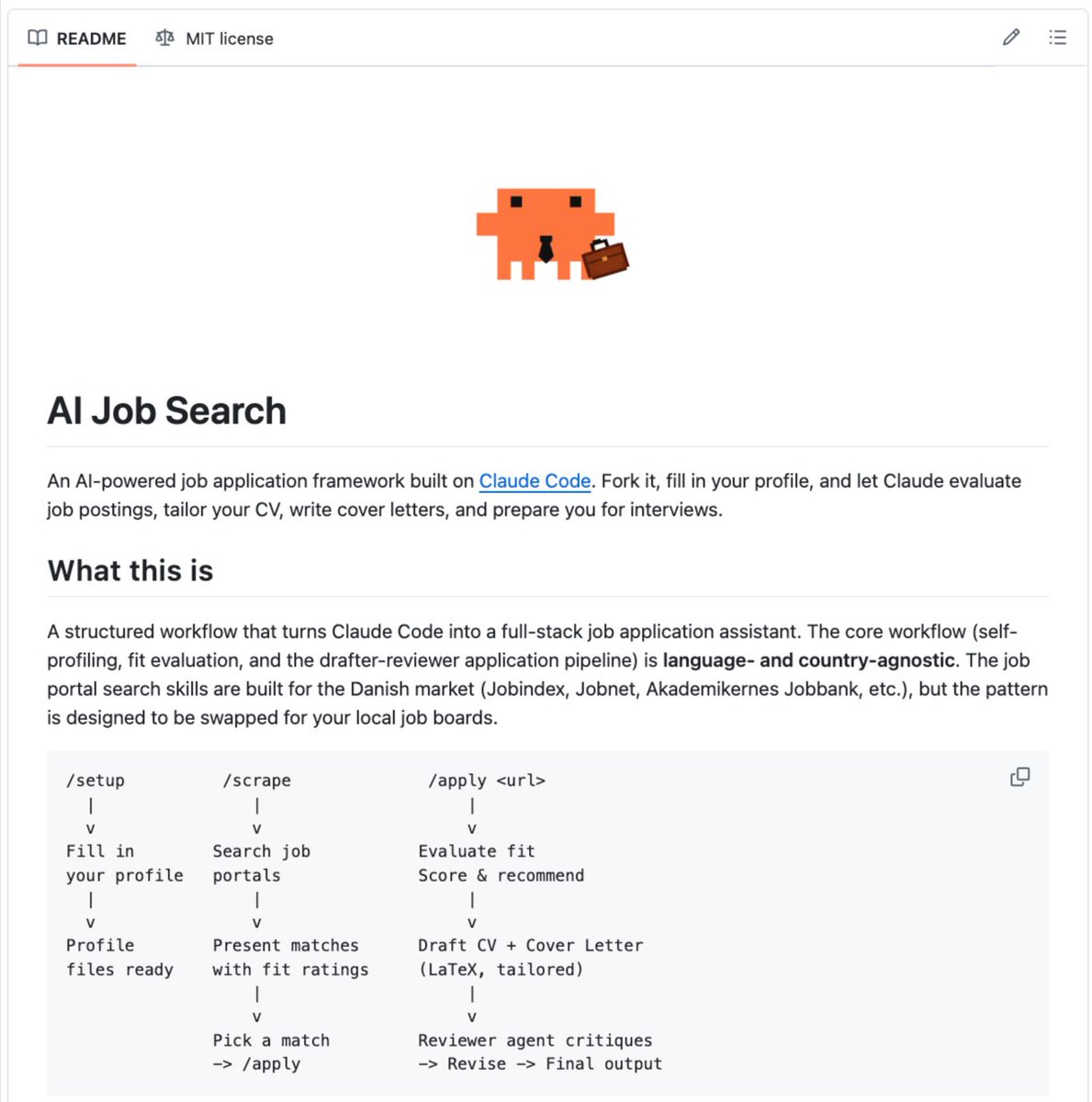
A scientist in Denmark figured out how to make Claude prepare his job applications. He open-sourced the whole thing.
His name is Mads Lorentzen. He is a PhD geophysicist. He built it on top of Claude Code and released it under MIT license.
Here is what it does. You fork the repo, fill in your background once, and it runs a five-step pipeline for every job you want to apply to.
Step 1. It reads the job posting and scores how well you fit.
Step 2. It drafts a tailored CV in LaTeX, picking only the experience that matches.
Step 3. It writes a cover letter framed around what you would bring to the role.
Step 4. A second AI agent reviews the first agent's work, points out weaknesses, and the first agent revises.
Step 5. It compiles both into clean PDFs you can send.
The whole thing is a folder of markdown files. The candidate profile, the writing style rules, the CV templates, the interview prep notes. Every step is plain text you can read and change.
The job portal search is built for Danish boards. The application workflow itself works for any country.
489 stars. 270 forks. A fork-to-star ratio that high means people are using it, not only bookmarking.
Mads is not a startup founder. He built this because he needed it for himself, then shared it.
This is the future of job hunting. Not a service you pay for. A workflow you own.
(Link in the comments)
Introducing Ideogram 4.0: the best open image model in the world.
Think it. Make it. Own it.
Download the weights, fine-tune on your own data, and run it on your hardware. Live on every Ideogram plan and the API today.
Reminder: every Hugging Face Space is an API your agents can call :)
I asked mine to build a website about the flowers of France 🌸 and it used VAST AI's TripoSplat Space to turn photos it found into real 3D Gaussian splats, live on the page!
All on my HF Pro daily ZeroGPU credits (40 min/day renewed daily for only $9/month)
This is what education in the age of AI looks like. Start with the language: the linguistic surface is your roadmap. Much like an SDK has a set of function definitions, human language is the new API to the world.
It also always has been… there's never been an expert in any field without mastery over its language. The distinction is that English alone could not produce tangible things. You had to translate it into machine instruction, through learning or delegation to others. You can now go direct.
Introducing frame.md, a spec built for videos & motion
design.md kept your brand consistent across screens
but when applied to videos, agents translated it back into webpages and decks
frame.md teaches your agents how to make branded video
turn your design.md into frame.md ↓
We've changed the trigger word from "workflow" to "ultracode".
You can still say "use a workflow for this", but when you're clearly referring to something else, Claude won't kick off a dynamic workflow. For an explicit trigger, use "ultracode". We appreciate the feedback!
We just launched Sites into Codex!
Software creation was always about more than writing code. Sites in Codex fundamentally gives the power of end-to-end software creation to every user, no matter their technical fluency.
These Sites are fully deployed to a URL, private to workspaces, come with authentication, can have static files, and can store dynamic data in databases.
It is in preview for business and enterprise teams and will be rolling out to all workspaces over the next day. Give it a try by typing @ Sites into Codex and ask it to build anything!
This project took a massive amount of effort across hundreds of people at OpenAI - proud that we were able to get this out and excited to see what you all build with it!
Workflows are the biggest upgrade to Claude Code’s capabilities since skills and subagents.
I dove deep into it with @sidbid to figure out best practices, examples and more. I’m particularly excited about the non-technical tasks it enables for Claude Code.
We’ve added a CLI for Claude Platform to make every API endpoint runnable from your terminal.
Call the Messages API, stand up Claude Managed Agents, pipe results straight into your shell.
The ant CLI is well understood by coding agents (Claude Code) using the claude-api skill.
Introducing: New Browser Infrastructure. ⚡️
Chromium fork. Firecracker fork. Custom Linux kernel.
> 3x cheaper. $0.02/h.
> Unlimited scaling
> Subsecond cold starts
> Most stealth browser infra
Feel the speed. Now live.
Try it now ↓
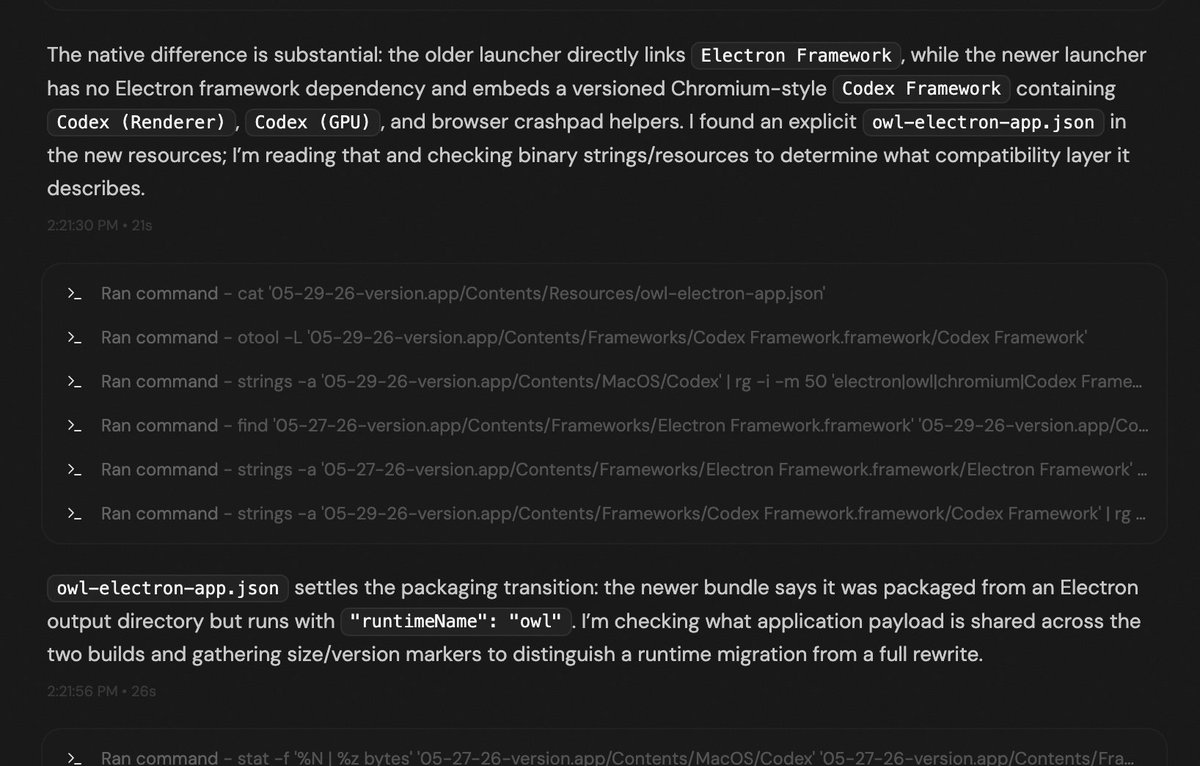
I think Codex stopped using Electron 👀
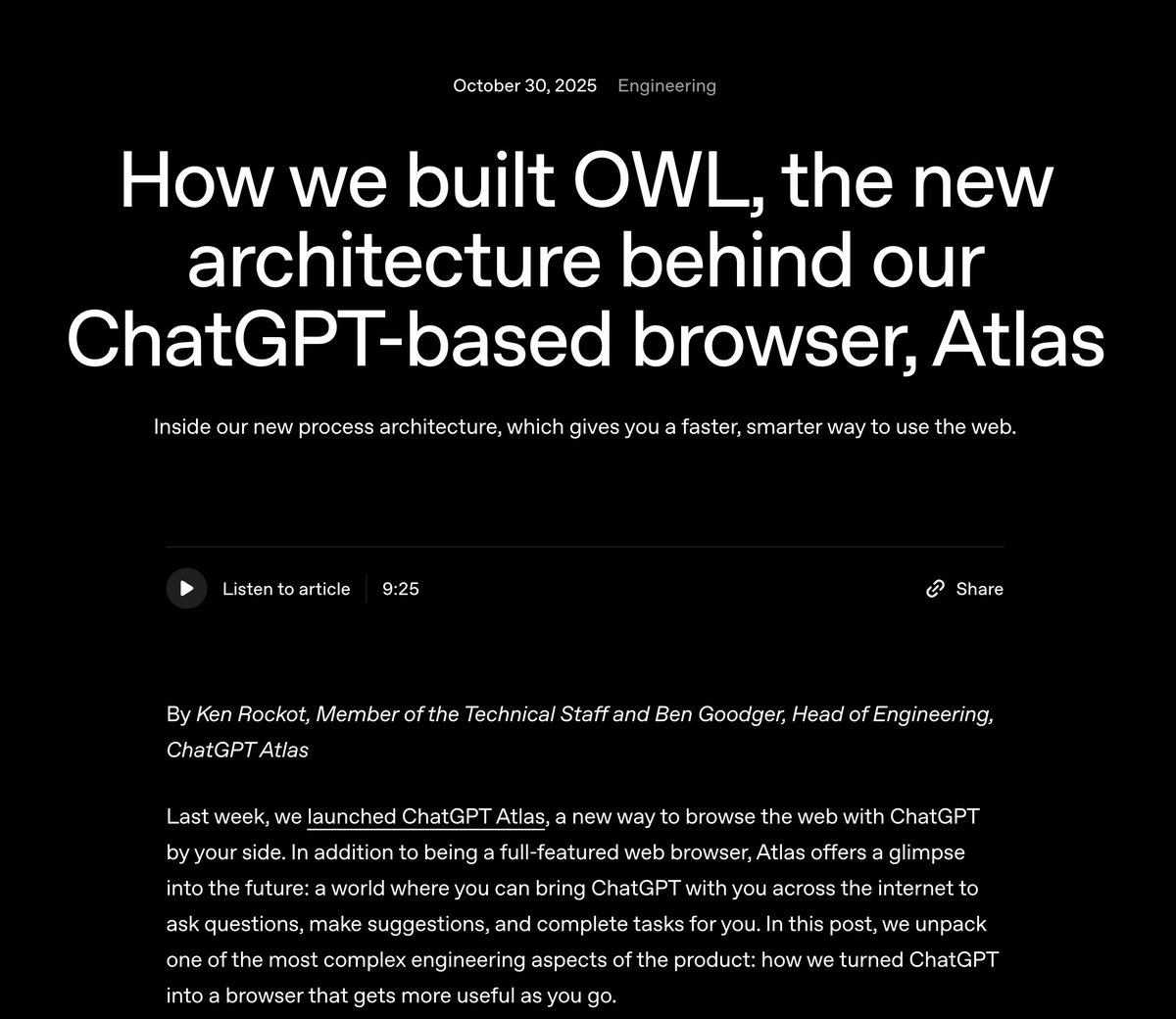
The owl was a big hint, the custom architecture used for the ChatGPT Atlas browser was called "OWL" (OpenAI’s Web Layer)
We made a cartoon episode without leaving Claude.
Claude writes the story, Nano Banana Pro draws the character sheets and storyboard, Seedance 2.0 animates the final cut. Higgsfield MCP routes it all.
What story would you make first?
So here's my latest set up
Every site I have is a profile on Termius like
> hoodmaps .com
I click it and immediately I'm in my server and I get dropped in a tmux session that's always tied to the corresponding site I wanna log in to
To make this work I have this startup snippet in each site's Termius profile:
> cd /srv/http/hoodmaps.com && tm
(so /srv/http is where my sites are and then hoodmaps .com is the example site here, and "&& tm" is the important part here)
Then in my ~/.bashrc file I added this (written by Claude Code) which defines the "tm" function, again all it does it just put me in the right tmux session based on the folder I'm in
The result is I can switch without interruption from my laptop to phone in Termius with auto reconnecting sessions and usually I just have Claude Code open in each session to work
Before I had to mess around with 1) not having smooth switching from laptop to phone, I'd have to use Claude Code's /resume for it, annoying, 2) having multiple sessions for same sites, gets messy and confusing fast, now it FORCES me into one session per site, this just works so well, I'm so fast, and each of my sites is just an open tab in Termius, I've never worked so structured and clean!
Here is the code, maybe it helps somebody:
# tmux session per folder. `tm` (no args) attaches to / creates a session
# named after the current dir's basename. `tm name` overrides the name.
# Works whether already inside tmux (uses switch-client) or outside it.
tm() {
command -v tmux >/dev/null 2>&1 || { echo "tmux not installed"; return 1; }
local name="${1:-$(basename "$PWD")}"
# tmux session names can't contain '.' or ':' — replace with '-'
name="${name//./-}"
name="${name//:/-}"
if [ -n "$TMUX" ]; then
tmux has-session -t "$name" 2>/dev/null || tmux new-session -d -s "$name" -c "$PWD"
tmux switch-client -t "$name"
else
tmux attach -t "$name" 2>/dev/null || tmux new -s "$name" -c "$PWD"
fi
}
# Auto-attach on interactive login: picks a session named after wherever
# you land. Plain `ssh server` lands in $HOME → session "root". Use
# `ssh server -t "cd /srv/sm.levels.io && bash -l"` to land in a site
# folder → session "sm-levels-io". Skips inside tmux and non-interactive
# shells so scp/rsync/scripted ssh keep working.
if command -v tmux >/dev/null 2>&1 && [ -z "$TMUX" ] && [[ $- == *i* ]]; then
tm
fi
Last month we launched Project Glasswing, our collaborative AI cybersecurity initiative. Since then, we and our partners have found more than ten thousand high- or critical-severity vulnerabilities in essential software.
Yes, the United States has the most progressive tax system in the world. The top 1% pay 40% of taxes, the bottom 50% pay 3% of taxes. We can make it even more progressive by zeroing out taxes on the bottom half. It’s a small amount of the total tax revenue but very meaningful to people in this group.












![levelsio's tweet photo. So here's my latest set up
Every site I have is a profile on Termius like
> hoodmaps .com
I click it and immediately I'm in my server and I get dropped in a tmux session that's always tied to the corresponding site I wanna log in to
To make this work I have this startup snippet in each site's Termius profile:
> cd /srv/http/hoodmaps.com && tm
(so /srv/http is where my sites are and then hoodmaps .com is the example site here, and "&& tm" is the important part here)
Then in my ~/.bashrc file I added this (written by Claude Code) which defines the "tm" function, again all it does it just put me in the right tmux session based on the folder I'm in
The result is I can switch without interruption from my laptop to phone in Termius with auto reconnecting sessions and usually I just have Claude Code open in each session to work
Before I had to mess around with 1) not having smooth switching from laptop to phone, I'd have to use Claude Code's /resume for it, annoying, 2) having multiple sessions for same sites, gets messy and confusing fast, now it FORCES me into one session per site, this just works so well, I'm so fast, and each of my sites is just an open tab in Termius, I've never worked so structured and clean!
Here is the code, maybe it helps somebody:
# tmux session per folder. `tm` (no args) attaches to / creates a session
# named after the current dir's basename. `tm name` overrides the name.
# Works whether already inside tmux (uses switch-client) or outside it.
tm() {
command -v tmux >/dev/null 2>&1 || { echo "tmux not installed"; return 1; }
local name="${1:-$(basename "$PWD")}"
# tmux session names can't contain '.' or ':' — replace with '-'
name="${name//./-}"
name="${name//:/-}"
if [ -n "$TMUX" ]; then
tmux has-session -t "$name" 2>/dev/null || tmux new-session -d -s "$name" -c "$PWD"
tmux switch-client -t "$name"
else
tmux attach -t "$name" 2>/dev/null || tmux new -s "$name" -c "$PWD"
fi
}
# Auto-attach on interactive login: picks a session named after wherever
# you land. Plain `ssh server` lands in $HOME → session "root". Use
# `ssh server -t "cd /srv/sm.levels.io && bash -l"` to land in a site
# folder → session "sm-levels-io". Skips inside tmux and non-interactive
# shells so scp/rsync/scripted ssh keep working.
if command -v tmux >/dev/null 2>&1 && [ -z "$TMUX" ] && [[ $- == *i* ]]; then
tm
fi](https://pbs.twimg.com/media/HI890TCWcAA7UVI.jpg)


