Husband & Father. Anglican Minister. (South Bend ➡️ South Carolina). Insufferable Notre Dame fan. Raising some very fine vegetables until the fire descends.
At some point in the last few years, there was a definitive book floating around about Anglican canon law in the Anglican Communion. I can’t remember the title, but could someone point me to it if you know what I’m talking about? Maybe @ArlieColes or @monkofjustice
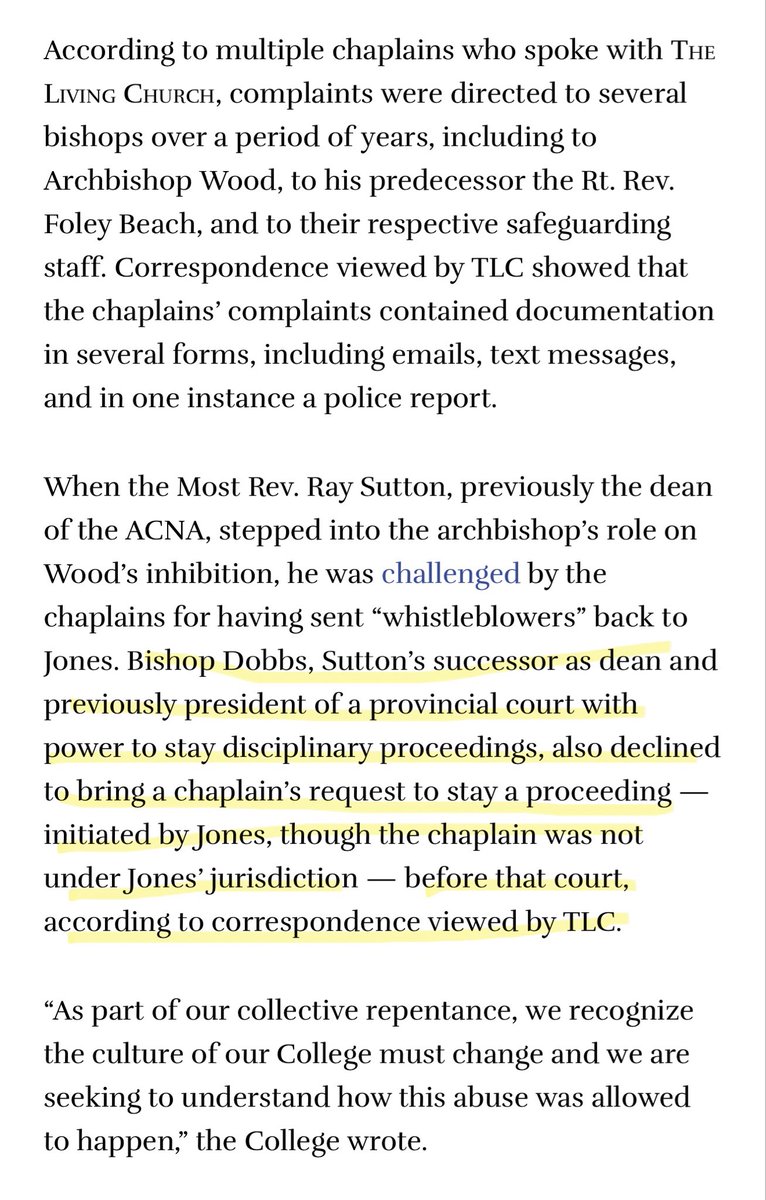
@ArlieColes I might be dumb, but this sentence is confusing to me. Can you clarify what it is saying? It sounds like the chaplains requested that Bp. Dobbs begin a proceeding based on their complaint and he refused, but I don’t understand the “initiated by Jones, though the chaplain was not under Jones’ jurisdiction” part.
Gotcha. Fair enough. Still not part of the American system and marks a significant change in the ACNA from TEC and I think it’s reflective of bigger mindsets in the province. Nevertheless, your point is the kind that would really help in the comments on the piece if you care to put it there. :)
To be honest, I did not hunt down what is done in other national churches, though many of them still have some tie to the British monarch and therefore still work in a different political context. My point was that church government is not a purely theological thing and works in culture over time and space. I couldn’t find anything about the vow of obedience in the American BCP commentaries because it’s not there. Hatchett simply points to the oath’s presence in the English book and says nothing else. Massey Shepherd says the same about the 1928.
@Canadian_Matt@monkofjustice That’s fair. Would it be more accurate to see it all working together though? Congregationalism, Democracy, all of it wrestling with a new world without a monarchy and established church?
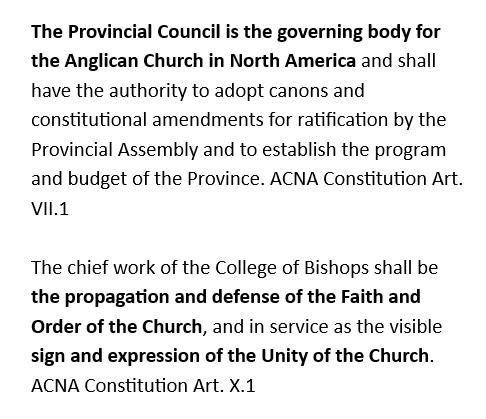
The idea here is that there should be some separation of power and governance—we should be developing leaders with skill sets beyond our bishops (surely they are already attending our churches).
But in reality the PC is also made up of bishops and even their wives. Diocesan bishops already sit on PC. Then some dioceses elect their other bishops to serve in the clergy roles. Some dioceses don’t even know what PC is or never have synodal elections for it. There is not a meaningful distinction between these bodies, even if our canons say there should be.
ACNA Bishops - please stop trying to govern the Province; let the Provincial Council do its job. Stick to your job description.
Provincial Council - time to step up, folks, please.
@nic_lucc@DrRobinWard@MadsDavies What’s it called when you say they are not required, but a good one can be really beneficial and bring about fullness, but a bad one can undermine the essence of the church without undoing it?
@monkofjustice@mrdavidrowe@LuhmannAudrey I saw a couple likes, but I mean it as a question. Does the PC need to wait for someone to bring a motion again? I’m assuming “yes, it does.” I can’t imagine a body that size just acting without it.
@monkofjustice@mrdavidrowe@LuhmannAudrey Genuine questions: The PC had this on the table this summer until ADOSC and DOMA took the deal and removed their motion, right? But it can still be raised to PC without prejudice if I remember. Can PC do something without such a motion?
ACNA college of Bishops censures Bishop Chip Edgar with no restrictions--'Brothers and Sisters in Christ,
It is with renewed hope and deep gratitude to our Lord Jesus Christ that I announce to you that the Anglican Church in North America’s College of Bishops have sentenced Bishop Edgar to a censure with no accompanying pastoral admonition. There are no restrictions to his exercise of his episcopal office and, this action puts to rest the official response of the Province to the [shared eucharist and] Chapel dedication at Porter-Gaud. Thank you for your prayers and concerns for Bishop Edgar. We now return our hearts and focus to the Gospel mission that is our primary calling....' https://t.co/m11OFHd63m #southcarolina #acna #churchdiscipline
Maybe.
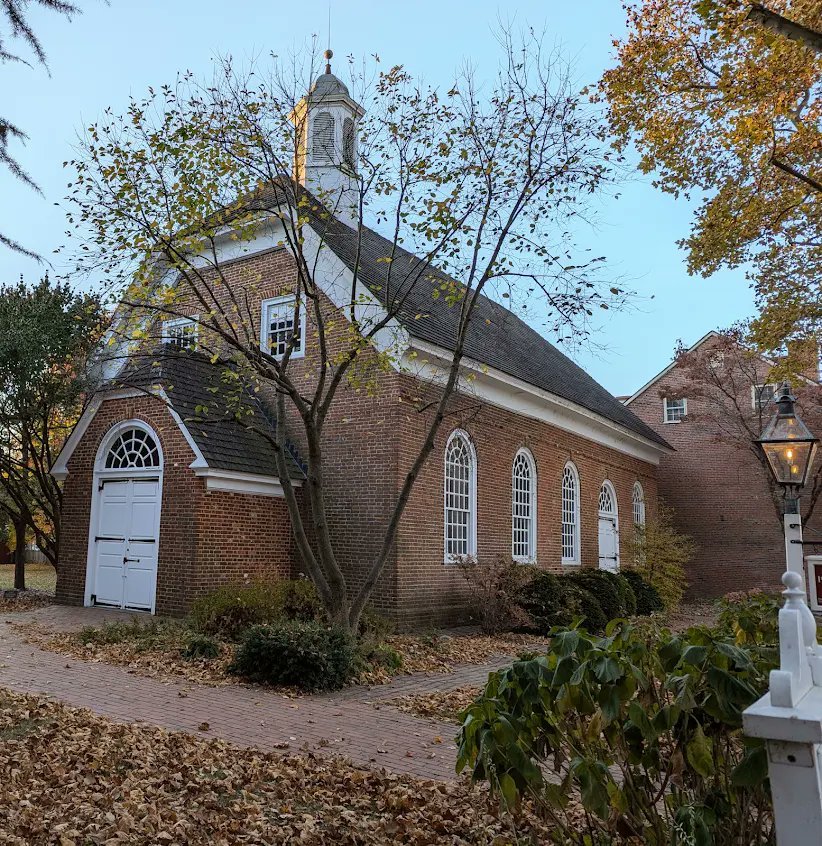
My statement above is “where my heart is.” I have worshiped in every Christian expression across the spectrum, and this is where I have found the most peace and life—especially the older I get. I honestly just want to be with Jesus at this point and have never found the extra stuff to actually bring me closer. I just need to be still and know that God is God. (Screens and rock bands are a non-starter for me) I have also found the most re-enchantment in settings like the one above, which goes against a lot of popular arguments.
I am totally fine with more ritual and ceremony. For me it’s all adiaphora and I love the diversity within Anglicanism. The church is not a tree, it’s a whole freaking jungle with a river (the Holy Spirit) running right through it.
But I said the above because I think it’s not true to characterize the simple space above as being non-sacramental or non-enchanted or non-platonic—it *can* be argued that it is more so.
I serve a moderately high church parish (chasuble, dalmatics, occasional incense), but my heart is here.
When church becomes “another world,” it creates a sacred/secular mindset that holds the ordinary away from God. But clear glass that can see the trees, choir dress at every service, and the simplicity of the prayerbook break that down and reminds us that all of the world and all of life is sacred. The meal at this table is connected to all meals. Prayer in this chapel is connected to all prayer. The daily office is not less than the mass because it is communion with the same Word. There is no part of creation where God doesn’t say “mine.”
I’ll say it…Alexander Schmemann taught me this and I think classical Anglicanism does it better. 🤷♂️ (@cath_cov helped too). Christianity is the end of “religion,” and trying to make a sacred/secular distinction is a very modern move.
Anyway…go on and hate me. I’m just gonna wear the surplice even harder. 😜
Before the ACNA, it was generally common for southern Episcopal dioceses to have one Anglo-Catholic parish in every major city.
Greenville, SC - St. Andrews
Columbia, SC - Good Shepherd
Charleston, SC - Holy Communion
The rest were pretty classical low church (Seersucker Low). After the 70’s you start to see chasubles in urban settings, but rarely dalmatics and never smells/bells. In suburban and rural settings, still surplice etc.
When the ACNA was formed, it drew lots of evangelicals interested in liturgy, and they took all manner of forms in the name of “mission”. What we’ve seen over time, however, is that our church plants increasingly gravitate to the center of Anglican practice and that this actually serves mission better. Our newest plant is using choir dress and northside celebration in their first core group meetings. Rented buildings/spaces (like ours) present challenges, but I think the trend is overall toward the center—some higher and some lower.
@cappuccinoo2000 I am ACNA, but my comment relates more to region than province. In rural SC, even in TEC, this is higher than average—though obviously not “HIGH.”
Actually, I would very much consider myself a platonist (agreeing with various patristic criticisms of platonism, of course).
But I would come at it like this. If the material world is but a shadow of the Real (I might call that Truth-Goodness-Beauty Himself), then in worship why would I fix my attention on shadows? God has given us Word and Sacrament as embodied means of participating in the divine life, but anything else can be a distraction.
I believe Cranmer was a platonist pushing it to its logical conclusion which is that worship is for God alone (Reality Himself), and simplicity (like that in the chapel above) fulfills that best. The only images you are left with (water, bread, wine, your neighbor, and the Word proclaimed) are the ones God has ordained. That is where he wants us to commune with him in our bodies.
(I’m not a true blue iconoclast, but I certainly don’t believe that icons are a sign of good platonism)


![KendallHarmon6's tweet photo. ACNA college of Bishops censures Bishop Chip Edgar with no restrictions--'Brothers and Sisters in Christ,
It is with renewed hope and deep gratitude to our Lord Jesus Christ that I announce to you that the Anglican Church in North America’s College of Bishops have sentenced Bishop Edgar to a censure with no accompanying pastoral admonition. There are no restrictions to his exercise of his episcopal office and, this action puts to rest the official response of the Province to the [shared eucharist and] Chapel dedication at Porter-Gaud. Thank you for your prayers and concerns for Bishop Edgar. We now return our hearts and focus to the Gospel mission that is our primary calling....' https://t.co/m11OFHd63m #southcarolina #acna #churchdiscipline](https://pbs.twimg.com/media/HTBCMhXXcAAJojt.jpg)