🌞 Good morning, everyone!
Yesterday's market revealed something more important than the decline in the major indexes. The S&P 500 fell 0.35%, and NVIDIA dropped 4.34%, while AMD and Broadcom moved higher. Energy stocks also led the market for the fourth straight session. This suggests investors aren't simply leaving the stock market. They're reassessing where the better investment opportunities are
👉🏻AMD rose as expected. Our price targets are clear, so let's not let market sentiment interfere with our trading plan
👉🏻As for NVIDIA, some employees are calling for Jensen Huang's return. I've always emphasized that as long as a good company's revenue and future growth prospects haven't deteriorated, we shouldn't make emotional trading decisions. Let's wait until after NVIDIA's earnings report next Tuesday before deciding whether to take a larger position. For now, those who have already established a starter position can simply hold and wait for the right opportunity
👉🏻Turning to crypto, keep an eye on the buying ranges I shared yesterday. Both BTC and ETH are moving down toward those levels. Similarly, once you've established a starter position, you can hold it for now. I'll let everyone know in the group when I see a good opportunity to add
☀️ Good morning, everyone!
Yesterday, the Dow jumped 3.03%, the S&P 500 gained 1.58%, and the Nasdaq rose 1.44%. But beneath the post-election rally, we're already seeing a shift in market leadership
This morning, Nasdaq futures are lower, while Dow futures are holding up better. Semiconductor and data center stocks remain under pressure, while some major tech companies are showing relative strength
The question now isn't just how much companies are spending on AI, but how quickly that spending can turn into real earnings growth
📊 What's Moving the Market?
The midterm election results have raised concerns about tighter restrictions on data center construction. UBS estimates that around 30% of planned U.S. data center capacity additions in 2028 could face delays or other disruptions
This is creating a clear divide. Data center developers and equipment suppliers could face slower order growth, while major tech companies may benefit from more disciplined spending
Qualcomm (QCOM) is down around 10% in premarket trading after its smartphone chip sales outlook disappointed investors. Meanwhile, AppLovin (APP) is up more than 16% after beating earnings expectations
To me, this shows that investors are paying closer attention to actual earnings rather than simply rewarding companies for being part of the tech sector.
🔍 What I'm Watching Today
The S&P 500 closed at 7,688.62 yesterday. I'll use that level as my first reference to see whether the broader market can hold its post-election gains
I'll also compare the Nasdaq with the Dow. If tech continues to lag while financials and industrials hold up, I'll shift more of my short-term attention toward stronger companies in those sectors
Today's labor market updates and Friday's jobs report could also influence Treasury yields and expectations for the Fed's next move
💡 My Investment Strategy
I'm still bullish on the long-term U.S. stock market, but I'm becoming more selective about where I invest new money
Today, I'll focus on companies with improving earnings and stocks outperforming the broader market, rather than businesses relying mainly on expectations of future AI spending
Before opening new short-term positions, I want to see whether the S&P 500 can hold yesterday's closing level and whether selling pressure in semiconductor stocks begins to ease
I believe the real opportunity is recognizing where market leadership is shifting before everyone else starts paying attention
And I've always believed that finding a promising company early and investing in it is worth far more of our time and effort than any short-term trade
☀️ Good Morning! Here's What Matters in the Market Today
November 2, 2026 | Monday
Last week's selloff confirmed the risk I highlighted in Thursday's and Friday's market outlooks. The weakness that initially centered on Big Tech spread across the broader market on Friday, with the Nasdaq falling 2.86%, the S&P 500 losing 1.82%, and the Dow declining 1.09%.
This morning, futures are recovering, helped by lower oil prices and a rebound in technology stocks. But after Friday's selloff, I want to see buyers reclaim specific price levels before treating this as a meaningful recovery.
📊 My Market Outlook
Nasdaq: Cautiously bullish for an early rebound, using QQQ as my trading reference. I want to see QQQ break above $698.63 and hold that level. If it does, $711–$718 becomes the next area to watch. Below $683.45, I'd turn bearish again.
S&P 500: Slightly bullish, using SPY as my reference. A sustained move above $761.43 would improve the short-term outlook, with $766.62–$770.76 as the next resistance area. A break below $750.37 would be a warning that selling pressure is returning.
Dow Jones: Neutral to slightly bullish. I'm watching DIA, the Dow-tracking ETF. A move above Friday's $522.02 high would strengthen the rebound case, while a break below $515.01 would weaken it.
💡 My Take
I'm expecting a rebound attempt today, but I'm not calling a market bottom.
My preference is to avoid chasing a strong opening gap. If QQQ and SPY can break their recovery levels and hold above them, I'll become more constructive on the short-term outlook. If they fail and start moving back toward Friday's lows, I'll stay defensive.
Apple and Palantir report after the close, and Tuesday's midterm elections could add volatility. That's another reason I want clear price confirmation rather than an emotional reaction to the first move.
Buffett: “A really wonderful business is very well protected against the vicissitudes of the economy over time & competition. We’re talking about businesses that are resistant to effective competition…
And 3 of those will be better than 100 average businesses.”
The full Q&A:
https://t.co/Jc60zGq8nz
Right now I'm lying on the lawn at Sheep Meadow in Central Park, just soaking up the sun. The weather today is absolutely unreal!🌞
Have a great weekend!🌹🌹
Gold has a habit of shaking out investors just before its next big move.
After two strong years, our 2026 Outlook called for a correction and a position washout.
That is what we got. Now our projected cycle low is approaching.
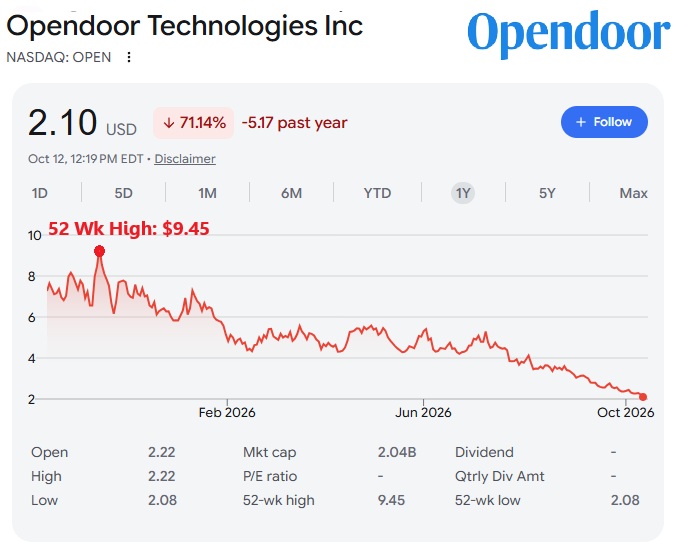
JUST IN: Opendoor stock continues to PLUNGE and is now down a massive ~80% from their 52 week high
I've been warning people about this sh*t company for over a year
Buying and flipping homes nationally is one thing
Doing it profitably at scale is another
Things will only get worse long term without a major pivot
The iShares Semiconductor ETF $SOXX, weekly.
The three-stage parabola from Part 1, updated: a 21% correction from the summer peak, and the rebound since
U.S. stock index futures are rebounding across the board. Technology and semiconductor stocks are recovering after the sharp pullback in the previous session. Falling oil prices and easing geopolitical tensions have helped ease concerns about inflation and interest rates. Yesterday’s broad sell-off in semiconductors triggered a flight to safety, but this morning’s premarket trading is showing signs of short covering and dip buying in technology stocks.
For very short-term and intraday traders, the key after the open will be to watch whether this is simply an oversold bounce or whether trading volume supports signs of a more sustained stabilization.
Delta Air Lines (DAL): The company has reported its latest earnings, and the stock is trading slightly higher in premarket trading. It’s worth keeping an eye on.
Bitcoin finally lost the 84K area and the pullback is starting to look more serious.
$BTC price is now testing 82.2–82.8K, the first zone where buyers actually need to show up. Getting back above 84K would calm things down a bit, but momentum is still pointing lower right now.
If this level fails on a daily close, 80.8–81K is the next area I’d be watching.
Not calling a full breakdown yet. This support just matters more than the ones above it.
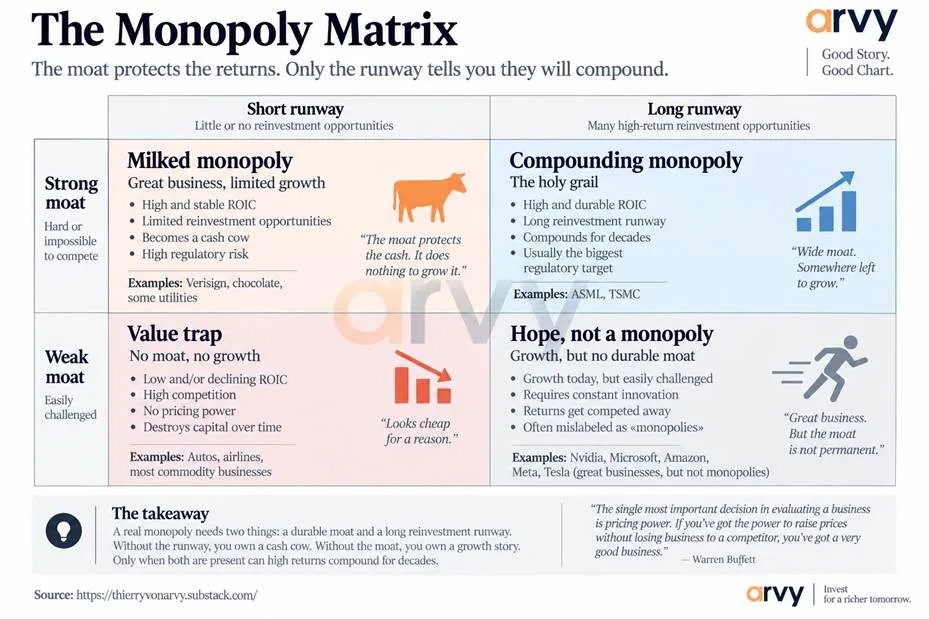
The cautionary tale: the milked monopoly
To feel why the runway matters more than the moat, look at a monopoly that has everything except a place to grow.
A pure toll-road monopoly is the mental model. One bridge, no competitor, guaranteed traffic, fat margins: the textbook moat. And a terrible compounder, because there is nothing to reinvest in. The bridge is built. Every franc of profit comes out as a dividend, gets taxed, and the business grows at the rate of local traffic and inflation, no faster. You own a bond that happens to be called a monopoly.
This is the trap hiding inside many «safe monopoly» theses: a regulated utility, a mature registry, a single-product patent with the cliff in sight. Each has a pristine moat and no runway, and the pristine moat is precisely what seduces you into overpaying for the melting ice cube. The moat protects the cash. It does nothing to grow it.
Contrast that with a monopoly that can still reinvest: TSMC ploughing profits into the next node, Intuitive into new procedures and installed base, CoStar into new data verticals and geographies. Same monopoly structure, utterly different destiny, because one has a next franc to deploy at 30% and the other hands you 4% and calls it safety. The moat tells you the returns are protected. Only the runway tells you they will compound.
Strive acquired 1,355
$BTC
for $107.7M at an average cost of $79,475 per bitcoin, bringing total holdings to ₿26,355.
Warrant exercises began last week, generating $21.2M in gross proceeds. Including those proceeds, 57.7% of total capital raised came from SATA.
$ASST
$SATA
Strive acquired 1,355 $BTC for $107.7M at an average cost of $79,475 per bitcoin, bringing total holdings to ₿26,355.
Warrant exercises began last week, generating $21.2M in gross proceeds. Including those proceeds, 57.7% of total capital raised came from SATA.
$ASST $SATA
$BTC
faces a new macro test: the Fed raised rates 25 bps to 3.75%–4%, its first hike since 2023. Bitcoin held the $73.5K–$75.6K support zone as markets reassess the path to cuts.