Am not in #Antalya in person, though following the discussions on #climatechange and #health closely.
Sharing the link to a book, #TheGreenPen (2016), a pathbreaking collection of essays by journalists covering science, health and environment in #SouthAsia which spotlighted many issues discussed today.
I contributed a chapter.
It was edited by two of our stalwarts —
@keyaacharya and @fn .
My chapter — Environment, Exotic Diseases and the Media: Emerging Issues — starts from page 116.
Those following climate change and health may find it interesting, though written a decade ago.
Hugely relevant today, especially in the wake of the pandemic. #OneHealth
https://t.co/DwoSn6xfbn
The Pathogen Access and Benefit-Sharing annex, currently under negotiation, has profound implications for dependency and health sovereignty in South and Southeast Asia. https://t.co/HERmYgZSVp
I write:
“The #streets don’t have #algorithms,” a Brazilian woman exclaimed on Instagram as news broke of
Luiz Inácio Lula da Silva’s (@LulaOficial) victory over Flávio Bolsonaro in #Brazil’s October 2026 presidential run-off.
“You can’t algorithmically control what happens when people start talking to each other, when they organise, when they show up,” she said, despite all the money and power.
There are key lessons here, beyond Brazil. In a hyper-connected world, people learn from each other, across cities, countries and continents.
......
One word that ties these different youth mobilisations and protests is #accountability. You can’t copy-paste blueprints for protest or anything else.
But the demand for accountability leaps out, even when #politicalcontexts diverge.
In #India too, it is the demand for accountability that is bringing together different youth groups as well as #Oppositionparties.
.....
What is palpably clear: Urban India has changed. Indian youth will not go back to how they were before. The protests may or may not lead to immediate policy overhauls. But even in the face of barricades and security, the foundational relationship between young citizens and the state is being fundamentally rewritten.
.......
Many thanks to the Brazilian woman on Insta who inspired me to write this column and to everyone who was/is inspired in #India, #Brazil, #Serbia, #Europe and the rest of the world.
Friends and followers in Brazil, I forget the name of the person but do share this with her if you know who she is.
Thank you @SrdjaPopovic for that great essay!
https://t.co/ydS9GDfptT
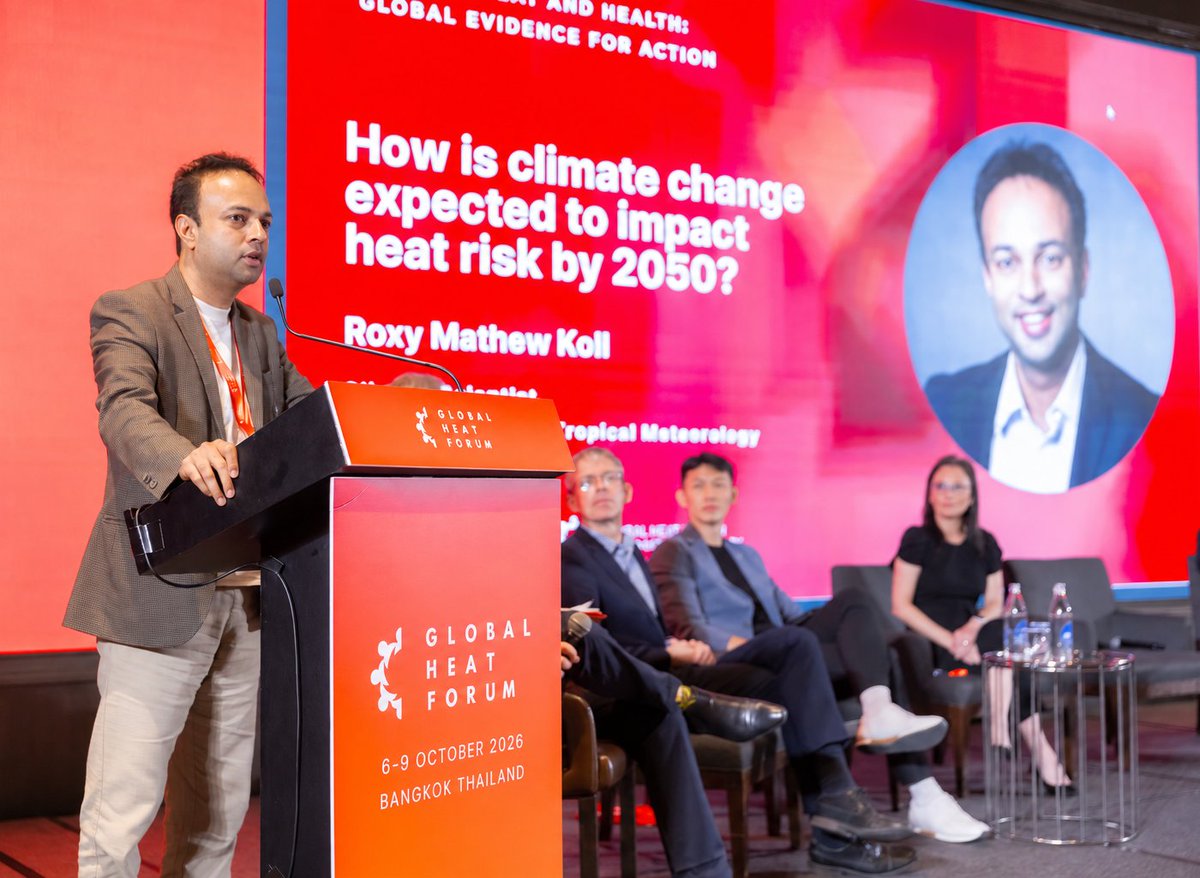
Heat will be harder to escape by 2050, when many of us will be older and more vulnerable. Add about 25 years to your age now. Are you prepared!
Harder to escape, both in space and time.
We come home from a hot day outdoors, expecting relief, but the heat is already in the bedroom, since our housing and urban setup trap the heat. And the nights are getting warmer, and rising humidity makes it harder for our bodies to cool.
The good news is that the data help us understand these risks and protect ourselves better. We need to learn how to grow older in a hotter world.
Global Heat Forum, Bangkok, 2026
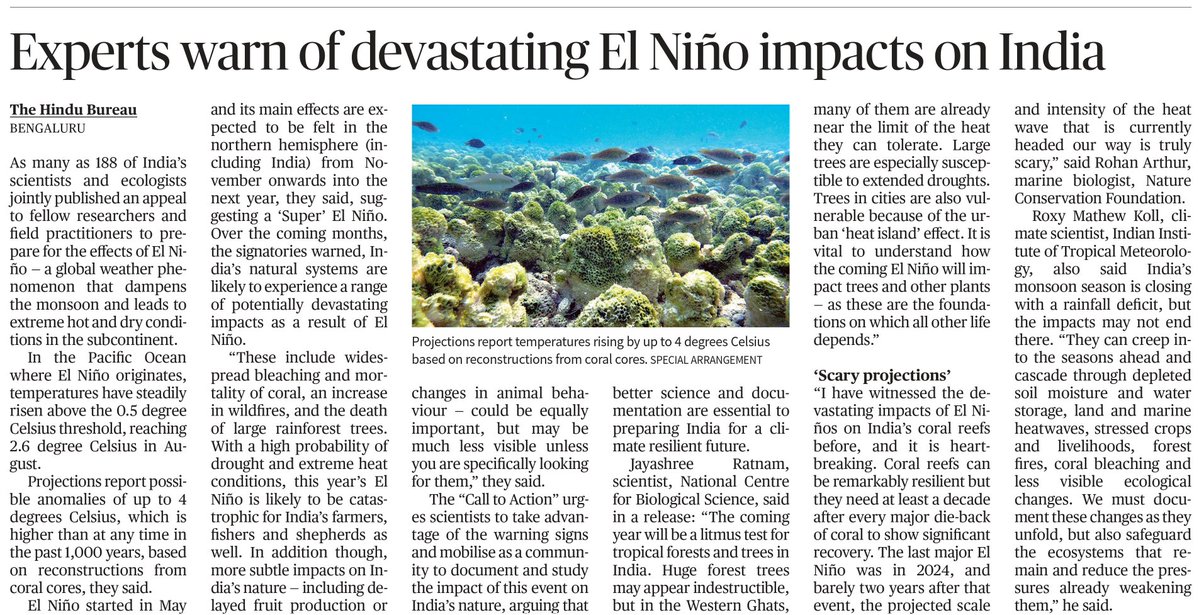
Sharing a call to action signed by 188 scientists and ecologists from across India, urging researchers and field practitioners to prepare for, document and respond to the ecological impacts of the evolving 2026/27 El Niño.
India’s monsoon season is closing with a rainfall deficit, but the impacts may not end there. They can creep into the seasons ahead and cascade through depleted soil moisture and water storage, land and marine heatwaves, forest fires, coral bleaching and less visible ecological changes. The call asks us not only to strengthen monitoring, but also to safeguard the ecosystems that remain and reduce the pressures already weakening them.
The full call is available here:
https://t.co/qNY8sM9kyp
#Artificialintelligence is usually presented in #India as an opportunity too large to miss. It can improve public services, help doctors, transform education, make businesses more productive and create a new generation of technology companies.
But while India is concentrating on how quickly it can build and deploy AI, a more disturbing conversation is taking place elsewhere: how safe are these systems becoming, and who is responsible when they fail?
#AISafety
My 10th column on #ArtificialIntelligence for @AmarUjalaNews .
Earth Journalism Network scores big at 2026 global Covering Climate Now awards #coveringclimate Winner: Collaborative special report Dark side of the boom https://t.co/ajWRUffULa led by Earth Journalism Network
Earth Journalism Network scores big at 2026 global Covering Climate Now awards #coveringclimate Winner: Beneath the panel: The hidden losses of India’s solar parks https://t.co/7a8scTxa8g from Renewable Energy Reporting in India project #REinIndia
Earth Journalism Network scores big at 2026 global Covering Climate Now awards #coveringclimate Winner: Where land disappears https://t.co/60J77PjsY3 from the Bay of Bengal project on Non-Economic Loss and Damage, & its documentary https://t.co/m1WticTyF4
জলবায়ু পরিবর্তনের কারণে অর্থনীতি-বহির্ভূত লোকসান ও ক্ষতিবিষয়ক প্রতিবেদন করার ওপর বাংলাদেশের সাতক্ষীরায় সাংবাদিকদের জন্য earth journalism network এর কর্মশালা ২৭-২৯ অক্টোবর। যোগ দেবার জন্য আবেদন করতে এখানে ক্লিক করুন। https://t.co/8WjG4DDJne
আবেদন করার শেষ তারিখ ৬ সেপ্টেম্বর
For years, I have tried to explain and warn about the growing risks of environmental and climate disasters. Yet, too often, we begin talking about these dangers only when a disaster strikes—and then, once the headlines fade, we move on and forget.
At Eco N Energy Talk, we believe this conversation cannot be seasonal. Throughout the year, we work on reports, research-based explainers and stories that examine emerging risks, highlight scientific evidence and flag dangers before they become disasters.
This is not simply about views and eyeballs. It is a constant endeavour to make environmental and climate risks better understood—and, hopefully, to encourage action before it is too late.
People in vulnerable areas should already know their local evacuation procedure.
Read my op-ed on why we need "disaster preparedness drills" along with this article by Nirajan Siwakoti on how quick decision making and dissemination of danger helped save a few lives during the Tibet-Nepal floods.
https://t.co/iw506q0YUI
Earth Journalism Network (EJN) invites journalists in Bangladesh to join a workshop on how to improve reportage of non-economic loss and damage (NELD) due to climate change in Satkhira on October 27-29. Apply before September 6. Details: https://t.co/XQwVc5qhNY