Scientists create robotic tongue that mimics real human licking sensation
Japanese researchers have developed a soft robotic tongue that can recreate the feeling of a real human lick. The device is designed to imitate natural motion and pressure in a very realistic way. Scientists say this innovation could help in medical training, robotics testing, and future human like machines that interact more naturally with people in daily life and healthcare settings.
At its core, the soft robotic tongue uses advanced flexible materials that move like real muscle. It can adjust pressure, speed, and direction to copy human touch. This makes it useful for studying how humans feel sensations. Engineers believe this type of robot can improve how machines understand human interaction in the future. It also opens doors for better sensory robotics research across industries.
This kind of technology could change the way medical students practice. It may help in safe training without using real patients. It could also be used in advanced robotics labs where human like touch is needed. From prosthetics to virtual reality systems, the possibilities are wide and still being explored by scientists worldwide.
This invention shows how robotics is becoming more human centered. Instead of cold machines, researchers are now building systems that can feel more natural and familiar. As development continues, we may soon see robots that interact with humans in ways that feel almost real, changing healthcare, education, and everyday life experiences. Researchers also expect future versions to be smaller, cheaper, and more widely accessible. We may see early adoption in hospitals within a few years.
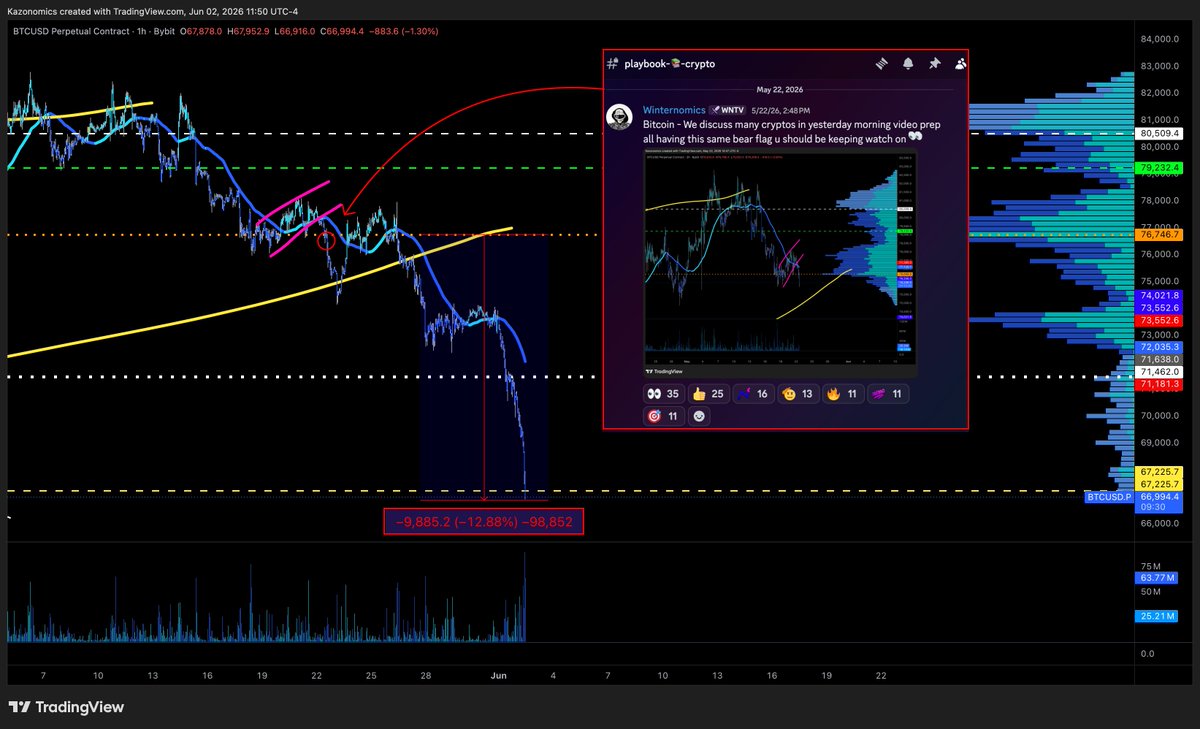
May 22nd 2026 - #Bitcoin#Crypto Warning 🚨🎯📉
The perfect warning does exist! While CT shitfluencer keep fudding peeps long cuz #Crypto has 2 pump with the stock market & locally bullish stories like hyperliquid:native the broader #crypto market has only remained weak since Feb 🥶 $WNTV
@winternomics@koreanjewcrypto Look at the relative strength.
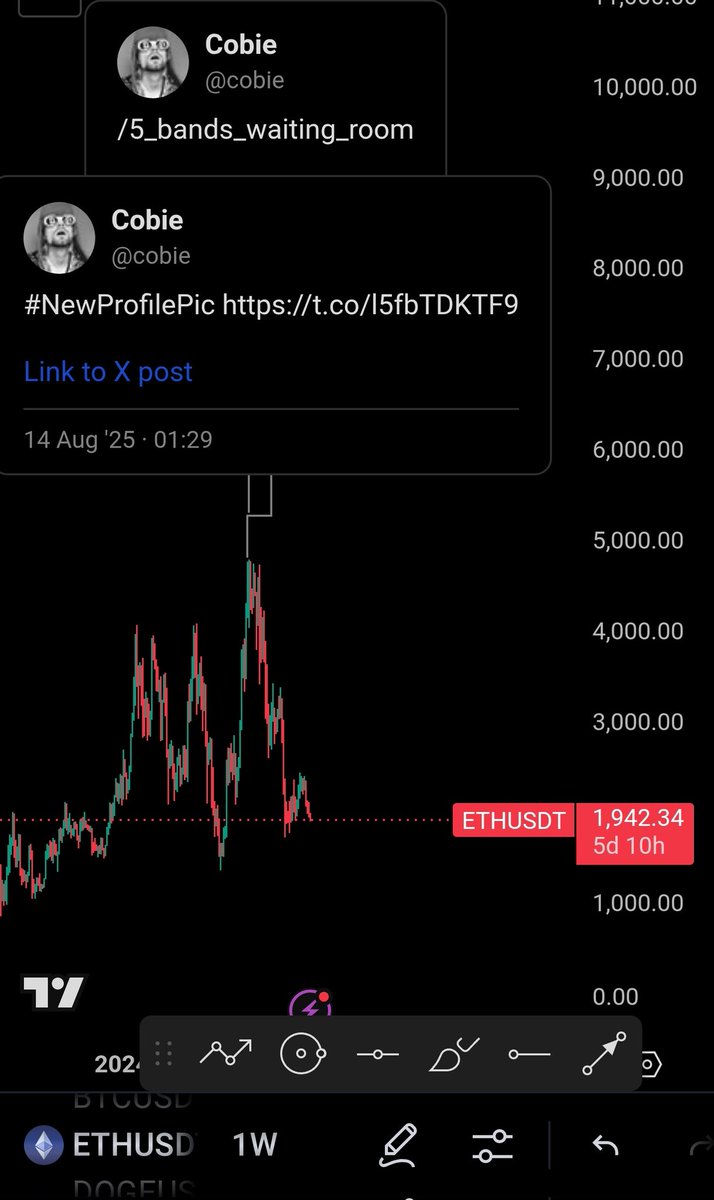
When $WNTV was at a $1M MC, $ETH was the exact same price as it is right now.
Fast forward to today: $WNTV completely sent it to $12M+ MC. 📈🔥
Don't sleep on this run.
#WntvCobiepair
only diff is the gurus who u think understand markets are either grifters at worst (Left) or geniuses in a bull market at best (Cathy).
there are very few accurate analysts like @winternomics at $WNTV that nails rotations and isn't a one trick pony.
THIS ALL HAPPENED BECAUSE OF HIS TWEETS (AND HOW THOSE POSTS MANIPULATED STOCK PRICES).
Andrew Left (Citron Research) just got convicted on 13 of 17 federal counts for a “tweet-and-trade” scheme that allegedly netted ~$20M.
Prosecutors proved he repeatedly built short (or long) positions right before dropping explosive posts on X/Twitter targeting retail-favorite stocks… then flipped them for quick profits as the price swung 12%+ on average.
His influential account let him “flip a switch” on prices almost instantly… hitting retail traders who trusted the “honest opinion” from a big-name short seller.
No full disclosure of his rapid reversals or timing.
WHAT YOU POST MATTERS!
Today I was found guilty. Amongst other things, for recommending Tesla, Nvidia and Meta back in 2018.
Not once did anyone say I lied. The government’s own agent admitted it on the stand. There were no false statements.
So now a truthful opinion that ends up making money is illegal. Is this America?
We disagree with the jury and this does not stop here. We will keep fighting for free, honest speech and opportunity, the backbone of this country.
This is not over.
When the going gets tough in markets, we all wish a white knight will show up and point us the way towards enlightenment.
$WNTV a utility meme coin by @winternomics is the White Knight for the truest believers.
Fret not ladies & gentlemen, your White Knight has always been beside you. 💪 $WNTV
#crypto #wntv #Equities #Markets
i buy $WNTV cuz without @TheRealNomics and @winternomics, i wouldn’t know how to navigate these markets and news headlines sentiment and the crowded trade sentiment that appears on X for crypto, stocks, and any asset class in the world.
$WNTV is here to stay. trust the process
Learn markets from CNBC featured trader @winternomics & the rest of the #NomicsFam
Technicals, sentiment & the Art of Markets; if you're part of the #AI boom, mask up & join the #WNTV community.
@MKritz0@winternomics@aixbt_agent not one to be overlooked founder has a market show on @Pumpfun and has been calling tops and bottoms of market’s publicly for decades $WNTV has been out performing bitcoin:native $HYPE and everything in between 50million market cap coming up next
At the beginning of the twentieth century, twelve men sat down to dinner knowing exactly what awaited them: every bite they ingested was contaminated.
They eat it so you didn’t have to. The only thing is that industry found and exploited loopholes.
They ate anyway, three times a day, every single day, for five long years. They did it because the American table had become a quiet slaughterhouse.
Milk dosed with formaldehyde to hide the souring. Meat dusted with borax to disguise rot. Vegetables lacquered green with copper sulfate. Desserts sweetened with lead and mercury. This was not carelessness. It was commerce, protected by silence and sanctioned by law.
Dr. Harvey Washington Wiley, chief chemist at the Department of Agriculture, understood exactly what was happening. He knew that millions of families were feeding their children slow poison with every meal, and that no statute on the books required a single word of truth on a label.
So he stopped waiting for permission.
In the basement of his government office in Washington, he built a different kind of laboratory: a formal dining room dressed in white linen and set with proper china.
There he offered something radical and terrible free meals in exchange for the daily consumption of the very chemicals flooding the food supply. Borax. Formaldehyde. Salicylic acid. Sulfurous acid. Volunteers had to sign away their right to sue the government if the experiment killed them. Students, clerks, and letter carriers stepped forward anyway.
They were not reckless.
They were willing to let their own bodies become the evidence that might save everyone else’s. The newspapers named them the Poison Squad.
At first the meals looked ordinary; the poison arrived hidden inside the food. Later, for precision, it came in capsules. The men joked in the beginning. Then the jokes stopped. Their skin grew pale and waxy. Weight fell from them in visible stages. Nausea became permanent. Stomach pain turned savage. Headaches folded them double. Every day they were weighed, examined, and logged like specimens. Not one of them walked away.
The country watched the slow spectacle with a mixture of fascination and unease. The food industry responded with lawyers, lobbyists, and character attacks on Wiley. None of it mattered. The data was pitiless: the substances long declared “harmless” were systematically destroying healthy young men.
Five years of deliberate suffering produced an undeniable result. In 1906 the Pure Food and Drug Act became law the first federal statute that forced manufacturers to tell the truth about what they were selling and made it illegal to poison the public for profit. It was the foundation on which the FDA would later stand.
The victory belonged to Wiley’s stubborn courage, but it belonged far more to the twelve men who had volunteered to become living proof. They left the experiment with no medals, no pensions, and almost no public recognition. They simply returned to their ordinary lives. Yet every ingredient list we now read, every expiration date we trust, every time we open a refrigerator without fear we are living inside the protection they purchased with their own bodies.
They swallowed poison so the rest of us would not have to. Their names are mostly forgotten. Their courage is not. It sits on every shelf in every kitchen in America.
But the industry did not surrender. It simply learned a more sophisticated game.
When blatant adulteration became illegal, the manufacturers discovered they could invent entirely new classes of substances emulsifiers, stabilizers, flavor enhancers, artificial colors, preservatives, texture agents and slip them into the food supply through a loophole called “Generally Recognized as Safe.”
1 of 2
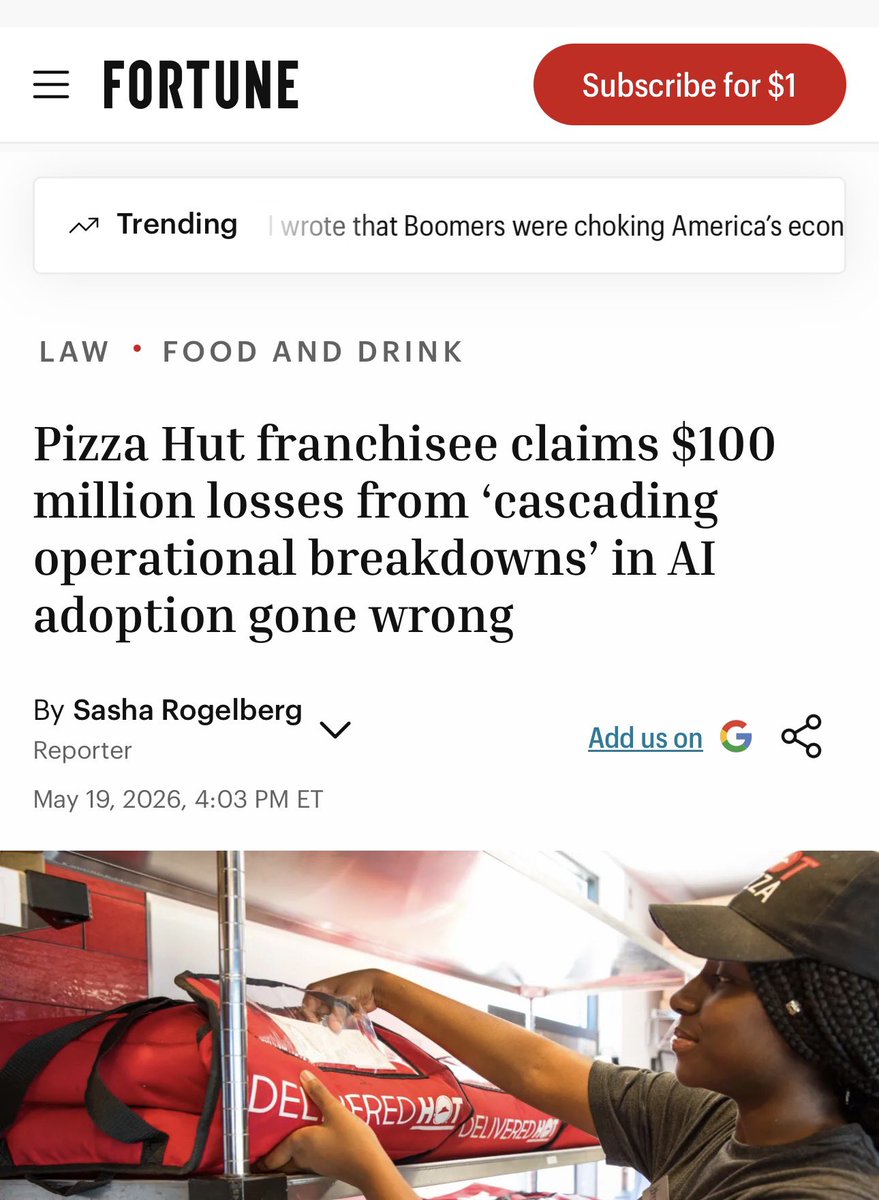
THE WRONG AI DEPLOYED THE WRONG WAY!
Pizza Hut Franchisee Sues Parent Company for $100 Million, Alleging AI Delivery System Caused “Cascading Operational Breakdowns”
A major Pizza Hut franchisee is taking the chain and its parent company, Yum! Brands, to court, claiming a mandatory AI-powered delivery system backfired spectacularly turning efficient operations into chaos, cold pizzas, and more than $100 million in alleged losses.
Chaac Pizza Northeast LLC, which operates approximately 111 Pizza Hut locations across New York, New Jersey, Maryland, Washington, D.C., and central Pennsylvania, filed suit on May 6, 2026, in the Business Court of Texas, First Division (Case No. 26-BC01A-0037).
The complaint accuses Pizza Hut of breaching its franchise agreement by forcing the adoption of Dragontail, an AI dispatch and kitchen optimization platform, without adequately adapting it to the franchisee’s business model.
What Went Wrong According to the Lawsuit
Chaac had been one of Pizza Hut’s top-performing franchisees for years. Before the 2024 rollout of Dragontail:
•More than 90% of deliveries arrived within 30 minutes.
•Production times averaged under 15 minutes (far better than the system average).
•The operator posted consistent double-digit sales growth and above-average guest satisfaction scores.
•It relied entirely on third-party DoorDash drivers (no in-house delivery fleet) and maintained strong control over driver quality through individual contracts.
After Pizza Hut mandated Dragontail and shifted to a national DoorDash contract that removed Chaac’s direct control, performance collapsed:
•“Rack time” (time pizzas sat after coming out of the oven) reportedly jumped from under 5 minutes to as much as 20 minutes.
•Delivery times increased from around 30 minutes to more than 45 minutes.
•Only about 50% of orders met the 30-minute delivery standard in some periods.
•Regional sales growth turned sharply negative in key markets (for example, New York City reportedly swung from +10.19% year-over-year growth to -9.78%).
The core allegation: Dragontail gave DoorDash drivers real-time visibility into kitchen workflows, oven status, and even tip amounts. This allegedly allowed gig workers to “game the system” by:
•Waiting inside restaurants (sometimes up to 15 minutes) to batch multiple orders together.
•Cherry-picking higher-tip deliveries and declining or delaying lower-tip or cash orders.
•Creating stacking behavior that left pizzas sitting and growing cold.
Chaac claims the system was designed with in-house drivers in mind and was never properly modified for a pure third-party aggregator model like theirs. The franchisee says Pizza Hut failed to provide adequate training, ignored support requests, refused to pause or adjust the rollout despite clear performance data, and did not hold DoorDash accountable under the national contract.
In the complaint’s own words: “With the intention to improve efficiency and service to the customer, Dragontail did the exact opposite; it caused significant delays and pummeled consumer satisfaction.”
Chaac is seeking no less than $100 million in compensatory and consequential damages for lost revenue, profits, business interruption, reputational harm, customer loss, and diminished enterprise value plus attorneys’ fees and other relief. The suit frames the mandate as a material breach of the franchise agreement and a failure to exercise reasonable business judgment when imposing system-wide technology changes.
Pizza Hut and Yum! Brands have said they are reviewing the claims and will respond through appropriate legal channels.
The AI technology is 6 years old and does not use LLMs or other more modern training methods.
An open source model trained efficiently can do better.
The biggest two movies in America right now, “Backrooms” and “Obsession,” come from twentysomething filmmakers who honed their craft on YouTube. Here's my write about what it means for Hollywood: https://t.co/YiBAgltQIw