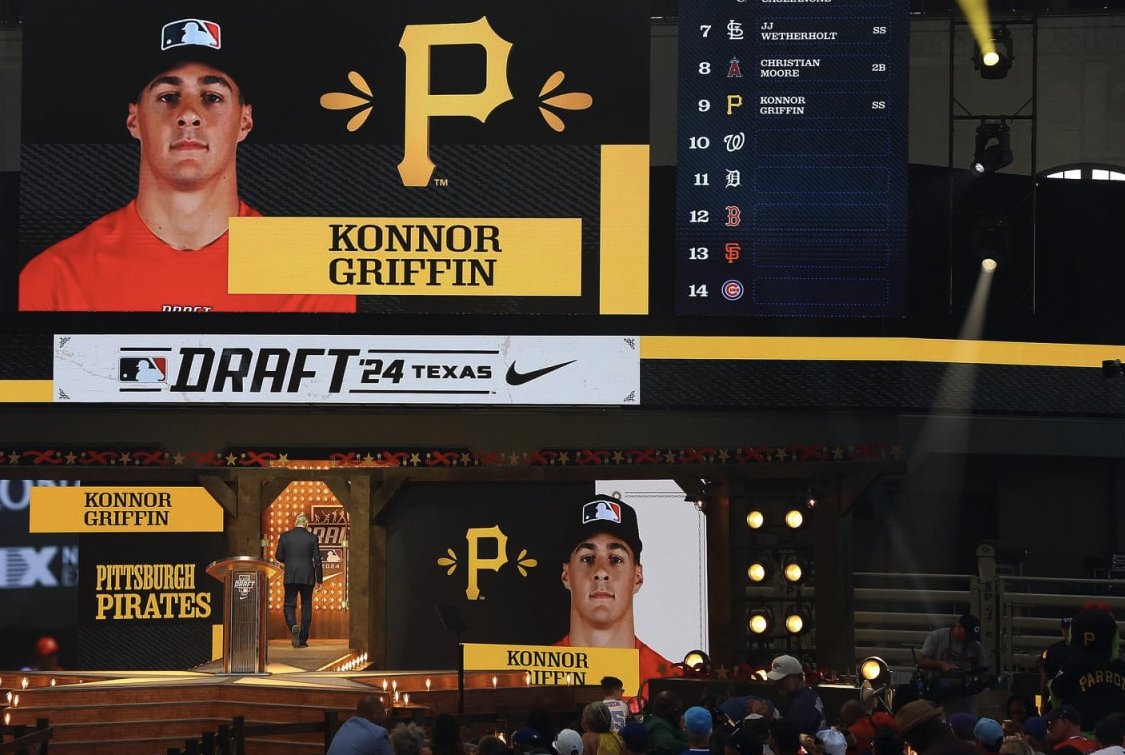
NEWS: The Pittsburgh Pirates are naming Justin Newman their new Director of Amateur Scouting. Newman has spent the last ten years with the Pirates. He has an heavy analyical background and served as the team's Director of Player Analysis this past year.
👇MORE BELOW👇
Kinda love this. You’d honestly get better information from the stadium biomechanics capture that can be compared 1-to-1 with that pitcher’s history, especially if this becomes a regular thing.
I think the Marlins turning bullpen days into relief outings for SPs is a bet that after considering objective workload variables, injuries are either a) inevitable and/or b) random.
Good bet? I have no idea. But their thinking and application is electric.
I have to believe something was lost in translation here. Maybe AI in the broadest sense but almost certain all these pitch calling models are your everyday machine learning kind
@jjcoop36@onemillioncubs@BaseballCards32 Minor league performance is correlated with different degrees of MLB success so seems perfectly fine to me to have recent hot/cold streaks inform rankings- just a matter of weighting it correctly.
@jjcoop36@onemillioncubs@BaseballCards32 I’d argue rankings should change relatively frequently but/and with smaller shifts. Superforecasting papers provide evidence this is the more accurate way: https://t.co/mqxG8dbOuT
A few years ago I ran a quick analysis of team-level injured days over expected (from player-level predictions) and saw close to zero correlation in team rank year-over-year.
With @Britt_Ghiroli -- why do certain teams seem to have an injury problem in the minor leagues? We talked to GMs, trainers, coaches, and analysts to try and figure it out: https://t.co/Y2KU8lDWnL
@pierreanalytics@pymc_labs I always found beeswarm plots even more effective than ridges for MLB coaches/players because users were able to highlight individuals below/above them.
@gabe_appelbaum Yeah probably! I’m not as intimately familiar with the men’s mile record but there’s a good academic paper trail for this phenomenon: https://t.co/JxbEXUwgRf
@LanceBroz@enosarris Stephen Jay Gould has a good chapter on this in "Full House" re/ why the 0.400 batting average is probably never going to happen again
@LanceBroz@enosarris Think this is a common sport development phenomenon. League-wide distribution shifts right while right-tail stays mostly the same/changes much slower. See it in many Olympic sports where variance shrinks as participation + selection pressure increases.
@EliBenPorat Grip strength correlates with power but I don’t remember it having much marginal predictive power beyond bodyweight in a model.
A 200 value though depends on testing protocol. Were these down at the side, at 90 degrees flexed, etc? Different positions and techniques can inflate
@RosenJordanBlum Curious why you think OOPSY and Steamer differ so much on this player? https://t.co/QFuQ0LiaqC
Different handling of BABIP regression and/or age/level controls?
@hedgertronic If anything, PULSE has an interesting use case here since (I think) it can measure biomech deviations/variance intra-player, not in its external load summation. I’d argue it’s actually just a marketing issue for the product.
My thoughts on this are already captured in my previous thread - ACWR is an outdated and mostly incorrect method for estimating injury risk https://t.co/sj6M5NTmLf
Nolan Ryan produced an incredible workload (5th all time in IP) and did so w/high velo. Managing and building workload remains far from optimized. What would attempting to a Ryan-like workload look like today? @maxengelbrekt, @hedgertronic and I explored: https://t.co/F0N5GLyTuY
@hedgertronic The thread of mine that I linked has ideas/examples of better dynamic load monitoring tools that are/probably are far more predictive of injury than ACWR. I didn’t mean to cite that study in my thread as a case against ACWR, that was more anti-seasonal load measures.