When you have a dream or an ambition and it's so far away and it's so high up, you can feel overwhelmed. But when you look at it as just one step at a time, one day, you're gonna look up from your feet and you'll be at your destination.
Gazini ang simpleng sagot sa tanong mo ay ACCOUNTABILITY. Cyberbullies should be held accountable for their acts to deliver justice to their victims. #MGIAllStars
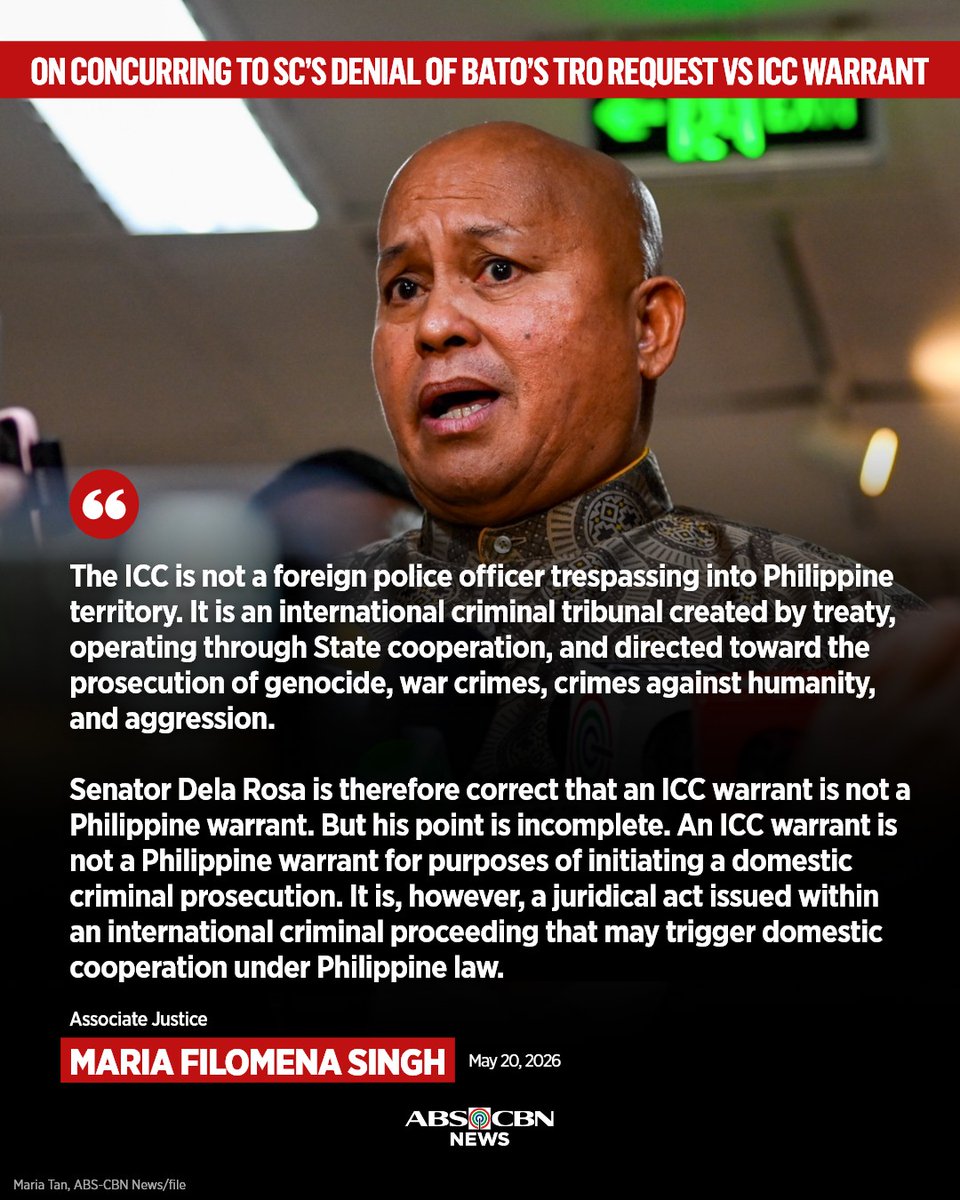
Associate Justice Maria Filomena Singh, in her concurring opinion, noted that Dela Rosa evaded legal processes and only appeared for Senate leadership change, as she also stressed on accountability of public officials.
Associate Justice Maria Filomena Singh: As a final note, the main issue in this case is ACCOUNTABILITY, under our Constitution, under our local laws, under the Rome Statute, under general principles of international law, as correctly framed by the parties. | via @adrianayalin
Idiniin ni Associate Justice Maria Filomena Singh na hindi dayuhang puwersang bastang nanghihimasok sa Pilipinas ang ICC kundi pandaigdigang hukumang nilikha ng kasunduan ng mga estado upang litisin ang mabibigat na krimen.
BASAHIN: https://t.co/VmG7OkL03K
The #SupremeCourtPH En Banc, during its session today, May 20, 2026, acted on G.R. No. 278747 (Rodrigo Roa Duterte and Senator Ronald “Bato” M. Dela Rosa v. Hon. Lucas Bersamin, et al. ) and denied the prayer for a temporary restraining order (TRO) and/or status quo ante order (SQAO) filed by Senator Ronald “Bato” M. Dela Rosa, in a vote of 9-5-1.
In Senator Dela Rosa’s manifestations, he prayed for a TRO and/or SQAO to prevent the Department of Interior and Local Government, the Department of Foreign Affairs, the Department of Justice, the Philippine National Police, the National Bureau of Investigation, the Bureau of Immigration, the Armed Forces of the Philippines, and the Criminal Investigation and Detection Group from arresting him on the basis of any warrant from the International Criminal Court, red notice and diffusion from the International Criminal Police Organization, or any foreign judicial or quasi-judicial instrument without a Philippine judicial warrant.
The full Resolution and the Separate Concurring and Dissenting Opinions of the Members of the Court will be uploaded to the Supreme Court website on Monday, May 25, 2026.
The Supreme Court only decided on the prayers for interim relief. The main issues raised by the parties in their pleadings and motions are yet to be resolved in the main case.
A copy of the available pleadings may be downloaded from the Current Cases section of the Supreme Court website.
Copying of this content is subject to the SC PIO’s Credit Attribution Policy: https://t.co/6W5N1BgfaL
Naglabas ang #KorteSuprema ng isang Desisyon sa wikang Filipino, na layong gawing mas malapit sa mga mamamayan, mas nauunawaan at mas nakatuon sa mga pangangailangan ng publiko ang katarungan.
Sa Desisyon sa kasong Velarde at Macasaet v. Kagagalang-Galang na Hukuman ng Pag-aapela sa Buwis na isinulat ni Associate Justice Maria Filomena D. Singh, nagpasya ang Ikatlong Dibisyon ng Korte na isantabi ang petisyong inihain nina Mel V. Velarde at Angeline L. Macasaet dahil naging 𝘮𝘰𝘰𝘵 na o wala nang saysay ang usapin.
Kinuwestiyon sa petisyon ang mga naging pagdinig ng Hukuman ng Pag-aapela sa Buwis o Court of Tax Appeals (CTA) kaugnay ng kasong kriminal na 𝘵𝘢𝘹 𝘦𝘷𝘢𝘴𝘪𝘰𝘯 na nag-ugat umano sa sadyang pagdeklara ng mas mababang halaga ng transaksiyong may kinalaman sa ari-arian (𝘶𝘯𝘥𝘦𝘳𝘷𝘢𝘭𝘶𝘢𝘵𝘪𝘰𝘯 𝘰𝘧 𝘢 𝘱𝘳𝘰𝘱𝘦𝘳𝘵𝘺 𝘵𝘳𝘢𝘯𝘴𝘢𝘤𝘵𝘪𝘰𝘯).
Naging 𝘮𝘰𝘰𝘵 ang kaso nang pagbigyan ng Court of Tax Appeals ang 𝘮𝘰𝘵𝘪𝘰𝘯 𝘧𝘰𝘳 𝘳𝘦𝘤𝘰𝘯𝘴𝘪𝘥𝘦𝘳𝘢𝘵𝘪𝘰𝘯 ng mga petisyoner sa pagtanggi nito sa kanilang 𝘥𝘦𝘮𝘶𝘳𝘳𝘦𝘳 𝘵𝘰 𝘦𝘷𝘪𝘥𝘦𝘯𝘤𝘦. Ibig sabihin, tuluyan nang isinantabi ang kasong kriminal. Dahil dito, nagpasya ang Korte Suprema na wala nang natitirang aktuwal na kontobersiyang kailangang resolbahin at hindi rin ito isa sa mga eksepsiyon sa doktrina ng 𝘮𝘰𝘰𝘵𝘯𝘦𝘴𝘴.
Sa paggamit ng wikang Filipino, mas naipapaintindi ng Korte Suprema sa mga mamamayan ang pangangatwiran sa mga desisyon nito. Mas madali kasing maintindihan ng publiko kung nakasulat ito sa wikang Filipino, bilang isa sa mga opisyal na wika ng bansa at wikang malawak na nauunawaan ng nakararami.
Kapag ang batas ay naipahahayag sa wikang ginagamit ng mga mamamayan, nakatutulong itong patatagin ang tiwala ng publiko at iparamdam sa kanilang bahagi sila ng sistema. Higit sa lahat, natutugunan ang pangako ng Saligang Batas na ang katarungan ay dapat madaling maabot at mapakinabangan ng lahat.
Basahin ang buong press release sa https://t.co/1o3Hi0eykb
Basahin ang buong Desisyon sa https://t.co/bsVEZpUCVc
Sumunod sa Credit Attribution Policy ng SC PIO: https://t.co/F48RF1vtzZ.
#SupremeCourtPH #ScphTranslations
My thoughts:
Miss Universe: La Union
Miss Supranational: Cebu City
Miss Cosmo: Taguig
1st Runner Up: Pampanga
2nd Runner Up: Cebu Province
#MissUniversePhilippines2026
#Storycon | Vice President Sara Duterte remains the most preferred candidate for president in 2028, but her gap against her predecessor and incumbent Naga City Mayor Leni Robredo has already “narrowed” in the first quarter of the year. https://t.co/Nv7nuOz9fk | via @onenewsph
Hello, Moon. It’s great to be back.
Here’s a taste of what the Artemis II astronauts photographed during their flight around the Moon. Check out more photos from the mission: https://t.co/rzM1P0QbOl
LIVE: Watch with us as the Artemis II astronauts make their closest approach to the Moon, traveling farther from Earth than ever before. https://t.co/Zpy7GdTqA8
LIVE: Agency leaders answer media questions and provide updates on our Artemis II mission ahead of the lunar flyby set for Monday, April 6. https://t.co/3qsuYqPamK
The #SupremeCourtPH (SC) has ruled that same-sex couples who live together may be recognized as co-owners of property under Article 148 of the 𝘍𝘢𝘮𝘪𝘭𝘺 𝘊𝘰𝘥𝘦, provided there is proof of actual contribution.
In a Decision written by Associate Justice Jhosep Y. Lopez, the SC’s Second Division granted a woman’s complaint for partition of property and recognized her as a co-owner of the house and lot she shared with her same-sex partner.
Article 148 of the 𝘍𝘢𝘮𝘪𝘭𝘺 𝘊𝘰𝘥𝘦 governs the property relations of couples who are living together but cannot legally marry, acknowledging co-ownership based on their actual contributions.
The two women lived together as a couple. A year into their relationship, they purchased a house and lot, and agreed to register the property in one partner’s name to facilitate banking transactions.
Upon separation, they agreed to sell the property and divide the proceeds equally. One partner signed an 𝘈𝘤𝘬𝘯𝘰𝘸𝘭𝘦𝘥𝘨𝘮𝘦𝘯𝘵 stating that the other had paid about 50% of the purchase and renovation costs.
However, she later refused to sell the property and denied that her former partner was a co-owner.
To protect her interest, the former partner annotated an adverse claim on the title and demanded partition of the property. When this failed, she filed a case for partition of real estate and damages, relying on the 𝘈𝘤𝘬𝘯𝘰𝘸𝘭𝘦𝘥𝘨𝘮𝘦𝘯𝘵 as proof of co-ownership.
The SC granted the complaint for partition of real estate, as it clarified the provisions in the 𝘍𝘢𝘮𝘪𝘭𝘺 𝘊𝘰𝘥𝘦 governing the property relations of unmarried couples living together.
Article 147 applies to unmarried couples who may legally marry. Property acquired during their cohabitation is presumed jointly owned.
Article 148, on the other hand, applies to couples who are not permitted to marry. Only properties obtained through actual contribution are considered common property.
Since the 𝘍𝘢𝘮𝘪𝘭𝘺 𝘊𝘰𝘥𝘦 only allows marriage between a man and a woman, the SC held that same-sex couples necessarily fall under Article 148.
Here, the SC found that the signed 𝘈𝘤𝘬𝘯𝘰𝘸𝘭𝘦𝘥𝘨𝘮𝘦𝘯𝘵, where one partner admitted that the other paid about half of the property costs, was a binding admission and sufficient proof of actual contribution. This established co-ownership.
Read the full text of the press release at https://t.co/yjEQQVShu8.
Read the full text of the Decision at https://t.co/PrGAAS6Ydb.
Read the Concurring Opinion of Senior Associate Justice Marvic M.V.F. Leonen at https://t.co/TGg13bUwaN.
Read the Concurrence of Associate Justice Amy C. Lazaro-Javier at https://t.co/6ixJ7sDPIC.
Copying of this content is subject to the SC PIO’s Credit Attribution Policy: https://t.co/F48RF1vtzZ.
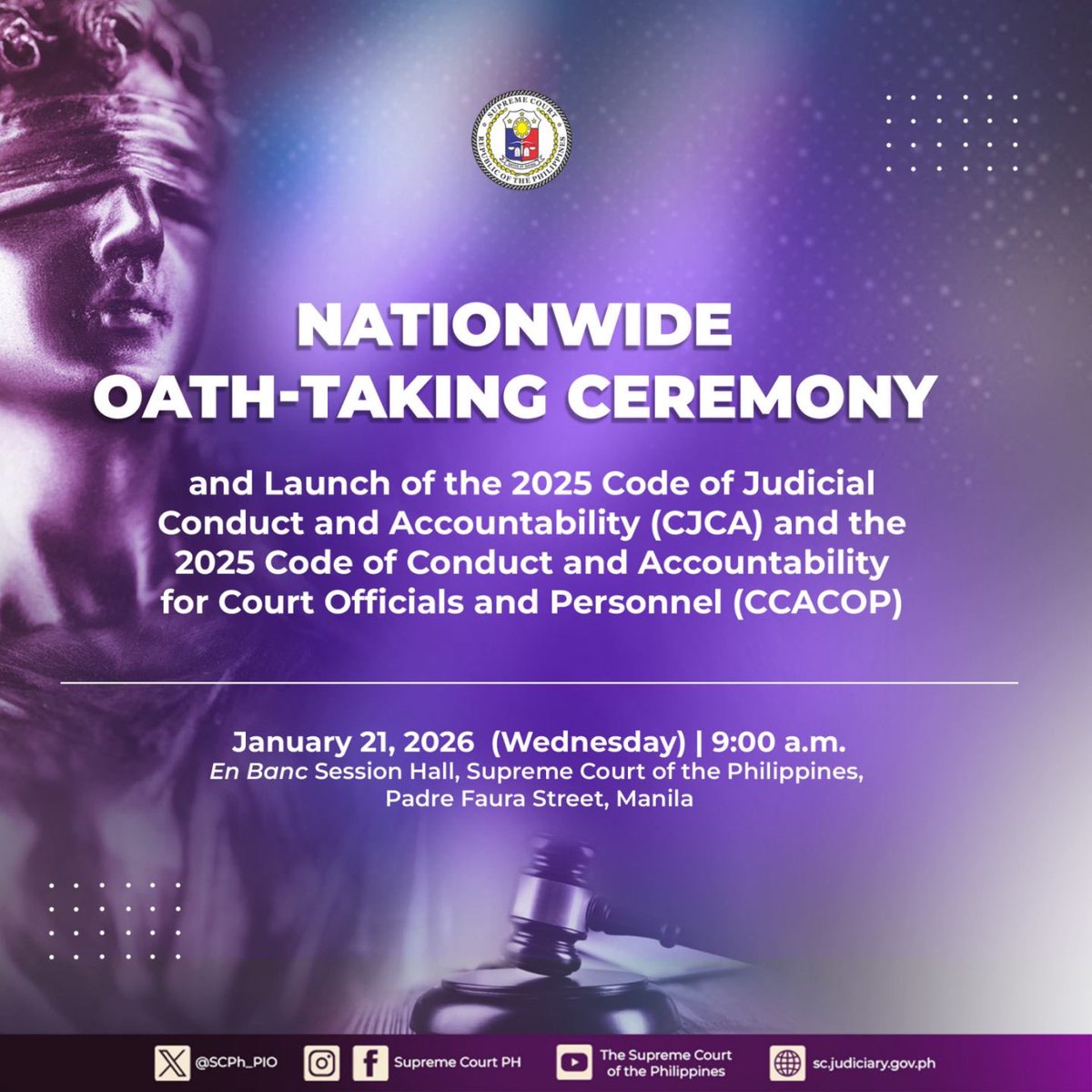
The #SupremeCourtPH will lead a nationwide oath-taking ceremony on January 21, 2026, launching the 2025 Code of Judicial Conduct and Accountability and the 2025 Code of Conduct and Accountability for Court Officials and Personnel.
Appellate and lower courts nationwide will participate online.
Warmest congratulations to our new UP lawyers!
It is with immense pride and joy that the UP College of Law community congratulates you on passing the 2025 Bar Examinations.
#UPCollegeofLaw#UPLaw