I'm not a politician, so I can say this. A large share of the population has been deluded into thinking the government's job is to give them things for "free" or at low cost. "Look at this shiny new thing I've given you."
You're also encouraged not to dwell on the reality: when government makes something "free", it usually ends up waaaay more expensive, and you pay for it anyway through taxes and inflation, with plenty of pork barrel crap bundled in. It's a doom loop no politician will ever challenge, unless we're ready for the conversation. (are we?)
Here's the part nobody wants to admit. Everyone taking a "free" scheme is quietly hoping someone else is paying more of it than they are. We can't all be right. The arithmetic doesn't allow a country of net winners. Take out the waste and the inflation and we get back less than we put in, every time.
That's why no politician will ever say it out loud. The illusion is what gets them elected; the truth costs votes. The loop only breaks the day voters would rather hear the bill than the giveaway.
The current example is the scramble for the car scrappage scheme. I get it, it's worth doing if you've an old car. But we'll all end up paying it back with interest, one way or another. We all think we're getting something for free, but deep down we have to know we're all paying for it, and some.
"man appears in court"
Funny how the national media full of pronouns can't bring themselves to mention the nationality, but they can tell instantly if the murderer is a man.
Voyager 1 is 24 billion kilometers from Earth.
It communicates with us using a 23-watt transmitter.
Less than a refrigerator light bulb.
The signal takes 22 hours to reach us, traveling at the speed of light.
By the time it arrives, it's 20 billion times weaker than the power of a digital watch battery.
NASA's Deep Space Network picks it up using 70-meter dish antennas cooled to near absolute zero to reduce electronic noise.
The engineering required to hear a 23-watt signal from 24 billion km away is arguably more impressive than the spacecraft itself.
Launched 1977.
Still transmitting.
Still being heard.
We built something that works perfectly, 47 years later, in conditions no one has ever tested in.
That's what engineering for the long term looks like.
Britain had a moment of silence for George Floyd. Our politicians kneeled en masse to show their outrage at his killing. "I can't breathe" became a slogan.
George Floyd died on the other side of the world. He wasn't British.
Henry Nowak *was* British and his treatment by the police was shocking and negligent in the extreme. Yet there is no minute of silence. There is no coordinated public campaign. There is no kneeling at sporting events.
And we all know why.
During the summer of BLM, some people said "All Lives Matter". This was treated as the highest form of racism and anyone who said this was immediately cancelled. Why? Because the people in charge don't actually think all lives matter in the same way.
They have created a racial hierarchy of victimhood where a career criminal who died through mistreatment by police in a foreign country with 0 evidence of racism like George Floyd is automatically sanctified because of the colour of his skin.
And Henry Nowak, a British man, one of ours, is automatically dismissed and ignored because of the colour of his.
This is the ugly fruit of so-called "anti-racism", an obsession with race that has created a two-tier society which treats people differently because of the colour of their skin.
This needs to stop.
Voltaire passed away today in 1778.
There are two quotes of his I always come back to:
"I disapprove of what you say, but I will defend to the death your right to say it."
and
“Those who can make you believe absurdities can make you commit atrocities.”
You can ignore reality, but you can’t ignore the consequences of ignoring reality.
One of the biggest mistakes we’ve made in the West is treating immigration as a question of virtue instead of a question of governance.
Of course our country can help people fleeing genuine persecution. But not against the wishes of its citizens!
That isn’t extremism. It’s reality.
@bitcoinwell But would this not mean he understands the danger it causes to the dollar hegemony and implement choke holds the prevent it taking over and instead use Bitcoin to support the dollar in some way ?
In 2025, 38% of 25-34 yr olds still live at home or are financially dependent on their parents, ten times the share of the same group in Denmark and Finland (4%)
It was 21% in 2012
You’re Not Unlucky—Your Brain Is Sabotaging You. But There’s a Way to Claw Back Control, Scientists Say. | Stav Dimitropoulos, Popular Mechanics
Here’s what you’ll learn when you read this story:
- Research shows that luck is partly shaped by our brain’s perception of a situation and how we act on it. Stress plays a significant negative role in our brain’s decision-making capabilities.
- Often what we call “bad luck” reflects overlooked opportunities, repeated poor choices, and a tendency to blame outside forces instead of reevaluating our own decisions.
- One study finding that has flummoxed scientists is that some people don’t make better choices even when they understand which choice leads to bad consequences, suggesting a brain disconnect between knowledge and action.
For centuries, people have tried to make sense of luck. They mapped it onto the stars, shuffled it into tarot cards, read it in omens—anything to explain why some days seem as if the skies pour down rare boons, while others rain down cruel curses. But what if at least some of what we call luck isn’t blind at all—and isn’t fate either? Perhaps luck is an outcome that your state of mind constructs instead: what it notices, what it misses, and how it nudges you to take the next step.
A 2025 study in Communications Psychology seems to show that your state of mind has more to do with your outcomes than you think. Researchers pushed 42 participants through the Trier Social Stress Test—an experimental setup designed to raise cortisol, the hormone released during threat and challenge. Participants delivered a mock job interview and performed rapid mental arithmetic while being watched and judged in real time, which triggered their bodily fight-or-flight response. Then they moved on to a fast-paced decision task known as the “knapsack” problem, weighing costs against benefits under time constraints—like deciding what to keep or cut without exceeding a limit.
As pressure mounted, decision accuracy declined. Participants made more incorrect choices, especially under time pressure and on more demanding problems—showing how quickly pressure can erode even careful thinking, and how what feels like bad luck can sometimes be the product of a mind pushed to its limits.
That’s when the brain starts thinking more negatively, the research suggests.
“Under stress and time pressure, we found tentative evidence that people respond more pessimistically—saying no more often, even when opportunities are there,” says Karlo Doroc, PhD, one of the three authors of the study and senior lecturer at the University of Melbourne. In other words, people in high-pressure conditions begin to scan for problems rather than possibilities.
When Doroc and his team used eye-tracking technology to monitor where participants looked and how long they focused on different parts of the task, they found that under stress, people spent less time engaging with the information that mattered for the decision and moved on more quickly. “This is consistent with a more pessimistic outlook and may make it harder to recognise the benefits of an option, even when you consider them,” he says.
And once that shift sets in, it doesn’t just affect complex decisions—it begins to shape even the simplest ones.
One unexpected and counterintuitive finding of the study is that when the brain’s resources thin out, it is the simplest decisions that suffer the most—sometimes more than complex ones. “Absolutely, the evidence suggests that even relatively simple decisions can start to break down,” Doroc says. In two related studies that are yet to be peer reviewed, the team found that when cognitive capacity drops—for example with age—the easiest choices become the most fragile—small failures that can easily pass for bad luck. “This was a surprise to us, but the evidence is quite strong,” Doroc says.
There’s good reason to think that our experience of bad luck often may unfold due to the brain’s poorer performance under pressure. Decades of research have shown how quickly performance can slip in demanding conditions. You’ve probably seen it yourself: you’re flying overseas and forget something obvious, like your passport; or in a week charged with ambition, you sprain your ankle.
You call it Murphy’s law. You blame the sadistic universe, the neighbor’s evil eye—or, in a moment of desperate, reluctant self-reflection, your own tired life and its misfortunes. But what if this is only half the culprit? What if that flicker of self-blame holds a grain of truth?
In a separate 2025 study, also published in Communications Psychology, researchers asked hundreds of participants from around the world to play a deceptively simple online game. In each round, they chose between two options: one that could reward them and one that could lead to a loss. At first, players had to learn through trial and error which option carried a penalty. Then the researchers made it explicit: this option is bad, this one is safe. Most people adjusted immediately. But a striking minority did not. Even after they understood the consequences, they continued to pick the harmful option.
By the end of the study, researchers identified three groups. The first learned quickly. The second corrected course once given clear information. The third kept making the same mistake despite knowing better—revealing a breakdown between knowledge and action. The researchers called this third group the “compulsives.”
“Those ‘compulsive’ individuals understand which choices lead to negative outcomes… but continue to make those choices. The perplexing thing is that they are aware of how they’re behaving and they stand by it,” says Philip Jean-Richard-dit-Bressel, a coauthor of the study and senior lecturer at the University of New South Wales.
The problem isn’t ignorance. These participants see what’s going wrong. The failure lies in the link between knowledge—“I know which option leads to a loss”—and action—“I’ll choose the safer one”. That knowledge simply doesn’t translate into behavior. Even when the correct move is obvious—avoid the option that consistently subtracts points—they don’t. They hedge, mixing safe and harmful choices, as if the brain can’t fully commit to what it already knows.
“We’ve described this as a failure in cognitive-behavioral integration, but that’s more a description than an explanation,” says Jean-Richard-dit-Bressel. “We still don’t fully understand why there’s a breakdown.”
Researchers have studied luck more directly elsewhere—for example, in the work of Richard Wiseman, a psychologist at the University of Hertfordshire in the early 2000s. Wiseman asked people who considered themselves “lucky” or “unlucky” to keep diaries and tracked how they navigated everyday situations. He found that those who saw themselves as unlucky were more likely to miss opportunities—failing to notice a £5 note placed in plain sight, for example—or fixate on negative outcomes.
But even though the 2025 studies don’t set out to pin down luck, they hint at its formation. For Jean-Richard-dit-Bressel, these patterns—pessimistic decision-making, overlooking what’s right in front of you, and failing to act on what you already know—may help explain why some people repeatedly end up in negative situations.
“There’s the saying that people can make their own luck, and I think that’s true for bad luck,” he says. “Our research shows that most people are surprisingly poor at detecting how their ongoing behavior contributes to their troubles.” Bad beats will always exist. But Jean-Richard-dit-Bressel argues that people often move too quickly to blame “luck” instead of reevaluating their own decisions—misattributing outcomes to external factors rather than their own choices.
Scientists have long observed this tendency. Since the 1950s, research on attribution bias—our tendency to explain outcomes by blaming circumstances rather than our own actions—has shown that we are quick to point our finger at our ill luck while overlooking our own role in what follows.
“Most of us know someone who says they’re unlucky in love, or unlucky in finance, or whatever it is—when it’s clear from our vantage point that it’s at least in part self-inflicted… We’re not as self-correcting as we think,” Jean-Richard-dit-Bressel says.
It may be worth paying attention to outside perspectives—at least according to him. “Some good advice that helps us change course can be all that’s needed to turn a string of ‘bad luck’ into ‘good luck,’” he says. Sometimes, that’s all it takes to make fate tilt quietly into a luckier future.
https://t.co/Kmnknw5P3d
1/ There are zero bitcoin inside your Trezor, Ledger, or Coldcard.
Your hardware wallet doesn't hold your Bitcoin.
Millions of people are operating with a fundamental misunderstanding of the hardest asset on earth.
Here is the reality of self-custody. 🧵
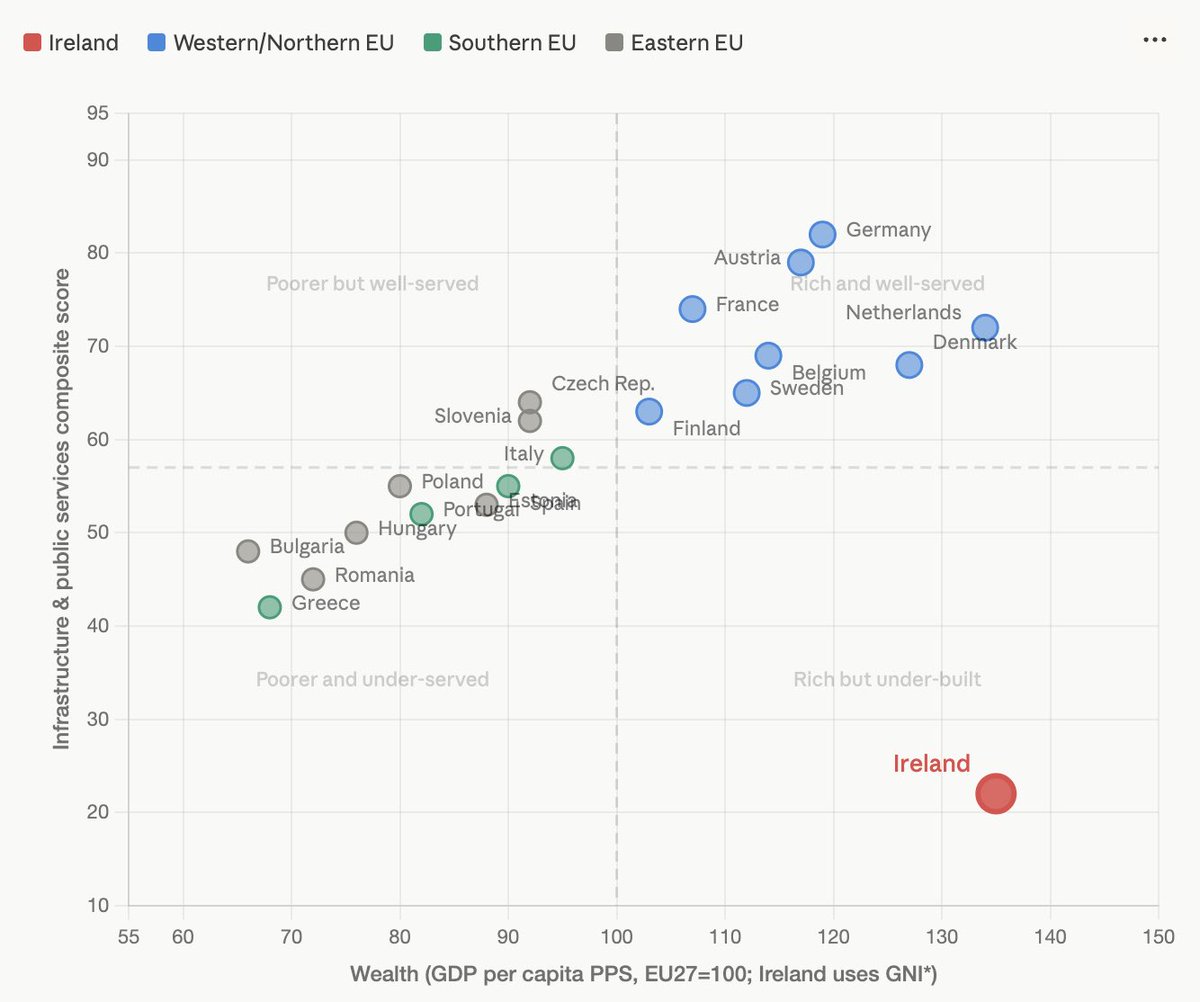
The protests in Ireland are not about just fuel! They are about the distance between Ireland on this graph and every other modern and developed economy. Ireland is second wealthiest but gets waaaaay less than any other country for that wealth. By a golden mile.
That visual gap in this graph? That’s what people are protesting. It’s a lack of infrastructure and the everyday enshittification of services, the economy, and the additional difficulty of trying to live, relative to peers in any other country. It also highlights why people don’t get uniformly listened to! - because there is no government architecture to engage meaningfully across this huge gap.
That gap is a three hour drive to work in traffic, a 14 month wait for an MRI, buses that don’t arrive, trains that don’t exist, schools that have no places for your kids, houses that are unaffordable, pubs that close before midnight, €12 sandwiches, expensive fuel.
People feel this gap, even if they can’t explain it precisely. And that builds into resentment, and ultimately protest. Fuel just happened to be the next thing that could be pointed to, today.
I've never seen Harris use this kind of vitriolic language against foreign migrants who enter Ireland illegally and then commit the most horrific crimes.
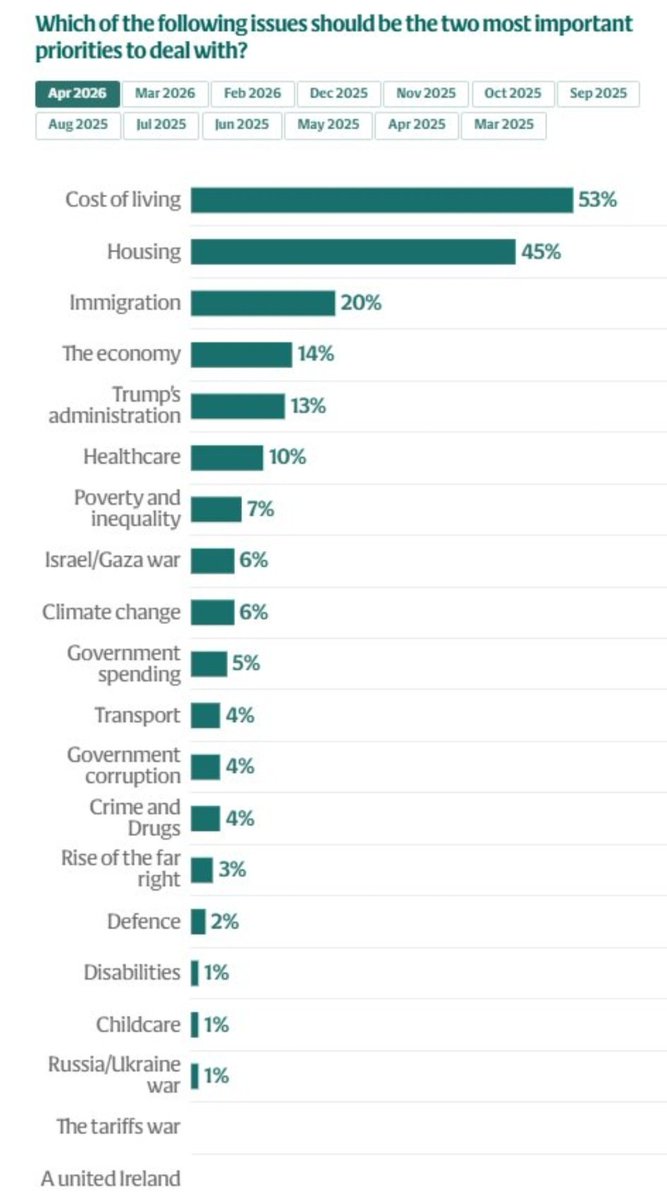
Less than 1% of Irish people are concerned about Russia / Ukraine, yes thats Less than 1%
So why are 99% of our politicians and media completely obsessed with it?
Who's funding and directing it?
@elonmusk Interviewer asked astronaut Victor Glover, on his way to the moon if he has an Easter message for the people of Earth.
Victor: "I don't have anything prepared"
God: "Don't worry, I'll speak through you"
What a beautiful message. Amen 🙏