When Ayrton Senna broke his 'home race curse' with one gear! 😮💨
A mind blowing performance from the legend during the 1991 Brazilian Grand Prix 🤯
#F1#BrazilGP
Aqui está a volta onboard do Felipe Drugovich durante o TL1 do #AbuDhabiGP.
Se eu tomar block, muito obrigado por todos os peixes.
🎥: Formula One Management (FOM)
#F1
Postdocs should be given opportunities to take initiatives and receive public recognition for their contributions and leadership.
We should only recruit postdocs when we are committed to actively support their scientific growth & career progression.
https://t.co/jt8EvKo2D2
BREAKING NEWS
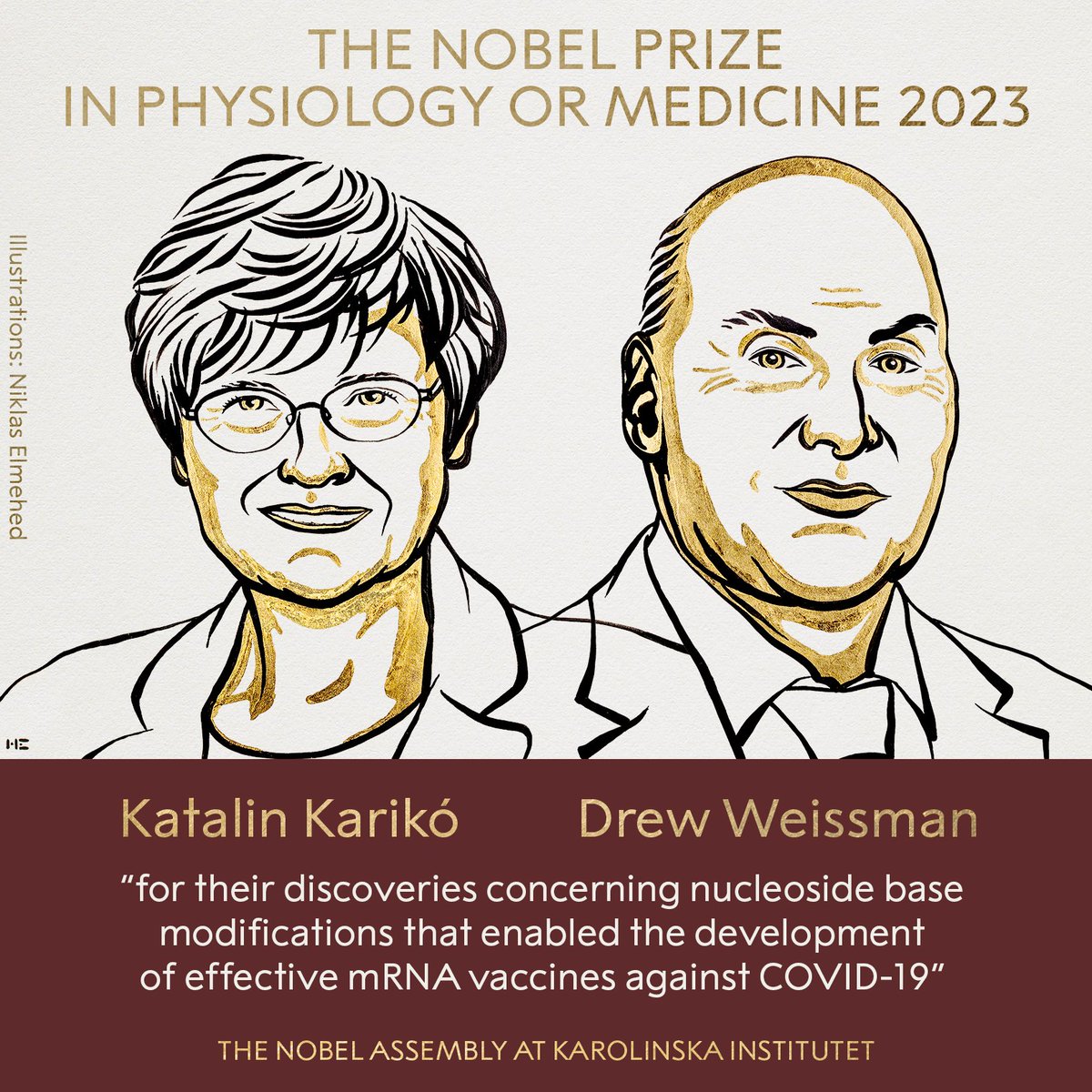
The 2023 #NobelPrize in Physiology or Medicine has been awarded to Katalin Karikó and Drew Weissman for their discoveries concerning nucleoside base modifications that enabled the development of effective mRNA vaccines against COVID-19.
Common Probability Distributions That Occur In Nature And Why Mathematics Is The Language Of The Universe
Fundamentally the patterns of the universe repeat themselves making machine learning and AI possible.
Basically, when training ML models, including NNs we are attempting to model the patterns in the data. A good model can predict unseen data points that are part of the original data distribution.
Here are the common probability distributions and where they occur naturally
Symmetry and normal distributions - Nature loves balance. You see it in butterfly wings, faces, and even in physical laws. Natural phenomena that exhibit symmetry often fit well with a normal distribution.
The Central Limit Theorem tells us that the sum of many independent, identically distributed variables approaches a normal distribution. These distributions are characterized by a mean and a standard deviation and everything from human heights, IQ scores, and even the velocities of molecules in a gas follow a normal distribution
Log-normal distribution - If the logarithm of the variable follows a normal distribution, then the variable itself has a log-normal distribution. The distribution of financial assets, or the sizes of particles generated by grinding, blood pressure, and metabolic rates in various organisms often follow a log-normal distribution.
The Log-Normal Distribution often arises from multiplicative growth processes, where you're repeatedly multiplying by some random factor.
Uniform Distribution. This is self-explanatory. All outcomes are equally likely. In the continuous case, the probability density function is flat between the minimum and maximum values. Rolling a fair die, or picking a card from a well-shuffled deck follows uniform distributions
Poisson Distribution It describes the probability of a given number of events occurring in a fixed interval of time or space. The events must occur with a known constant mean rate and independently of each other. It is the go-to for predicting rare events.
Poisson distribution models the number of times a radioactive atom decays in a given time period, or the number of cars passing through a certain point in a given time frame.
If a particular intersection sees an average of 10 cars passing through it per minute, the Poisson Distribution can estimate the probability of 15 cars passing through in the next minute. Similarly in sports like hockey or soccer where goals are rare, you can use distribution to model the number of goals scored by each team.
Bernoulli Distribution, the binary star of the probability universe! Scientifically speaking, it's a discrete probability distribution that models a single experiment with exactly two outcomes, often termed "success" and "failure," and is characterized by a single parameter p, the probability of success.
The flip of a coin, genetic inheritance (you either have a trait or you don't), and the polarization of a single photon (either vertical or horizontal) model this distribution.
Binomial Distribution It describes the number of successes in a fixed number of independent Bernoulli trials, each with the same probability of success.
For example, The number of heads when flipping a coin multiple times, or the number of defective items in a batch of manufactured goods can be modeled with this distribution.
Exponential Distribution models the time you have to wait for the next event in scenarios where events happen independently and at a constant average rate. It's often used to describe phenomena like the time between bus arrivals or the intervals between radioactive decay events.
In essence, it's the go-to distribution for understanding "waiting times" in various natural and man-made systems.
This is a summary of the most common distributions. There are a bunch of other distributions that are related or variations on the above distributions and the image below captures some of them.
These naturally occurring distributions speak to why mathematics is the language of the universe and how you can use it to model and predict its behavior
The Longest Equation in Physics
The model Lagrangian is a mathematical expression that summarizes the Standard Model of particle physics, which is the most successful theory of the fundamental interactions between elementary particles. It is composed of four different parts, each describing a different aspect of the Standard Model.
The model Lagrangian is written in a compact notation that uses symbols and operators from quantum field theory, such as covariant derivatives, field strength tensors, Dirac matrices, and gauge group generators. It also uses various constants and parameters that are determined by experiments, such as coupling constants, masses, and mixing angles.
It is one of the longest equations in physics because it contains many terms and factors that account for all the possible interactions and symmetries of the Standard Model.
It was transcribed by Thomas Gutierrez who derived it from Martinus Veltman's Diagrammatica: The Path to Feynman Diagrams.
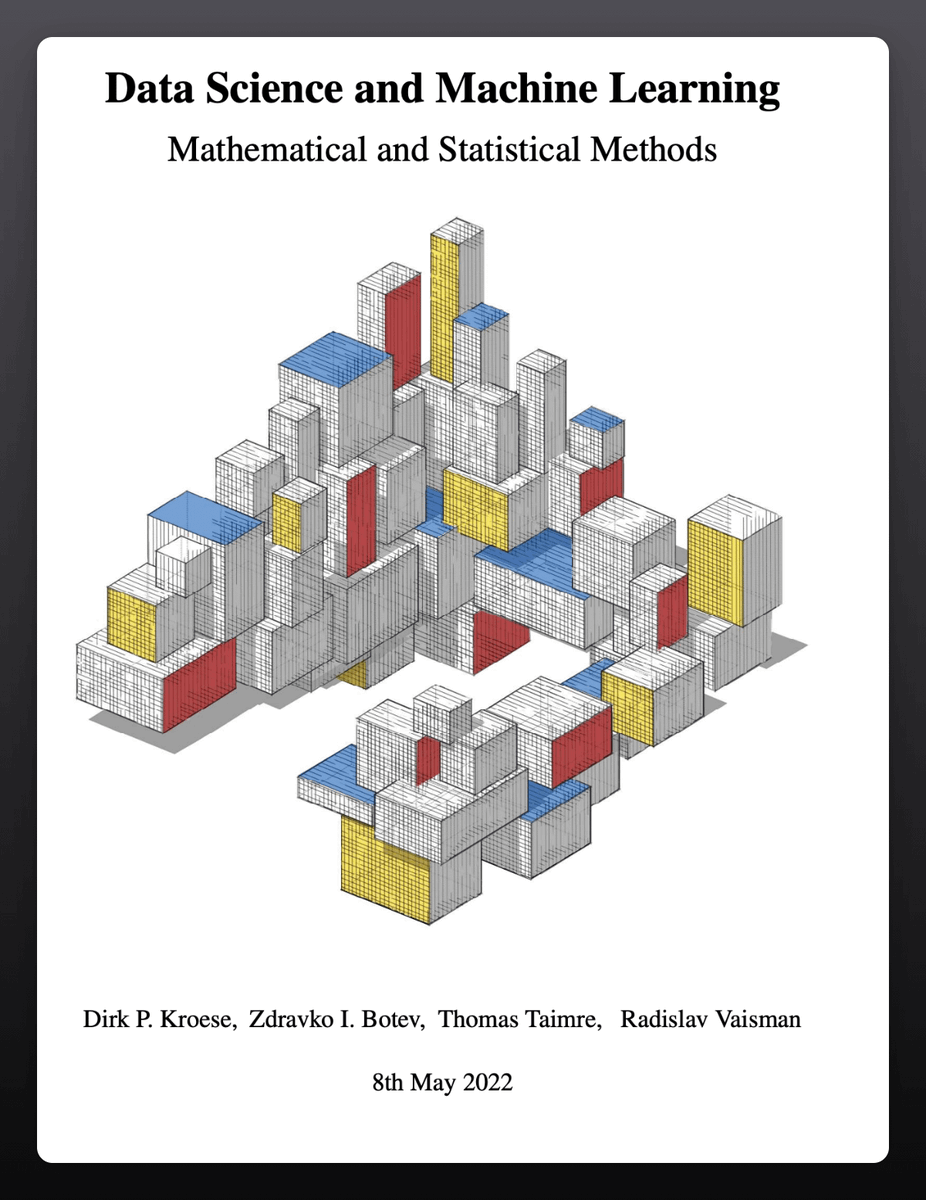
You can download this Data Science and Machine Learning book for free.
There are 4 sections for those who are starting:
• Python Primer
• Linear Algebra and Functional Analysis
• Probability and Statistics
• Multivariate Differentiation and Optimization
The rest of the chapters:
• Importing, Summarizing, and Visualizing Data
• Statistical Learning
• Monte Carlo Methods
• Unsupervised Learning
• Regression
• Regularization and Kernel Methods
• Classification
• Decision Trees and Ensemble Methods
• Deep Learning
Download the book here: https://t.co/wNK3BfAxul.
Carlos César Salvador Arana Castañeda foi um escritor e antropólogo peruano. Seu sucesso como escritor está relacionado à publicação de uma série de livros autobiográficos sobre suas experiências com o bruxo Don Juan Matus, índio da tribo Yaquis. #FraseDoDia#Forbesbr
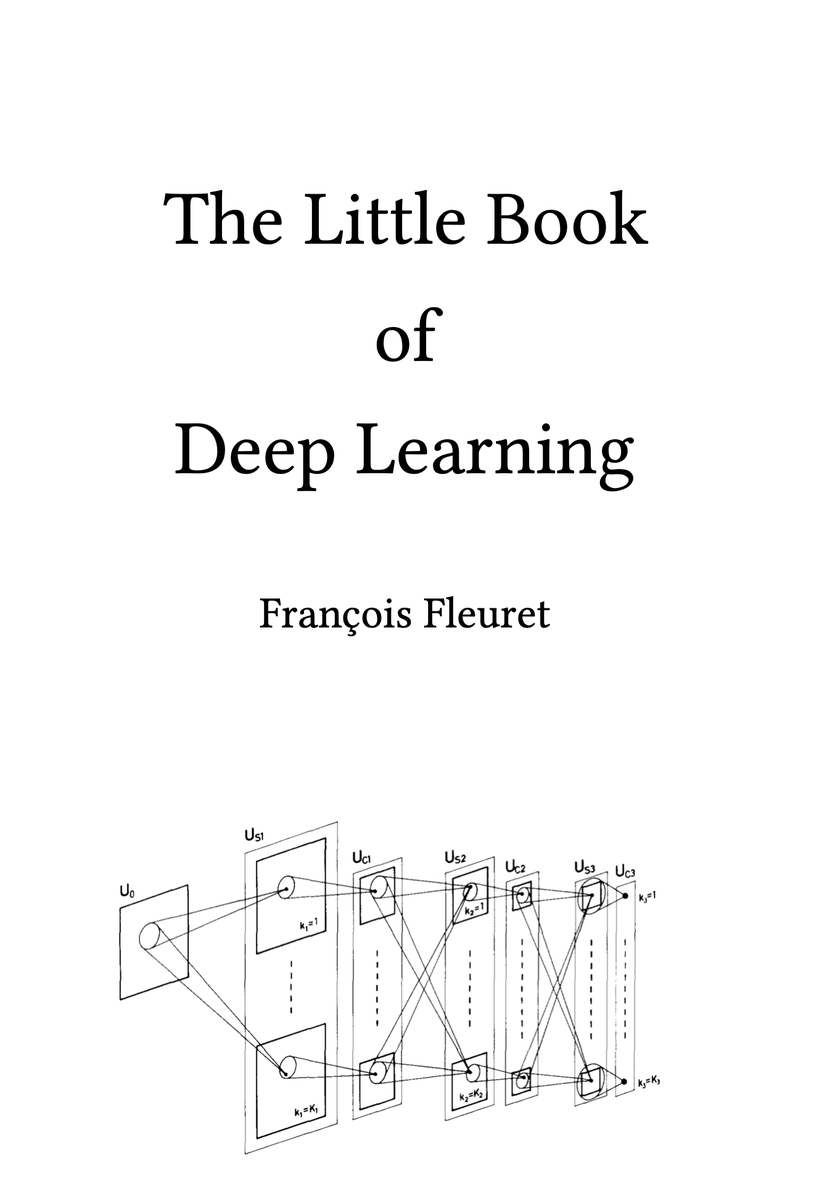
The Little Book of Deep Learning.
This is a very concise guide to deep learning.
It covers various topics, which includes:
- Machine Learning Foundations
- Efficient computations with GPUs & TPUs.
- Model Architectures &
- Model Training
And it's free: https://t.co/NirAkvOQi7
Artificial intelligence vs. human brain - a love-hate relationship
As AI models (neural networks) have become more performant they have surpassed the human brain at multiple tasks
Neural networks are fundamentally modeled on the human brains.
Here is how they are similar
Neurons vs. Nodes -
Biological neurons - The brain receive signals from other neurons through dendrites, processes them, and then passes them on through axons.
Artificial neurons - Nodes in the network receive inputs, add some mathematical transformation and produce an output. So the fundamental workflow is the same.
Learning mechanisms are similar -
Brain Learning: When we learn, the strengths of the neuron connections (synapses) change. For example, if you touch a flame and get burned, your brain strengthens the "fire = hot & painful" connection.
Network Learning: Neural networks adjust their weights (connections) based on errors in prediction
Layered architecture -
Brain's Hierarchical Processing: The human brain processes information in a hierarchical manner. Different parts of the brain are responsible for different functions.
Layers in Neural Networks: Neural networks, especially deep networks, also employ a hierarchical structure. The initial layers often capture low-level features (like edges in images), and deeper layers capture high-level abstract features.
But while they share these basic concepts, this is where the similarity ends!
AI models excel at
Specific tasks - on narrow defined tasks, AI models can easily outpace the human brain. For example, AI can search the entire web and recollect information from the web way better than the brain
Games - AI models have outplayed humans in some games like Chess and Go
Processing Speed: AI models can crunch numbers and process data much faster than the human brain
However, they are still very behind the human brain in these key abilities
Learning and Generalization - The human brain needs very few examples to learn and can easily apply the learning from one context to another. AI needs thousands of examples to learn and can't easily generalize the learning
Energy Consumption - AI models consume way more energy than the human brain. Your brain only uses about 20 watts, which is like a dim light bulb. Yet, you still get bright ideas!
The Super Cool Stuff - No, GPT-4 is not secretly in love with you! AI models don't have feelings, dreams, consciousness or intuition. This is what makes us human, AI models have none of this!
In summary, the human brain is versatile, creative and adaptable while AI models are brilliant at specialized tasks.
Lately, there has been a lot of hate, fear and loathing of AI models, with some people claiming that AI threatens our very existence
In reality, the human brain is far more sophisticated and complex than AI and we should embrace and love AI models whose creation have been inspired by our brains. They can be great tools that can transform our lives for the better and unlock the mysteries of the universe
The Fourier series is a great technique to break any function into simple sine waves, which can then be pieced together for an approximation of arbitrary precision. This is key in any technology involving signal processing of EM waves e.g. radio, wifi.
#MathType#mathfacts
Harvard University is offering online courses on:
- Python
- Data Science
- Machine Learning
- Data Preprocessing
- Data Visualization &
- Statistics
No application required!
Here are 5 FREE courses you don't want to miss:
Thread🧵👇
Information entropy is a basic quantity associated with a random variable expressing the average level of "information" of the variable's possible outcomes. It can be written as a function of a logarithm of any base.
#MathType#math#mathfacts