Wow. The editorial board of the Globe & Mail just flat out admitted that it screwed up by failing to scrutinize the false 2021 claims that “unmarked graves” had been “confirmed” at Kamloops. It’s taken five years, which is a disgrace, but give them credit for finally saying it
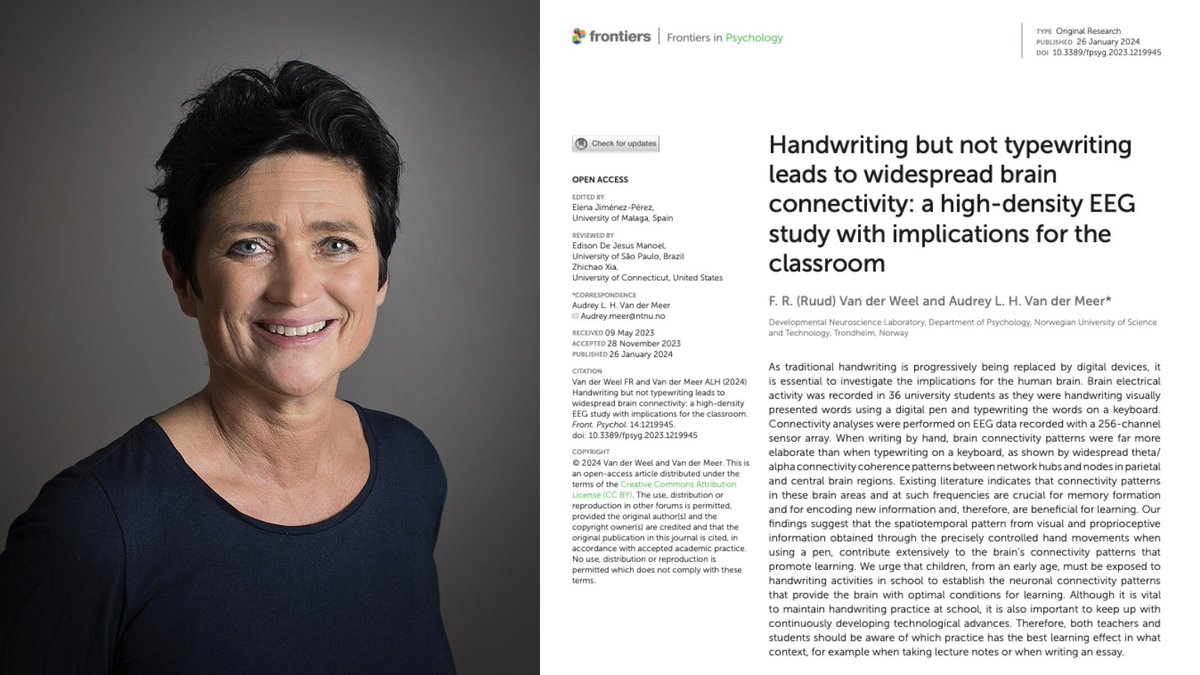
A Norwegian neuroscientist spent 20 years proving that the act of writing by hand changes the human brain in ways typing physically cannot, and almost nobody outside her field has read the paper.
Her name is Audrey van der Meer.
She runs a brain research lab in Trondheim, and the paper that closed the argument was published in 2024 in a journal called Frontiers in Psychology. The finding is brutal enough that it should have changed every classroom on Earth.
The experiment was simple. She recruited 36 university students and put each one in a cap with 256 sensors pressed against their scalp to record brain activity. Words flashed on a screen one at a time.
Sometimes the students wrote the word by hand on a touchscreen using a digital pen, and sometimes they typed the same word on a keyboard. Every neural response was recorded for the full five seconds the word stayed on screen.
Then her team looked at the part of the data most researchers had ignored for years, which is how different parts of the brain were communicating with each other during the task.
When the students wrote by hand, the brain lit up everywhere at once.
The regions responsible for memory, sensory integration, and the encoding of new information were all firing together in a coordinated pattern that spread across the entire cortex. The whole network was awake and connected.
When the same students typed the same word, that pattern collapsed almost completely.
Most of the brain went quiet, and the connections between regions that had been alive seconds earlier were nowhere to be found on the EEG.
Same word, same brain, same person, and two completely different neurological events.
The reason turned out to be something nobody had really paid attention to before her work. Writing by hand is not one motion but a sequence of thousands of tiny micro-movements coordinated with your eyes in real time, where each letter is a different shape that requires the brain to solve a slightly different spatial problem.
Your fingers, wrist, vision, and the parts of your brain that track position in space are all working together to produce one letter, then the next, then the next.
Typing throws all of that away. Every key on a keyboard requires the exact same finger motion regardless of which letter you are pressing, which means the brain has almost nothing to integrate and almost no problem to solve.
Van der Meer said it plainly in her interviews.
Pressing the same key with the same finger over and over does not stimulate the brain in any meaningful way, and she pointed out something that should scare every parent who handed their kid an iPad.
Children who learn to read and write on tablets often cannot tell letters like b and d apart, because they have never physically felt with their bodies what it takes to actually produce those letters on a page.
A decade before her, two researchers at Princeton ran the same fight using a completely different method and ended up at the same answer. Pam Mueller and Daniel Oppenheimer tested 327 students across three experiments, where half took notes on laptops with the internet disabled and half took notes by hand, before testing everyone on what they actually understood from the lectures they had watched.
The handwriting group won by a wide margin on every question that required real understanding rather than surface recall.
The reason was hiding in the transcripts of what the two groups had actually written down.
The laptop students typed almost word for word, capturing more total content but processing almost none of it as they went, while the handwriting students physically could not write fast enough to transcribe a lecture in real time, which forced them to listen carefully, decide what actually mattered, and put it in their own words on the page.
That single act of choosing what to keep was the learning itself, and the keyboard had quietly skipped the choosing and skipped the learning along with it.
Two studies. Two countries. Same answer.
Handwriting makes the brain work. Typing lets it coast.
Every note you have ever typed instead of written went into your brain through a thinner pipe. Every meeting, every book highlight, every idea you captured on your phone instead of on paper was processed at half depth.
You did not forget those things because your memory is bad. You forgot them because typing never woke the part of the brain that would have made them stick.
The fix is the thing your grandmother already knew.
Pick up a pen. Write the thing down. The slower road is the faster one.
The CBC "prank show" deception scandal is getting so much worse.
The producers (operating under fake identities/fake company names with fake websites) told a number of RCMP veterans - people who dedicated their lives to serving on the frontlines - that they were invited to film for a show called "Life After Service." A ceremony to thank them for their service would follow, and they were told dignitaries would be present. This would take place at the CBC Vancouver studio. They were told to come in uniform.
When the RCMP vets arrived at the CBC Vancouver studio on March 25th and 26th, the "pranksters" took their phones away, which they claimed was CBC Vancouver studio policy. The former RCMP officers were also placed in front of an audience of what they were told were about two dozen "journalists." And it was sprung on them that this was a "live broadcast", with "media availability" afterwards!
Then the producers switched up the whole session to be not about life after service, but the historical wrongs committed by the RCMP against indigenous peoples - to berate these vets for being part of the RCMP.
There is so much more but I am hoping the individuals targeted in this elaborate scheme will be able to share their stories themselves.
Seriously, what even sounds remotely funny or silly about this concept? It is just sick and cruel
@CBCNews and @APTNNews... what are you thinking?
@RaquelDancho New gas cars are currently trading above MSRP in BC specifically because manufacturers can’t sell enough EVa or buy enough EV credits to import more vehicles.
The result is more old gas cars staying on roads longer (more emissions than newer gas cars), and BC public losing $$.
While @websummit was again a well-oiled machine for technology and networking, Vancouver, BC, Canada has become a city of drug addicts and vagrants as far as the eye can see. The once booming and gorgeous metropolis has taken socialist policies to such an extreme that people now don't own the property they thought they did (ancestors of the native tribes do), where the average worker earns $60k Canadian (net $35k), while the homeless get $80k of value tax free with free needles, drugs (yes, drugs) and cell phones. Note that the public employees get ($100k) far more than the taxpayer who they work for. Human incentives are everything. They are backwards in BC.
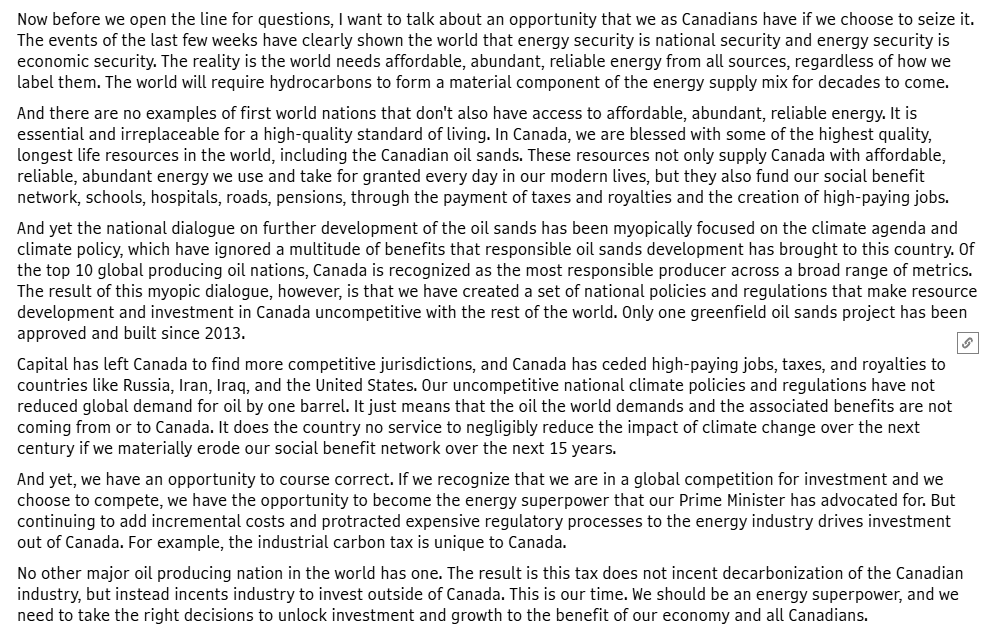
This is the bilingual CEO of TC Energy, a 🇨🇦 company that moves 30% of ALL natural gas within North America across 94,000 km of pipelines. He successfully chaired a 🇺🇸 gov’t study to streamline permitting. His analysis of Canada’s competitiveness?
“Canada has fallen behind… for too long capital has not felt welcome here… we’re competing with the world under a very different set of expectations…the US sanctioned $56 billion of LNG projects, Canada zero… we began construction 8 months after filing our permit (in Mexico)… their Plan 2030 seeks to attract investment of $300 billion."
While Carney dithers with his net zero nostalgia, 🇨🇦 is losing out.
Jon McKenzie, CEO of Cenovus, came out swinging on their Q1 conference call today. Great to see CEO's becoming more vocal about our squandered opportunity! To summarize: no other oil producing country is doing this to themselves...time for Canada to wake up!
You buy a German anvil. It contains 83 moving parts and requires winding twice a day. It's forged from excellent steel, holds tolerances across all three striking faces to within three microns, includes a beautifully indexed horn-adjustment mechanism nobody asked for, and requires a proprietary 11-point spanner should you need to replace the rebound calibration bushing. It runs flawlessly for years, but one day it starts up in limp mode because the onboard anvil-management system detects that it's overdue for its 50,000-strike inspection.
You search AliExpress for a Chinese anvil, and are presented with a multitude of offerings from such household-name brands as DUKXJYIBF, HDBTGMXI, AND UEJQIP. They're all priced to within a few pennies of each other, appear completely identical except for the nameplate, and obviously all came out of the same factory. You text your blacksmith friend to ask if they're legit. He tells you he got one like that from KIXJBU a few years ago, and that it's been great and a terrific deal. You thank him, but KIXJBU seems to have folded so you buy the one from UEJQIP. When it arrives, it feels suspiciously light. You scratch it and realize it's iron-plated aluminum.
You buy an American anvil. It's five times the price of the competition, but it comes from a brand that your great-grandfather used to love. It comes boxed with a warranty registration postcard, twenty pages of safety instructions, assay certificate, and a regulatory slip which lists its FCC certification and ITAR registration. It looks just like your friend's KIXJBU. There's a "Made In China" sticker on the bottom.
You buy a Russian anvil. It arrives coated in cosmoline, wrapped in newspaper from 1974, and weighing 40% more than advertised. The finish looks like it was machined with a shovel. The face is not flat, but somehow this does not matter. You drop it off a truck, accidentally leave it outside for six winters, and use it to straighten a bulldozer blade. It's fine.
You buy a Swedish anvil. It comes flat-packed in a long cardboard box with cheerful Neo-Grotesk lettering and a line drawing of a smiling man assembling it with an Allen key. The instructions contain no words, only pictograms showing the anvil face, horn, waist, feet, and 112 identical-looking fasteners. Halfway through assembly, you discover that the pritchel hole was installed upside down, but only because you used peg B17 where you should have used peg B71. Once assembled, it is clean, stable, and works better than it has any right to. You immediately wonder whether you should have bought two.
You buy a Japanese anvil. It arrives wrapped in rice paper inside a paulownia box, accompanied by a certificate bearing three generations of signatures and a photograph of the first production example being presented to the Emperor. The face has been hand-polished by a seventy-eight-year-old master whose family has made striking surfaces since the Muromachi period. You are given detailed instructions for oiling it with a cloth folded in a specific way. It is the most beautiful object you own. You never quite work up the nerve to strike it.
I put these clips together to highlight what’s taken place in just over a week since the Liberals have had the majority at committee.
Questions not being answered & meetings being put in-camera (meaning cameras are shut off from the public & media)
Does this seem like something a Government should be doing? Hiding information from the public? How are we to trust a single thing this Government is doing? We can’t.
I’m an eternal optimist and will always want to highlight good progress.
But the more I sit with yesterday’s economic update, the more concerned I get.
1. This government is falling into the trap of focusing on messaging and optics over outcomes. Claiming the new investment fund is a Sovereign Wealth Fund when it’s clearly not is a prime example.
2. There’s a concerning approach to shifting numbers to make our financial position look better than it is.
Most Canadians will miss this, but this government has adopted an approach of presenting figures that show on all-government net debt-to-GDP ratio is at just 10.2 percent while in reality it sits at 75 percent of GDP. The 10.2% figure only works when the assets held by the Canada Pension Plan and Quebec Pension Plan are subtracted…. funds that appear on no government balance sheet and are not available to any level of government to pay off their debts.
3. Spending is still out of control and is leading to rapidly growing interest payments. Our debt is growing so quickly that interest on debt is now the fastest-growing government program, expected to cost more than $80B in four years.
4. There is still no action on the well known, fundamental ways to boost productivity: capital gains and corporate tax reform; aggressive red tape reduction; and bold opening of protected sectors to competition.
Without these reforms, Canada is cooked. Our productivity will continue to slide regardless of the other efforts we make, no matter how well-intentioned.
“I’ve never seen this level on ineptitude and incompetence.”
Former legal council for the BC Attorney generals office who’s been advising government on First Nations law for more than 30 years can’t believe what he’s seeing.
Food for thought.
Chevron’s move into Venezuela says more about the new world than any communiqué from Ottawa. What Canada needs now is concrete deals and shovels in the ground at home, not another performative boondoggle dressed up as an investor summit.
In recent weeks, as war and great‑power tension have snapped energy security back to the top of the agenda, Chevron has signed a deal to pour fresh capital into Venezuela’s Orinoco Belt. It is increasing its stake in a major joint venture and securing new drilling rights in one of the world’s dirtiest heavy‑oil basins, because Gulf Coast refineries need those barrels now. That is how capital behaves when energy security, not climate targets, is the first priority.
Against that backdrop, Prime Minister Mark Carney will host 100 of the world’s biggest investors in Toronto this September, pitching Canada as a safe, green home for their trillions. It is an odd spectacle for a country that has spent a decade in an investment drought. Business spending has lagged peers, capital per worker has slipped, and Canadian firms and pension funds have put more money abroad than at home. Trillions have passed through Canadian hands. Too little has stayed.
The core irony is that the problem is not the barrel. It is the politics wrapped around it. Canadian heavy crude is already cleaner and more tightly regulated than Venezuelan heavy. Alberta producers operate under carbon pricing, methane rules and environmental standards that Venezuela does not match. If the world is going to burn heavy oil for decades yet, it is rational to prefer more Canadian barrels and fewer Venezuelan ones. Yet the fresh capital is going to Caracas, not Calgary.
Canada has turned its advantage into a liability. Ambitious climate policy has often been implemented in a way that feels performative to investors: ever‑shifting rules, sprawling reviews, talk of hard caps and now an emerging expectation that large‑scale carbon capture is a de facto requirement for future growth. Each measure can be defended on its own terms. Taken together, they signal a jurisdiction where politics moves faster than permits and long‑term projects are continually reopened.
Pipelines crystallize the issue. For a decade, Canadian leaders have talked about “economic sovereignty” and reducing dependence on the U.S. market. The minimum requirement is obvious: east–west pipelines to tidewater so Canadian oil can reach Europe and Asia. Instead, major projects have been cancelled or delayed, and the only large expansion has required a federal rescue and long overruns. The most reliable route to tidewater for Canadian barrels still runs south, through American pipes and American politics.
The environmental outcome is as perverse as the economic one. By making it harder and riskier to invest in relatively cleaner Canadian heavy, Canada constrains supply that could displace higher‑emissions barrels from places like Venezuela. Demand does not disappear; it shifts to producers with weaker standards. On paper, slower growth in domestic output and higher carbon prices can be presented as climate progress. In practice, what matters is which barrels actually get burned.
What Canada needs now is not another stage‑managed gathering in Toronto, but bankable projects, clear approvals and real deals on Canadian soil. The world has changed; energy security is back at the top of the hierarchy. Canada, sitting on cleaner crude in a dirtier world, needs to wake up and act like it.
https://t.co/weWdlKsECE
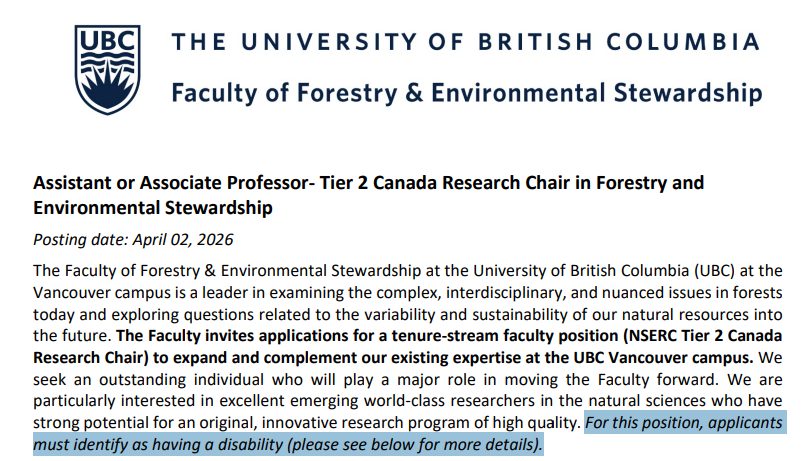
The University of British Columbia (@UBC) just posted a job for a tenured professor of Forestry.
There were 6,125 wildfires across Canada during 2025, with 21,782,339 acres burned.
Salary: $120k-$150k
"For this position, applicants must identify as having a disability."
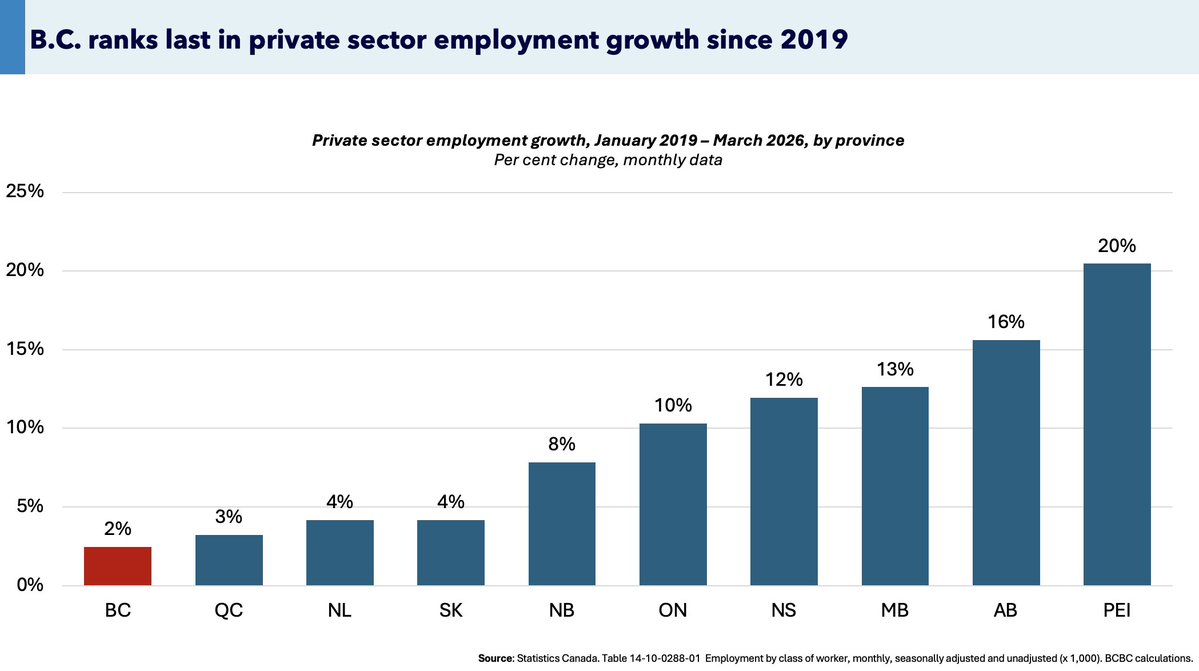
BC ranks dead last amongst all provinces for private sector job growth since 2019. Now add record deficits, and credit downgrades and you have the NDP playbook.