Profesional account with personal opinions. Tweets in spanish, catalan, english and french about HR, Business & Digital Transformation.RT is not an endorsement
We are Worldline
. European leader in payments and secured transactions
. Worldwide #4 in payment services
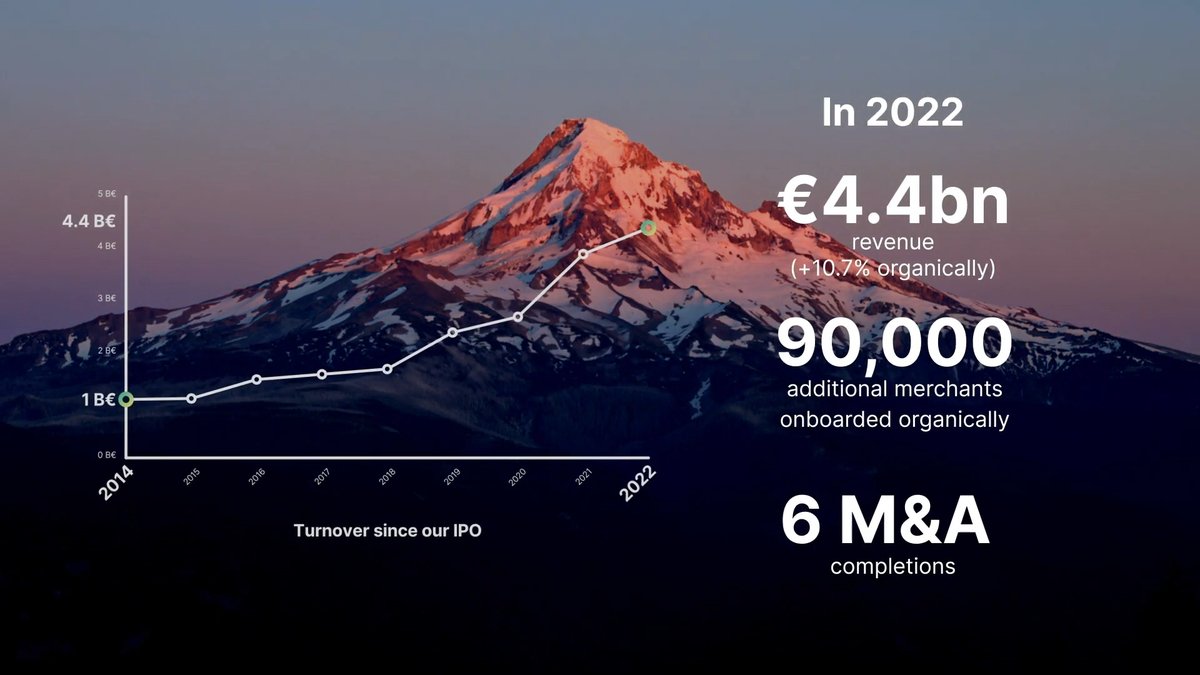
. €4.4bn Revenue in 2022, from €1bn€ since Worldline IPO Oct14 (+440% )
https://t.co/GL4ORTWWTP
https://t.co/n1ChTD1ZiO
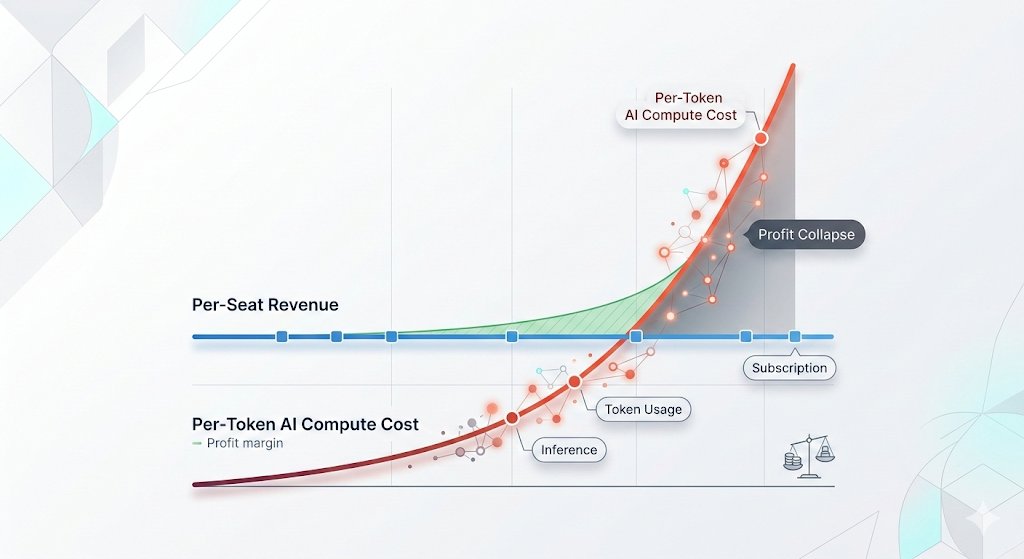
🦔Microsoft canceled its internal Claude Code licenses this week after token-based billing made the cost untenable, even for a company with effectively infinite cloud resources. Uber's CTO sent an internal memo warning the company burned through its entire 2026 AI budget in just four months. American AI software prices have jumped 20% to 37%, and GitHub (owned by Microsoft) is dropping flat-rate plans for usage-based billing across its products.
My Take
The AI subsidy era is ending in real time. The same company that put $13 billion into OpenAI and built the Azure infrastructure powering most of Anthropic's compute just looked at the bill from a competitor's coding tool and decided it was not worth paying. That is not a productivity failure on Anthropic's end. Token-based pricing is forcing every enterprise customer to confront the actual cost of running these models at scale, and the number turns out to be far higher than the flat-rate experiments suggested.
This ties directly to my Gemini Flash post yesterday. Anthropic, OpenAI, and Google all raised effective prices in the last six months. Enterprises that built workflows assuming AI costs would keep falling are now watching annual budgets evaporate in months. Two outcomes look likely from here. Either enterprises scale back AI usage to fit budgets, which slows the revenue ramp the labs need to justify their valuations ahead of IPOs, or the labs cut prices and absorb the losses, which makes the unit economics worse at exactly the wrong moment. Both paths land in the same place, the numbers stop working, and somebody has to take the writedown.
Hedgie🤗
I needed to book flights for a bunch of upcoming travel. As always, I used Claude Cowork to do it.
In the past, Cowork has been decent at booking flights, but with Opus 4.7, for the first time ever, it 1-shotted it!
The UK AISI found Mythos Preview is the first model to solve both their cyber ranges end-to-end. No model had ever solved the AISI’s “Cooling Tower” cyber range before.
We're getting it to defenders as fast as we responsibly can. More to come on our Glasswing work soon.
A lot of people have been wondering about Mythos, Glasswing, and the vulns we / our partners are fixing. Today, I’m excited for us to start sharing more. (For context, I lead Glasswing @AnthropicAI.)
Two independent evaluations this week—from XBOW and the UK AISI—confirm what we've been seeing internally: Claude Mythos Preview is a step change in autonomous cybersecurity capabilities. We need to start preparing fast for a world of models with this level of capabilities.
The UK AI Security Institute tested the model we shipped at the launch of Project Glasswing and found Mythos Preview is the first model to solve both of their end-to-end cyber ranges, including one (Cooling Tower) which no model had ever cleared. But attackers (and defenders) have sophistication & cost constraints – Mythos is also the only model that clears every one of their tasks estimated over 8 hours under their deliberately low 2.5M-token cap.
XBOW tested it on their offensive security benchmarks, finding "token-for-token, unprecedented precision." It's the only model to succeed at subtle V8 sandbox work.
Other Glasswing partners shared similar stories. In a few weeks of testing, Mythos Preview has helped them find many thousands of (estimated) high + critical severity vulnerabilities, sometimes double what they'd normally find in a year.
I don't share this to boost Mythos. In fact, this is not about Mythos. It’s about preparing for the coming world of models being better, faster, cheaper, and more creative than some of the best human experts at dual use capabilities. Clearly, we need them supporting defenders as widely as can be done safely – and especially the least resourced ones.
Within a year, Mythos will probably look quite dumb (relative to other new models). And others may release openly available or unguardrailed models of Mythos-level capabilities.
We started Project Glasswing because capabilities like Mythos Preview's won't stay rare, or stay in careful hands. We are bringing it to defenders as fast as we responsibly can, while working to figure out, for example, the right safeguards and patching & disclosure processes.
Also, to be clear, compute has never been a limiter in our rollout.
Expect a fuller update on our Glasswing work in the coming days.
XBOW report: https://t.co/Mumtbf3kE3
UK AISI report: https://t.co/vBgqz0AeKJ
LARENTA .es es ahora open source.
Una webapp con Astro 6, React 19 y Tailwind v4. SSG en Vercel, OG dinámicas con Satori, informes en PDF.
Si te interesa contribuir datos o código:
→ https://t.co/p6uUaqMd6U
Y de antemano, GRACIAS ☺️
Students who took notes by hand scored ~28% higher on conceptual questions than laptop note-takers.
Writing forces your brain to process and compress ideas instead of copying them.
For those unaware, SpaceX has already shifted focus to building a self-growing city on the Moon, as we can potentially achieve that in less than 10 years, whereas Mars would take 20+ years.
The mission of SpaceX remains the same: extend consciousness and life as we know it to the stars.
It is only possible to travel to Mars when the planets align every 26 months (six month trip time), whereas we can launch to the Moon every 10 days (2 day trip time). This means we can iterate much faster to complete a Moon city than a Mars city.
That said, SpaceX will also strive to build a Mars city and begin doing so in about 5 to 7 years, but the overriding priority is securing the future of civilization and the Moon is faster.
Jensen Huang just BROKE the most important rule in the industry.
And it explains why Nvidia controls 95% of the AI chip market.
Last night at CES, he unveiled Vera Rubin - the new AI supercomputer that's shipping right now.
Full production started weeks ago.
But here's the part that made every semiconductor engineer in the room go crazy:
Reuben GPU is 5x faster than Blackwell.
But only has 1.6x the transistors.
That should be physically impossible.
Moore's Law says you get maybe 25% more performance per transistor generation.
Jensen just delivered 300%.
How?
He BROKE the most sacred rule in chip design.
The rule every company follows: "Never redesign more than 1-2 chips per generation."
Nvidia redesigned all six chips simultaneously.
Vera CPU. Reuben GPU. Connect X9 networking. Bluefield 4 DPU. MVLink switches. Spectrum X Ethernet.
Every. Single. Component.
From scratch.
He calls it "extreme co-design."
The industry calls it insane.
One rack now moves 240 terabytes per second.
That's TWICE the entire global internet bandwidth.
In a single rack.
And it runs on 45°C water - no chillers needed.
Which saves 6% of global data center power.
But the real story isn't the hardware...
It's what they're doing with it.
Nvidia just open-sourced Alpha Mayo.
The world's first reasoning autonomous vehicle AI.
Mercedes-Benz CLA launches with it in Q1. Europe Q2. Asia by year-end.
Not a concept car. Not a limited release.
Full production vehicles.
And the AI will even explain its reasoning out loud.
"I'm slowing down because the truck ahead is braking and there's a cyclist merging."
It thinks. Then tells you what it's thinking. Then executes.
Jensen drove it through San Francisco for an hour yesterday.
No hands. No interventions.
Through heavy Sunday traffic.
The whole thing is open source now.
Every line of training code. Every data source. The entire stack.
But why would Nvidia give this away?
Because they learned something from the last year:
Open models activated the entire world.
DeepSeek R1 proved open source can hit the frontier.
Downloads exploded. Every country, every startup, every researcher can now build AI.
And they all need Nvidia hardware to train it.
That's the strategy.
Give away the recipes. Sell the kitchen.
The partnerships tell you where this is going:
Siemens is integrating Nvidia into every industrial design tool.
Cadence and Synopsys are rebuilding chip design around Nvidia.
Palantir, ServiceNow, Snowflake - their entire platforms now run on Nvidia's agentic AI stack.
This isn't just selling chips anymore.
Nvidia is rebuilding the entire computing stack.
From design to manufacturing to deployment.
Every layer of the trillion-dollar AI infrastructure buildout runs through them.
And now they're 18 months ahead of everyone else.
Again.
The competition is still trying to match Blackwell.
Nvidia's already shipping the thing that makes Blackwell look slow.
What do you think - is anyone catching them?
The only company capable of this might be Google.
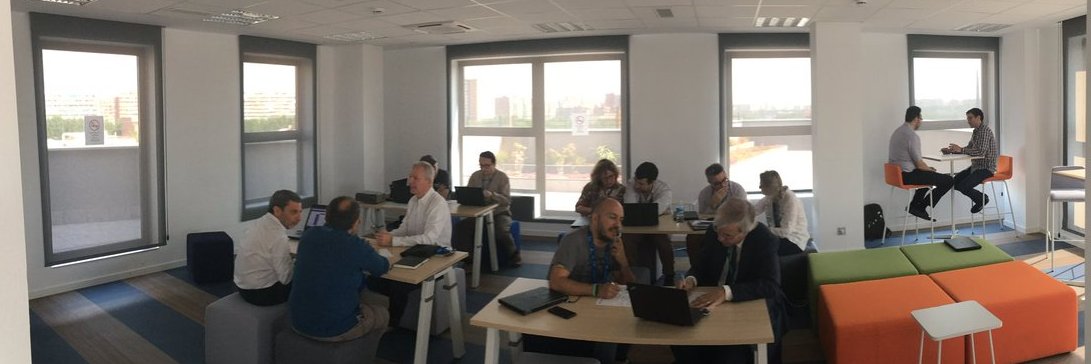
In just 10 days, the first edition of the #WorldlineTeX 2025 kick offs in Zaragoza!
The occasion for our local #tech communities to network, share insights, and tackle the latest Tech Trends!
Stay tuned for more! #TechAtWorldline
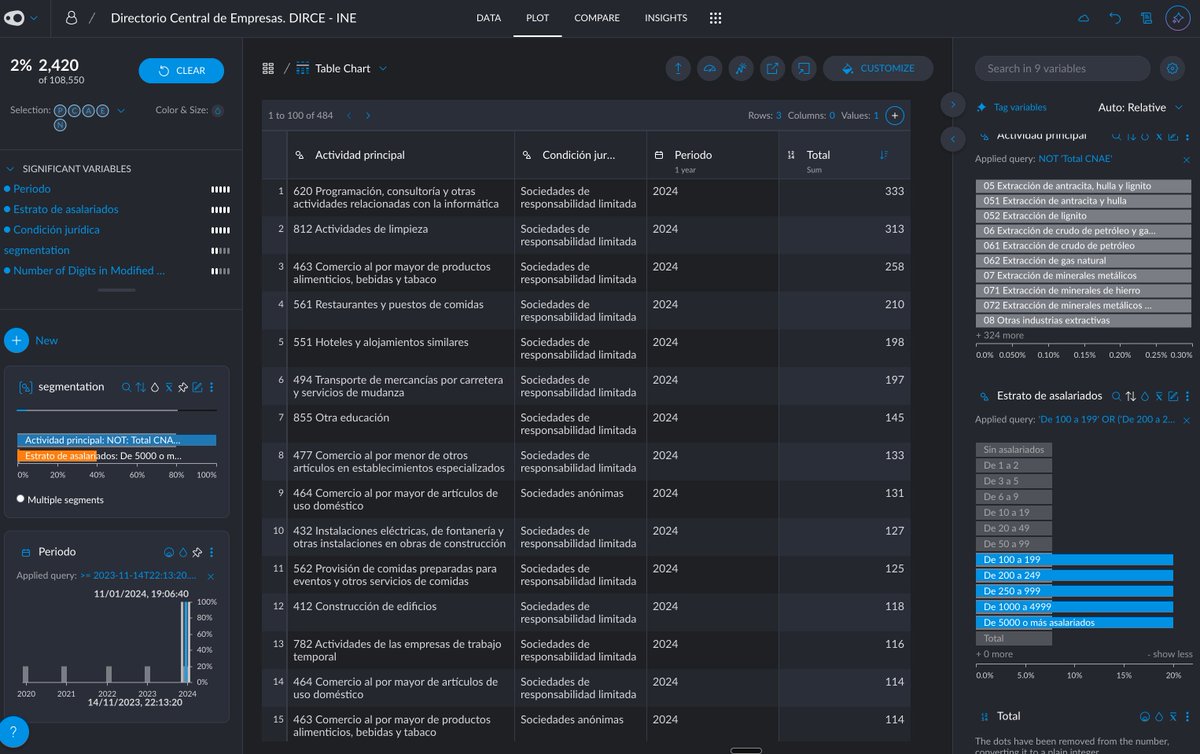
Aquí la distribución de tamaño de empresas IT - Programación, consultoría y otras actividades relacionadas con la informática. Que a su vez es una clasificación muy heterogénea (habrá programadores, startups, empresas que arreglan ordenadores...)
Hay unos 22K autónomos en España en el sector IT.
En España tenemos históricamente (comparado con el resto de países de primera división) demasiados autónomos y PYMEs pequeñas, que difícilmente pueden generar empleo de calidad con buenos márgenes y ser competitivas.
Pues mirando datos del INE de 2024, cuando filtramos empresas de más de 100 empleados, se ve cómo ya el sector más grande ahí son las empresas de informática! Ganan a las hoteleras, de limpieza o restauración por ejemplo.
Además como se ven en las tablas es algo nuevo y que crece rápido. En 2020 había 208 empresas de IT grandes, y era el 6º sector y ahora en 2025 ya hay 333 y es el primer sector en empresa de más de 100 empleados!
Datos del INE analizados con @graphext
La inteligencia artificial (#IA) es tan inteligente como el corpus documental con el que se entrena.
🔴 Pero si las sentencias de los tribunales —que según la ley son públicas— no están publicadas porque el CENDOJ del CGPJ prefiere comercializarlas, la IA jurídica entrenada con las sentencias será el oligopolio del puñado de empresas que puedan pagarlas.
🔴 Pero si las cuentas anuales de las empresas —que según la ley deben recibir publicidad— no están publicadas porque los Registradores y el Ministerio de Justicia prefieren venderlas, entonces no habrá IA mercantil capaz de encontrar corruptelas.
🔴 Pero si los gobiernos no publican todos sus informes y contratos —que según la ley deben ser transparentes—, entonces no habrá IA administrativa que proponga optimizaciones en las compras públicas.
En definitiva, la IA no hace magia: aprende de los datos existentes.
Pero si quienes más y mejores datos públicos tienen —las instituciones— no los publican, entonces seguiremos en la oscuridad.
In 2014, Elon "gave away" Tesla's secrets to BWM.
Everyone thought he was crazy.
But this "act of charity" was actually the most ruthless business move in corporate history.
Here's why BMW never saw it coming: 🧵
"Necesitamos más programas universitarios y dotar de más tecnología la mayoría de carreras"
Ana Freire, vicedegana de mpacto social e innovación académica de la @UPFBarcelona#AIBigData24
This weekend, the @xAI team brought our Colossus 100k H100 training cluster online. From start to finish, it was done in 122 days.
Colossus is the most powerful AI training system in the world. Moreover, it will double in size to 200k (50k H200s) in a few months.
Excellent work by the team, Nvidia and our many partners/suppliers.