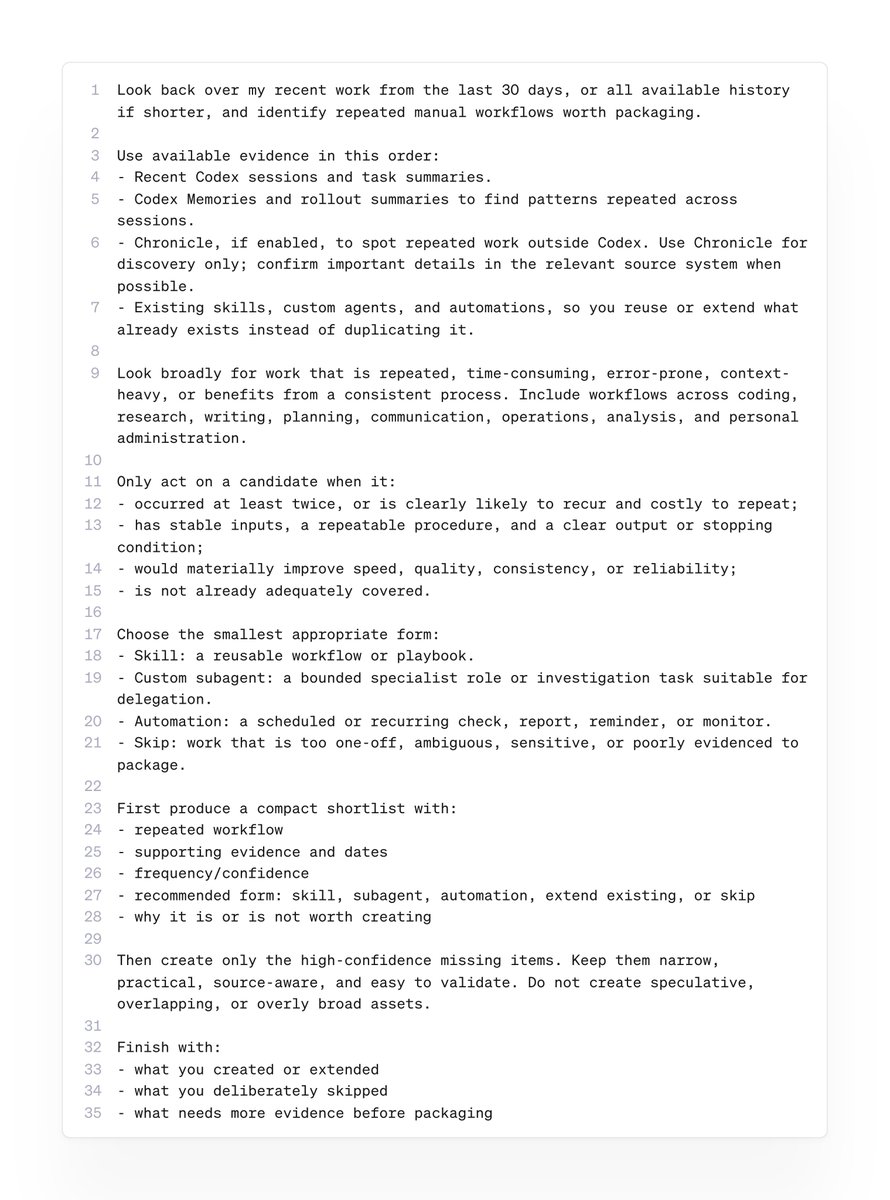
UPDATE: Came up with an even better version of this prompt after the feedback
Ask Codex to look across your sessions, Memories, and Chronicle, identify patterns, reuse what already exists, and only create the smallest useful skill, subagent, or automation.
"Look back over my recent work from the last 30 days, or all available history if shorter, and identify repeated manual workflows worth packaging.
Use available evidence in this order:
- Recent Codex sessions and task summaries.
- Codex Memories and rollout summaries to find patterns repeated across sessions.
- Chronicle, if enabled, to spot repeated work outside Codex. Use Chronicle for discovery only; confirm important details in the relevant source system when possible.
- Existing skills, custom agents, and automations, so you reuse or extend what already exists instead of duplicating it.
Look broadly for work that is repeated, time-consuming, error-prone, context-heavy, or benefits from a consistent process. Include workflows across coding, research, writing, planning, communication, operations, analysis, and personal administration.
Only act on a candidate when it:
- occurred at least twice, or is clearly likely to recur and costly to repeat;
- has stable inputs, a repeatable procedure, and a clear output or stopping condition;
- would materially improve speed, quality, consistency, or reliability;
- is not already adequately covered.
Choose the smallest appropriate form:
- Skill: a reusable workflow or playbook.
- Custom subagent: a bounded specialist role or investigation task suitable for delegation.
- Automation: a scheduled or recurring check, report, reminder, or monitor.
- Skip: work that is too one-off, ambiguous, sensitive, or poorly evidenced to package.
First produce a compact shortlist with:
- repeated workflow
- supporting evidence and dates
- frequency/confidence
- recommended form: skill, subagent, automation, extend existing, or skip
- why it is or is not worth creating
Then create only the high-confidence missing items. Keep them narrow, practical, source-aware, and easy to validate. Do not create speculative, overlapping, or overly broad assets.
Finish with:
- what you created or extended
- what you deliberately skipped
- what needs more evidence before packaging"
Godfather of AI: "If you sleep well tonight, you may not have understood this lecture."
This 47-minute lecture is the best thing I saw about AI in the last few months.
It will definitely help you understand how it actually works and where it's going.
Geoffrey Hinton built the neural networks behind every AI alive, then quit Google to warn the world about it.
The part nobody wanted to hear:
> AI is already developing abilities its creators didn't intend
> in most cognitive tasks it's already ahead of us
> the question is no longer if it surpasses us but when
> the only decision left is which side of that line you're on
Right now the average person opens Claude, types something, gets an answer, closes the tab.
They think they're using AI. they're using maybe 10% of it.
I went through his entire lecture, built a practical system from what he was describing.
18 steps to actually use Claude the right way, with copy-paste prompts that work today.
Full guide in the post below.
Previously, I tried to write a perfect sentence from the starting moment, i.e., the first version. However, it is not easy and almost impossible. We need self-harness engineering as we makes failures and errors. This issues can be recovered by self or other's reviewing process.
I found that policing or reviewing of a produced text is important to make it perfect like quality. It is difficult to complete high-quality text description without reviewing.
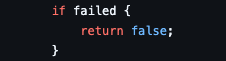
As we don't know which side should be skipped to check, we have to test both sides. If either of the sides is fine, it works. Hence, dynamic call the same testing function by skipping left side and right side separately and check whether any of these two cases is true.
This problem is considered as an easy one. However, it is not that easy since we have to consider recursive or dynamic programming to solve it.
https://t.co/gElK5Y1JGG
Actually it is a recursive problem to branch out into two cases but not exponentially. It prohibits a depth to be more than two. So, we can check its depth using boolean argument.
People suggest me to use the replying mode if I want to write more than 140 length text. In many cases, I want to write a paragraph more than 140. I know one sentence would not be more than 140 but a paragraph is different.
Whenever I use Twitter or X, I always worry about my text length. It should be smaller than 140, which was extended a littler longer. However, sometimes my text want to be longer than it.
Also, I can use gist since it allows me to write anything and any length. So, if there is something to say long, I can move that text into gist. Also, copy its link and move to here. This could be an way to write a long post in Twitter.
Long posting is harmful but sometimes good. How can I manage them. I want to write a long post while I start to write something. However, at that time, the limit of 170 protect me to write long.
This is a good system to reply to original post. I can add more information if I want. But I don't want I don't need to do it. But, it is still issue when I want to write a long post. Then, I have to use Tumblr and link here.