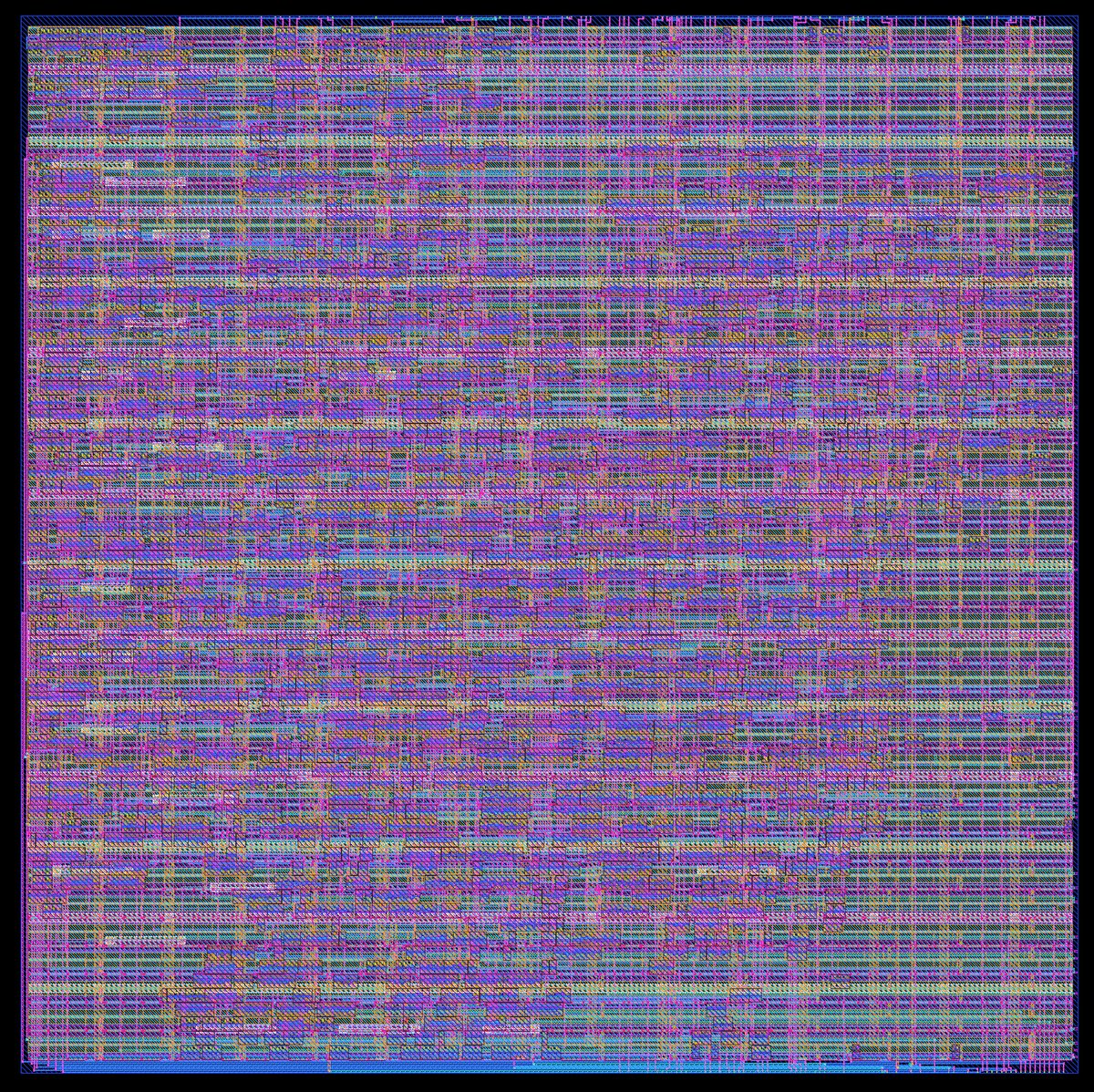
I spent the last six months trying to deconstruct Taalas's patents. We think it can be better: 100x fewer memfetches than their bitROM, better software by better quantization than their hardware team could.
So we wrote a compiler that:
> takes a huggingface checkpoint,
> quantizes the model
> descends the weights down metal layers to RTL and GDS, do your DRC, Yosys, PEX, make the electrical waveform execute a mat-vec from your huggingface checkpoint (thanks Cambricon tech papers)
in ~7000 lines of human-readable code.
we're looking for someone with contacts with a foundry/access to 7nm PDKs or contacts at a cheap EuroPTW shuttle? I'm broke and unemployed.
@itsclivetime this is what i think is the future of perplexity per picojoule. @zerohedge@zephyr_z9 you guys wanna see 40,000 tokens/sec?
Andrej Karpathy just made one of the most interesting arguments about AI model design that most people are completely missing.
His take is that frontier AI models are not too big because the technology is complex and too big because the training data is garbage.
When you or I think of the internet, we picture Wall Street Journal articles, Wikipedia entries, serious writing.
That is not what a pretraining dataset looks like.
When researchers at frontier labs look at random documents from the actual training corpus, it is stock ticker symbols, broken HTML, spam, gibberish.
One estimate puts Llama 3's information compression at just 0.07 bits per token meaning the model has only a hazy recollection of most of what it trained on.
So we build trillion parameter models not because we need a trillion parameter brain but because we need a trillion-parameter compression engine to squeeze some intelligence out of a firehose of noise.
Most of those parameters are doing memory work, not cognitive work.
Karpathy's prediction is separate the two entirely.
Build a cognitive core, a model that contains only the algorithms for reasoning and problem-solving, stripped of encyclopedic memorization and pair it with external memory that it can query when it needs facts.
He thinks a cognitive core trained on high-quality data could hit genuine intelligence at around one billion parameters.
For reference, today's flagship models run between 200 billion and 1.8 trillion parameters with most of that weight dedicated to remembering the internet's slop.
The trend is already moving his direction. GPT-4o operates at roughly 200 billion parameters and outperforms the original 1.8 trillion-parameter GPT-4.
Inference costs for GPT-3.5-level performance dropped 280-fold between 2022 and 2024 driven almost entirely by smaller, cleaner, better-architected models.
The real bottleneck in AI right now is not compute but rather data quality.
참고하실만한 MCP, Skill 및 CLI 소개
1. One CLI of Google Workspace
https://t.co/KO6GWqQH8t
2. Google MCP Servers
https://t.co/gOVwz1dUkD
3. Microsoft Ops Gadget
https://t.co/SQELR3o5dH
4. UI UX Pro Max
https://t.co/5GYrCvZCPm
5. oh-my-openagent
https://t.co/qX7XgVXdHB
Running 24/7 without any human babysitters has been really hard
We want robots operating at all times - even at 2am, on weekends, or on Christmas Day
The robots run until their battery is low. When one heads to dock for recharging, a second robot receives a message to leave the dock and make room for the incoming robot. The first robot then autonomously docks. By the time the first robot is charging, the second is already back to work
We never want downtime. If a robot has an issue, it goes to a triage area to dock while a replacement robot swaps in from another area. This could be due to a hardware or software issue
The robots dock onto a wireless inductive charger built into their feet. They step onto a pad that charges them via coils in their feet at up to 2 kW. It takes about an hour to fully charge at roughly a 1C rate
We’re now up and running across many different use cases like this. Crazy to see it
This is counterintuitive for some, which is why there’s a paradox named after it. But if you lower the cost of something that was previously supply constrained, demand for that thing goes up. Software engineering is just one of the easiest examples to contemplate.
The process goes like this: every small business, every IT team, every large enterprise sees that engineering can now drive vastly more output. They then start to consider all the new things they can build or automate. They even test building prototypes themselves.
They only get so far with that approach because they realize there are still 50 other tasks that go into building software and maintaining it. So they start to hire more engineers to do that work. All of this for work they never would have considered automating or having software for if AI didn’t exist.
So yes, automating tasks, in plenty of fields, will lead to demand for experts, not less.
Between Gemini 3.1 and Claude 4.6 it's honestly wild what you can build. This feels like Google Earth and Palantir had a baby.
Made this with all the geospatial bells and whistles -- real time plane & satellite tracking, real traffic cams in Austin, and even got a traffic system working. Panoptic detection on everything.
Skinned the whole thing to look like a classified intelligence system. EO, FLIR, CRT. Got a bunch more stuff on the roadmap. This is fun.
When I created Claude Code as a side project back in September 2024, I had no idea it would grow to be what it is today. It is humbling to see how Claude Code has become a core dev tool for so many engineers, how enthusiastic the community is, and how people are using it for all sorts of things from coding, to devops, to research, to non-technical use cases. This technology is alien and magical, and it makes it so much easier for people to build and create. Increasingly, code is no longer the bottleneck.
A year ago, Claude struggled to generate bash commands without escaping issues. It worked for seconds or minutes at a time. We saw early signs that it may become broadly useful for coding one day.
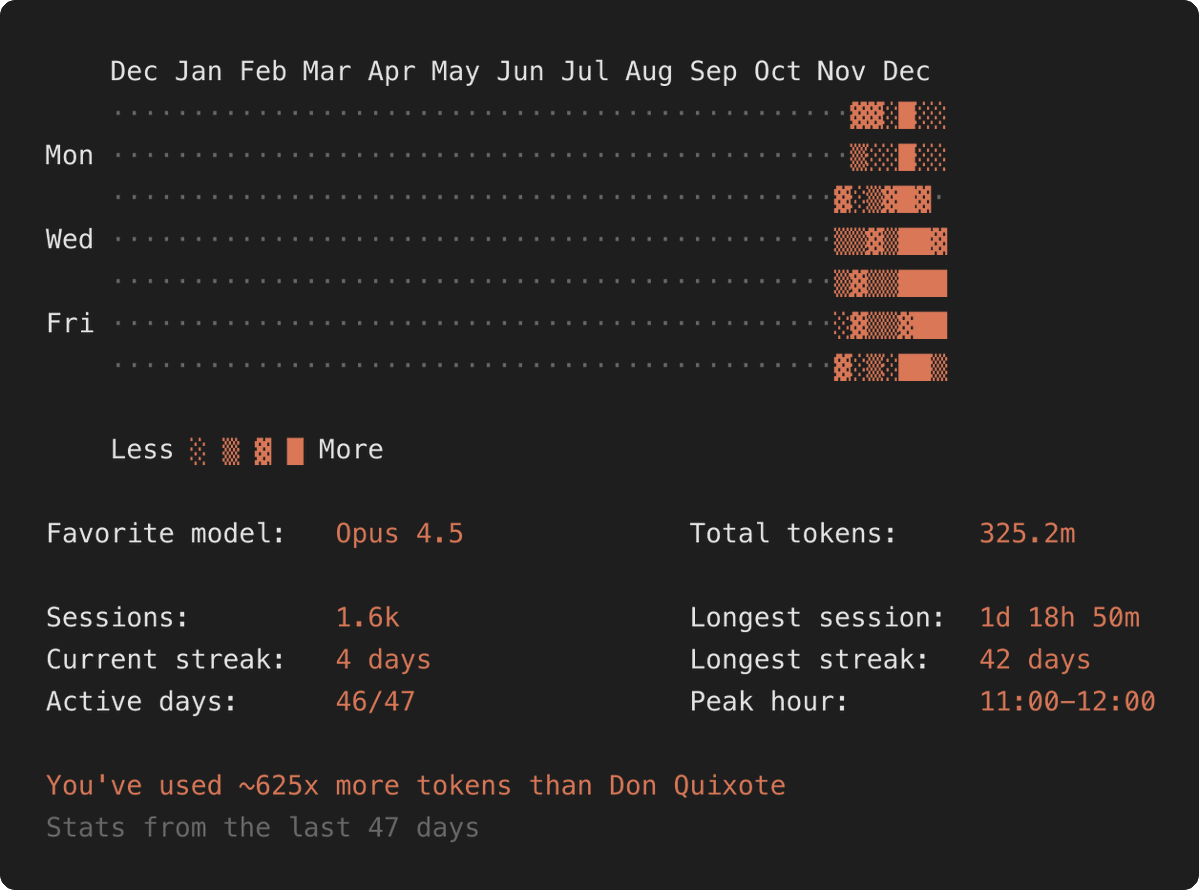
Fast forward to today. In the last thirty days, I landed 259 PRs -- 497 commits, 40k lines added, 38k lines removed. Every single line was written by Claude Code + Opus 4.5. Claude consistently runs for minutes, hours, and days at a time (using Stop hooks). Software engineering is changing, and we are entering a new period in coding history. And we're still just getting started..
I've never felt this much behind as a programmer. The profession is being dramatically refactored as the bits contributed by the programmer are increasingly sparse and between. I have a sense that I could be 10X more powerful if I just properly string together what has become available over the last ~year and a failure to claim the boost feels decidedly like skill issue. There's a new programmable layer of abstraction to master (in addition to the usual layers below) involving agents, subagents, their prompts, contexts, memory, modes, permissions, tools, plugins, skills, hooks, MCP, LSP, slash commands, workflows, IDE integrations, and a need to build an all-encompassing mental model for strengths and pitfalls of fundamentally stochastic, fallible, unintelligible and changing entities suddenly intermingled with what used to be good old fashioned engineering. Clearly some powerful alien tool was handed around except it comes with no manual and everyone has to figure out how to hold it and operate it, while the resulting magnitude 9 earthquake is rocking the profession. Roll up your sleeves to not fall behind.
Before the rise of AI,
DX was primarily about what to change through digital technology. However, it is now shifting toward the question of who to change.
“Including myself”
Today OpenAI announced o3, its next-gen reasoning model. We've worked with OpenAI to test it on ARC-AGI, and we believe it represents a significant breakthrough in getting AI to adapt to novel tasks.
It scores 75.7% on the semi-private eval in low-compute mode (for $20 per task in compute ) and 87.5% in high-compute mode (thousands of $ per task). It's very expensive, but it's not just brute -- these capabilities are new territory and they demand serious scientific attention.
코비드19 걸린 분이 혈전 생길 확률 15%, AZ백신 맞고 혈전 생길 확률 0.0004%. 올해 코비드19에 걸릴 확률은 700명/일x365일/5,000만명=0.511%이고 15%가 코비드19로 인해 혈전 발생하니 0.07665%이다. 쉽게 말해 접종 안하면 코로나로 혈전이 생길 가능성이 대략 200배쯤 된다. 뭐가 더 위험할까?
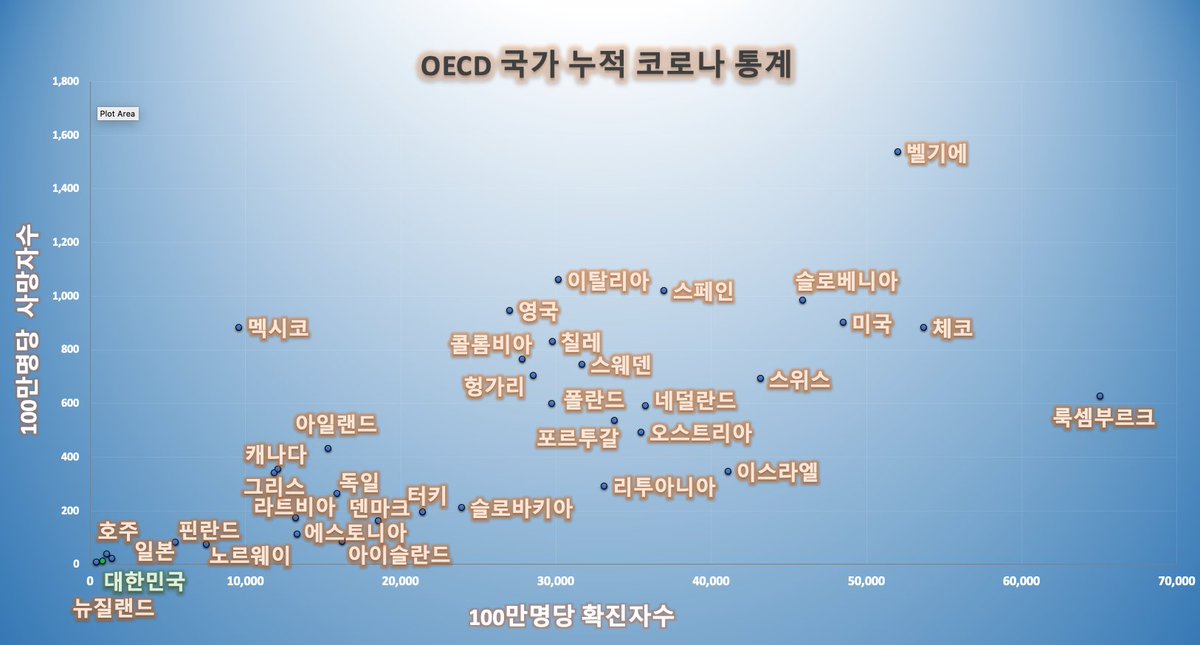
거리두기가 3단계로 격상되더라도 희망을 잃지 말자. 한국은 OECD국가 중 인구 밀도가 가장 높으나 현재까지 1인당 확진과 사망수는 두 번째로 낮다. OECD 평균을 적용하면 한국은 130만 확진와 25,560 사망을 경험했을 것으로 예상된다. 즉, 2만5천 명에 달하는 목숨을 구했고 50배나 확진를 피했다.