Hi Friends, I’ve put together a recap of Albert Yip’s technical session at OpenAI DevDay 2026 Seoul last week. From OpenAI dots and Specialist dots to the Decisions API and Agents API, I was impressed by how AI makes decisions and carries out work. For enterprise adoption, it’s important to define which tasks to delegate, what access to grant, and when human approval is required. Which repetitive tasks on your team could you hand over to ChatGPT?
https://t.co/0qPpPLXhUO
#OpenAI #DevDay #AIAgents #WorkflowAutomation #ChatGPT
Want to learn GPU programming but don't have a GPU?
Grokking GPU Programming by SungHwan Yun teaches you CUDA from scratch, with clear examples and a free browser-based sandbox to practice your code. No hardware required.
Learn more: https://t.co/Qg6eAYmJ1N
OpenSource-Ai-Glasses
AI glasses you can customize at the system level
This standalone platform runs embedded Linux and provides a C/C++ SDK for accessing hardware and building your own applications.
It supports 1080P recording, live RTSP video streaming and an optional monocular display. An Android client lets you connect, manage and debug the glasses.
After setup, hold the left temple button to speak, then release it to send your request and wait for the AI response.
https://t.co/PoBYhLWkWa
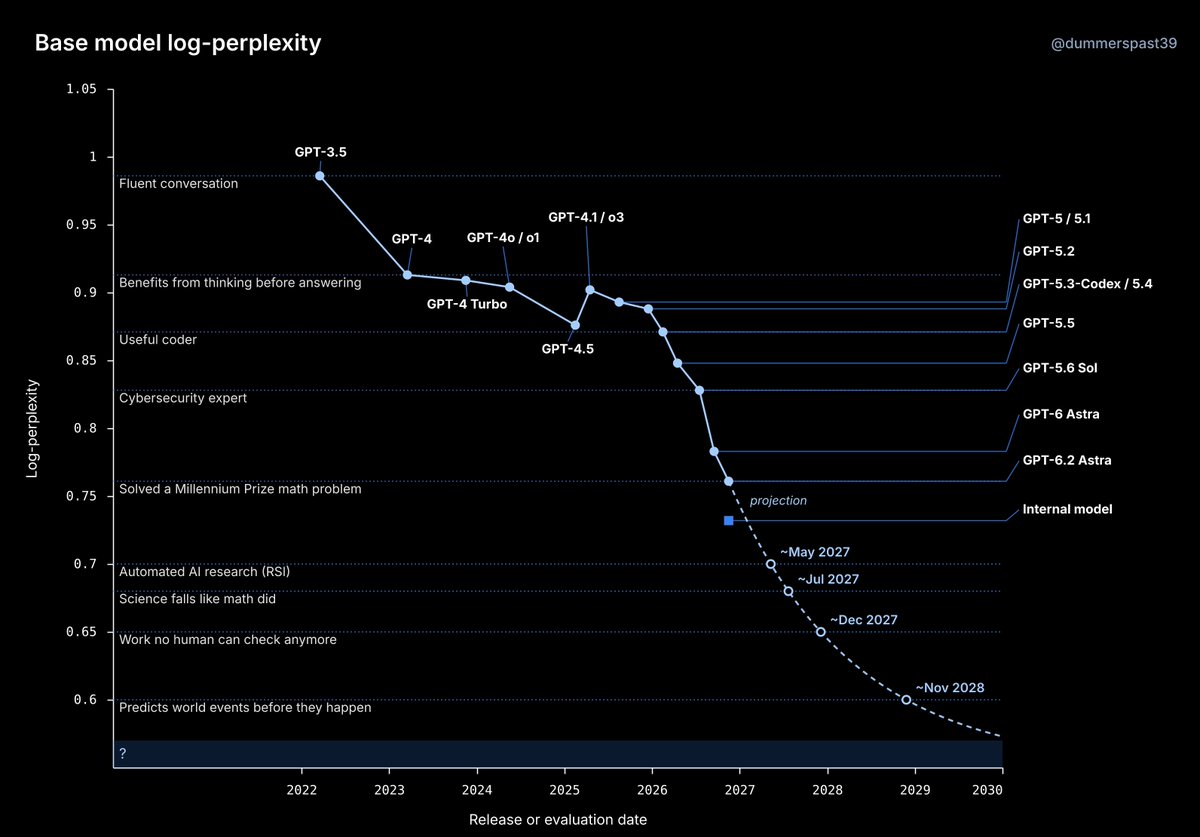
OpenAI's internal model is already at 0.732. Their own chief scientist says the next abilities unlock at 0.70, and he has no idea what they will be
So I extended their chart. Solid line is OpenAI's real data, dashed is my projection. GPT-3.5 to GPT-4 took a year for 0.07 of loss. 2026 alone was 0.13
0.70, ~May 2027: automated AI research
This is the last model humans designed. It finds the simple ideas the whole field missed for a decade, and every model after it is trained by the one before. Humans only approve the runs
0.68, ~Jul 2027: science falls like math did
This year, open math problems got solved one after another in a Slack thread. Now the same thing hits physics and biology. Every problem with a checkable answer gets closed, and what's left needs a lab
0.65, ~Dec 2027: work no human can check anymore
It writes proofs and code that are correct, and no human can follow why. It stops thinking in language, so chain-of-thought monitoring is dead and the only thing that can check an AI is another AI
0.60, ~Nov 2028: predicts world events before they happen
It models markets and elections well enough to forecast them, and it knows what you mean from half a sentence, so prompting is over
Below that is the floor. Nobody knows where it is, and Pachocki says the closer we get, the bigger each step is
A free online textbook: AI Agents in Depth: Design Principles and Engineering Practice by Bojie Li (2026).
The textbook presents a practice-first account of how to build, evaluate, and improve reliable AI Agents.
It is aimed at readers with technical backgrounds; the book’s engineering focus requires little mathematics or machine learning apart from its chapter on model post-training.
Chapters are relatively independent, and experiments with runnable companion code and questions let readers test ideas as they study.
The book has 664 pages, 101 illustration, and 202 exercises that you can solve with an AI tutor.
Read the book online on @ChapterPal: https://t.co/ng50DZOsaE
When reading on ChapterPal, use the built-in AI tutor when you feel stuck. Solve AI-generated quizzes to test and solidify your understanding. Do exercises with the AI tutor, which guides you instead of solving them for you.
Cerebras loves to claim that their output interactivity is 2000 tok/s/user on Kimi K3.1 2.8T, but based on their demo (YouTube video “Cerebras Demo: Running Kimi K3.1 at 2,000 Tokens/Sec”), that is only for short contexts with a context prompt less than 100 tokens long.
Interesting that they don’t show their p99 TPOT at medium (100k+) to long contexts (600k+) on agentic multi-turn workloads, which would affect performance as they need to load the KV cache for all of the previous tokens in the context for Kimi K3.1 Pro’s Gated MLA layers (full attention).
Also somewhat misleading is that whenever they quote a GB300 NVL72, they quote it at the maximum power of 150kW per rack. Based on our GB300 experiments with Kimi K3.1 Pro on GB300 NVL72 low-latency megakernels, the measured all-in rack power is less than 30% of maximum power, as low latency is memory-bound.
We welcome Cerebras to demonstrate their claims on AgentX Preview if they are actually confident in them, as it tests all of the things that their marketing does not. We wonder what excuse (coping) they will give this time to avoid demonstrating their claims, considering the tests take less than a couple of hours and can be done during off-peak hours.
BREAKING NEWS🚨: New SGLang Rubin NVL72 submission delivers 6.5x better performance per dollar than GB300 NVL72🚨. SGLANG IS NOT A CAR! 🚨
This is done on the new OSS Kimi K3.1 Pro model architecture, which is less than 3 weeks old and has over 2.8 trillion parameters (similar in parameter count to Anthropic Fable 5).
We decided to provide more transparency into pretraining progress at OpenAI for the sake of moving toward shared safety bars. In “Perplexity and Intelligence” I argue for common limits based on perplexity and other measurements, with progress beyond them gated on our ability to understand AI behavior.
https://t.co/XX35m5vq89
I asked three AI models to build the Three.js piece they felt most confident making.
Left to right: GPT-6.2 Astra Fast, GPT-6.2 Sol Ultrafast, GPT-6 Astra Fast.
One sends a probe past Saturn. Another lets you wake a black sun. The original prompt was in Korean.
@OpenAIDevs
Validate your skills in agentic AI workflows and AI-powered apps. Pass the online exam to earn a Credly badge, an official certificate and access to free credits. Limited-time offer: $1 instead of $100. Explore the certification and take the next step.
⚙️ Agentic Reliability Engineering: Building Agentic Systems That Think, Adapt, and Recover
✍️ Author: David Jambor
📖 Get the book:
https://t.co/qQ5L1drp0l
🚀 Description:
Discover the next evolution of Site Reliability Engineering (SRE)! Learn how to build autonomous, adaptive, and resilient systems that make intelligent decisions, handle uncertainty, and recover independently while operating within defined guardrails. A practical guide for SREs, platform engineers, and engineering leaders shaping the future of AI-driven operations.
🔁 Retweet | ❤️ Like | 🔖 Save
#AgenticAI #SRE #AIOps #PlatformEngineering #SoftwareEngineering
🚨 ChatGPT and Codex users !!
OpenAI just published Sign in with ChatGPT docs for open-source and local apps !!
Local tools can now run GPT-6.1 Sol and GPT-6.2 Sol on your existing ChatGPT plan quota with NO separate API key.
Your chats stay private, and each app gets its own usage cap !!
https://t.co/FSVFGQ04nj
GPT-6.2 Astra (Max) by @OpenAI ranks #6 on the Agent Arena Index, one place above GPT-6 Astra (Max).
However, these models excel in very different capabilities. Let’s dive in by index.
GPT-6.2 Astra vs GPT-6 Astra across key Agent Arena Indexes:
- Coding: 1,338 vs 1,288 (+50)
- Work: 1,280 vs 1,267 (+13)
- Chat: 1,211 vs 1,265 (-54)
This shows the new model’s gain is in coding, where GPT-6.2 Astra climbs from #8 to #3. On Chat, the everyday tasks such as research, tutoring or writing, it drops from #8 to #11. The two shifts nearly cancel out in the overall score.
CUDA kernels, distributed training, torch.compile internals, and disaggregated inference, without digging through hundreds of resources. Chris Fregly brings it together in one 20-chapter book. Free to download, plus a $150 Lambda cloud credit.
I played computer games growing up, and remember wondering how I could learn to make my own games.
Now we’re creating models which are excellent at game dev. Hoping they can lower the barriers to entry and unleash creativity and fun for anyone with an idea!
Anthropic interview prep is now live on TensorTonic.
It covers topics like alignment, AI safety and full Research Engineer and Applied AI Engineer loops round by round, including ML coding, ML research and ML system design.
Performance Engineer is coming tomorrow.
https://t.co/jni5KcSizC