The lab is hiring! We have a 4-year NSF funded postdoctoral position to move the needle on the molecular bases of seasonal rhythms/photoperiodism using the charismatic monarch butterfly as a model and cutting-edge approaches (CRISPR, scRNA-seq,...). Details below. Please 🔃
My lab will soon be reruiting a postdoc to work on the molecular bases of seasonal rhythms/photoperiodism in monarchs. CRISPR mutants/Bulk RNA-seq/scRNA-seq/bioinformatics on the menu, among many other great things. Email me if interested [email protected]
@neuroethology
@CircadianClocks@SRBR_Outreach Why don't people/politicians follow the recommendations of expert scientists (applies to Covid and many other medical issues)?
Would they build their house w/o following recommendations of engineers, architects, electricians?
I can't comprehend why people distrust scientists...
@kedelmore is the FIRST faculty to win a NSF CAREER in the history of @TAMU_Biology 🥳🥰.
Please, join me in making some well-deserved noise about it @TAMU_CBCR, @TAMUScience, @TAMU and retweet!!
She is recruiting to work on really cool projects!
Another legacy from @sassonecorsilab Special thanks for an elegant supervision from @JuleenRZierath Check this resource @Cell_Metabolism out if you love and need exercise. Fantastic dream team @DyarKen @lutter_dominik @treebak
https://t.co/6RqOSBlHgW
Why working on butterflies? Amazing creatures inspiring technological innovations. Awesome PBS NOVA documentary to be aired soon. Thankful that our lab was included! @TAMU@TAMUScience @TAMUBiology
Check out the preview @PBS: NOVA, Butterfly Blueprints https://t.co/WDhypXa2b4.
Hot off the press 🥳! A study from our lab reveals that the monarch butterfly light sensitive Cryptochrome 1 - but not the mammalian-like Cryptochrome 2 - mediates light-dependent magnetosensing of the Earth's magnetic field inclination https://t.co/jOkM2kDJvk
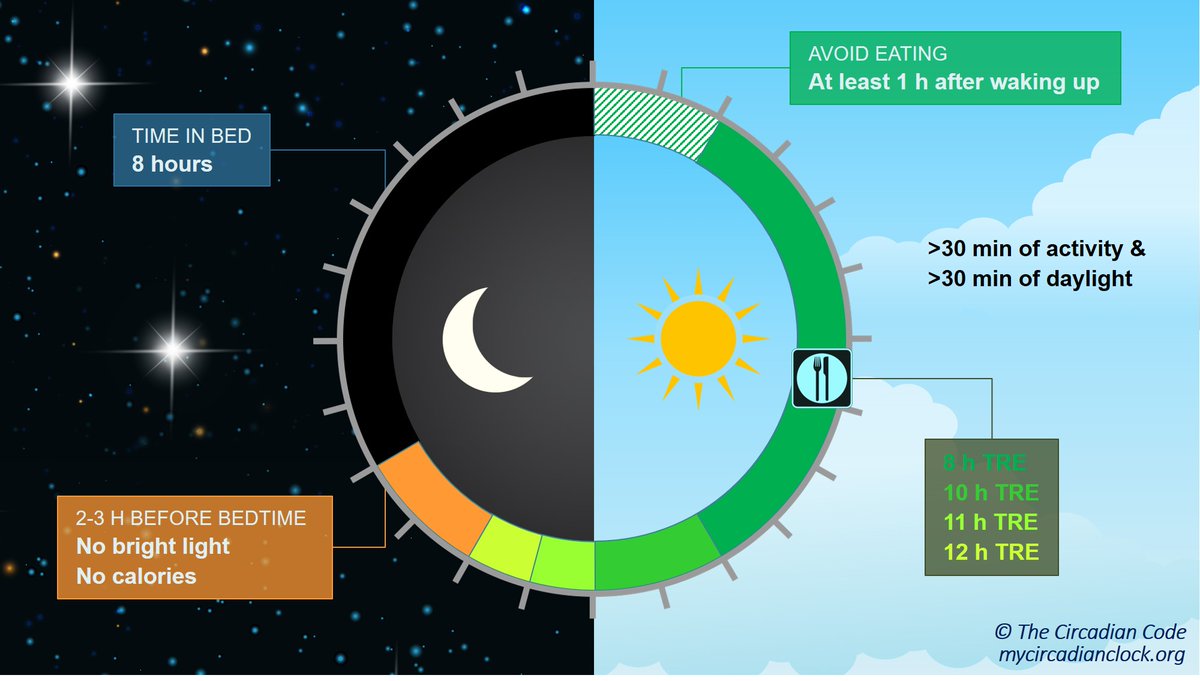
The Circadian #2021resolutions anyone can use.
* 8 h in bed
* Wait for >1 h before first calorie.
* Eat within a consistent window of 8-10 h; no longer than 12 h.
* >30min outdoor activity under daylight.
* No food, no bright light for 2 h before bedtime.
REPEAT.
Finally, we investigated whether RBP motifs were enriched at the polyadenylation site of rhythmic APA isoforms. Of the 84 RBP motifs examined, almost half showed an enrichment that was rhythmic across the 24-day.
9/n
Excited to share the latest story from the lab led by Ben Greenwell @b_gwell.
We looked at alternative polyadenylation (APA) in the context of #circadian rhythms, and found that rhythmic gene expression is largely APA isoform specific. https://t.co/vxNqch4M4M
1/n
Based on these and other results, we next examined if genes could exhibit rhythms in relative 3’ UTR length.
Hundreds of genes show a rhythm in 3' UTR length with shorter 3' UTR at dusk, mostly b/c distal APA isoforms preferentially peak at dawn while others peak at dusk.
8/n