In 2016, during my college days, a story from Malayalam Manorama stuck with me.
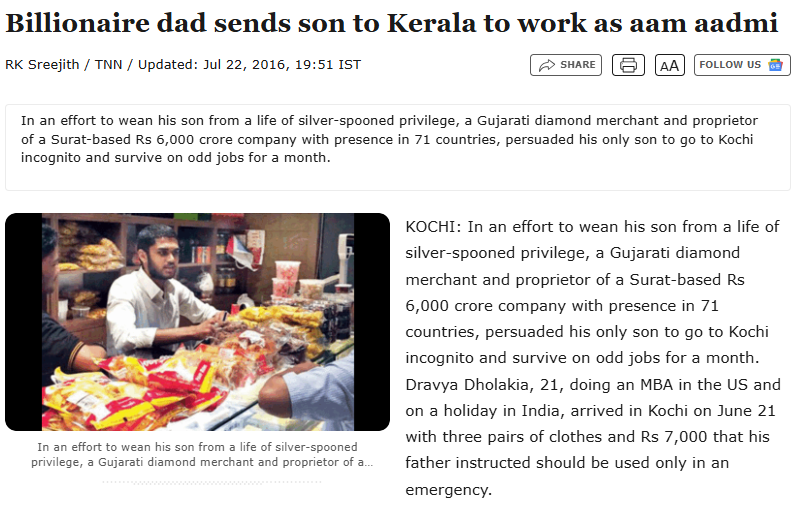
Savji Dholakia, a billionaire diamond merchant from Surat running a ₹6,000 crore empire, sent his 21-year-old son Dravya Dholakia to Kochi with just ₹7,000 and three conditions, he could not work in the same place for more than a week, he could not use his father's name, and that money was strictly for emergencies.
Dravya spent his first five days without a job or a place to stay, got rejected by around 60 places, and eventually found work at a bakery just to survive.
Why would a billionaire put his own son through this?
Because Savji Dholakia knew he did not build a ₹6,000 crore empire in comfort. He built it through hardship, and he wanted his son to feel the weight of that.
When I came across this story recently, it immediately connected to a conversation I had with Alex K Babu, founder and chairman of Hedge Equities Ltd, on the Kerala Product Hunt (KPH) Podcast.
There is a famous Japanese saying: "Rice paddy to rice paddy in three generations."
It is a saying about the third generation curse, the idea that what the first generation builds from nothing, the third generation loses entirely.
The first generation usually builds from scratch by going through hardships, taking risks, and facing uncertainty to build from almost nothing.
The second generation then steps in to expand the foundation, protect it, and make the business stronger.
However, by the time it reaches the third generation, comfort slowly enters the picture, killing responsibility.
This is why wealth rarely survives three generations, not because wealth disappears on its own but because the mindset that created that wealth is not always passed down.
The next generation might inherit the wealth and surname, but they do not always inherit that hunger, discipline, and responsibility.
According to Alex, "Complacency starts when everyone becomes comfortable and happy with what they already have."
This is why he believes families must keep putting challenges in front of the next generation, not to make their life difficult, but to ensure they keep thinking, moving, and creating.
Wealthy families often challenge their children more because they understand the danger of comfort, wanting the next generation to build something of their own instead of depending on ancestral wealth.
People who built something big from the ground went through hardship, and that hardship gave them the hunger to build empires.
And for that hunger to survive into the next generation, they need challenges that force them to think, take responsibility, break their own limits, and create something for the future.
See the goal is not to deny comfort, it is to make sure comfort does not kill growth.
Because in the end, legacy should never become a comfortable place to sleep, but rather a responsibility to continue building further.
99% OF PEOPLE DELETE THE WRONG THINGS WHEN GMAIL STORAGE GETS FULL.
THEY REMOVE EMAILS.
BUT GOOGLE HIDES THE BIGGEST STORAGE HOG SOMEWHERE ELSE.
I FREED 18GB WITHOUT TOUCHING A SINGLE IMPORTANT EMAIL.
HERE’S THE FIRST PLACE YOU SHOULD CHECK 👇
Every Olympic endurance coach in the world now tapes their athletes' mouths shut at night because a Swedish lab proved in 1995 that the nose produces a gas the mouth cannot, and that single gas determines whether your blood absorbs 100% of the oxygen you inhale or only 82%.
The gas is nitric oxide.
The lab was the Karolinska Institute in Stockholm. The discovery was published in Nature Medicine that same year, and it quietly rewrote everything respiratory physiology thought it knew about why humans have a nose in the first place.
Here is what they actually found.
The empty air-filled cavities inside your skull, the ones anatomy textbooks called evolutionary leftovers for a hundred years, are not empty and not useless.
The lining of those sinuses contains an enzyme called inducible nitric oxide synthase. It runs continuously. It produces large amounts of nitric oxide gas. That gas sits in your nasal cavity at concentrations hundreds of times higher than anywhere else in your body.
The Karolinska team measured it. Air leaving the nose contains roughly 56 parts per billion of nitric oxide. Air leaving the mouth contains 14. Air leaving the trachea, below both, contains 6. The nose is the only factory.
Then they ran the experiment that changed sports medicine.
When you inhale through your nose, that nitric oxide rides the airstream down into your lungs. It hits the small blood vessels surrounding your alveoli and forces them to dilate.
More blood flows past more oxygen, and more oxygen crosses into your bloodstream. The exact figure they measured was an 18% increase in arterial oxygen uptake compared to mouth breathing the same air.
Same lungs. Same oxygen in the room. Same heart rate. One nostril of difference and your blood is carrying nearly a fifth more fuel.
The reverse is what should haunt anyone who mouth breathes at night.
Mouth breathing bypasses the sinuses entirely. The nitric oxide never enters the lungs. Pulmonary blood vessels stay constricted. Less oxygen crosses into the blood.
The heart has to pump harder to deliver the same oxygen to the same tissues. A 2008 review in the Anatomical Record showed mouth breathers develop measurably higher pulmonary artery pressure over time, simply because the gas designed to lower it never arrives.
There is a second finding most people miss.
Nitric oxide is antimicrobial. It directly inhibits the replication of viruses and bacteria in the upper airway. During the COVID pandemic, researchers in the European Journal of Pharmacology proposed that habitual mouth breathers were getting hit harder partly because they had bypassed the body's first chemical line of defense. The nose was not just a filter.
It was a chemical weapons factory aimed at every pathogen trying to reach the lungs.
The implication is the part that should change how you sleep tonight.
Your body built a free 18% oxygen upgrade and a free antiviral system into the same organ. Both only activate when air passes through your nose. Both shut off the moment your mouth opens.
Half the adult population sleeps with their mouth open and has no idea they are running their lungs at 82% capacity for a third of their life.
The fix costs nothing. A strip of tape across the lips at night. That is the entire intervention.
The most expensive thing in human performance is the oxygen you already paid for and never absorbed.
The 18-year "Corridor of Growth."
Zoom out and the noise disappears. Since 2009, the Nifty IT index hasn't just gone up—it’s lived within this incredibly precise parallel channel. Every time the headlines claim "the party is over," the lower boundary steps in to prove the structural story is still intact.
The Forward Thesis:
We’ve just come off a brutal two-year "breather" that flushed out the weak hands. The index is now approaching the Value Zone near the channel’s lower support.
Keep an eye out for a false breakdown—a quick, scary dip that tests the 26,000–200 zone—before the big money steps back in. These "shakeouts" are often the precursor to the next major leg up. As long as we hold the structural floor, the path of least resistance remains higher.
From Investing perspective only, ignore the daily panic. Respect the primary trend. Keep a monthly close below 26000 as Stop Loss for your Investments.
Should Bitcoin continue with the most remarkable cyclic patterns of any market in the past 15 years, an investable low is scheduled for Sep/Oct 2026. That low might or might not penetrate the Feb 2026 low. The next high (should patterns continue) will be between $300k and $500k in Sep/Oct 2029
I will announce tradeable thrusts via Factor and @BitcoinLive1
https://t.co/Bq1PhjnRHa
and https://t.co/S9kNCOIrWc
Thousands of crores worth of solar panels are installed across Rajasthan right now. Generating power. With NOWHERE to send it.
India's most expensive electricity isn't the kind that costs more. It's the kind that's already been made and has no road.
I went back and studied the entire transmission value chain. What I found changes how you should think about the power theme.
India just crossed 283 GW of non-fossil installed capacity. 274 GW of renewable + hydro. 8.78 GW of nuclear. Total generation capacity crossed 513 GW as of December 2025.
The numbers look great on paper. The problem is on the ground.
Rajasthan alone has 130 GW of grid connection applications. Transmission systems planned or under implementation? 73 GW. That leaves roughly 60 GW of renewable projects just sitting there waiting for a wire.
If one state has this gap, imagine the national picture.
India doesn't have a generation problem anymore. It has a delivery problem.
The government knows this. The National Electricity Plan lays it out clearly:
🔹 Transmission network: 5.04 lakh circuit km today → 6.48 lakh ckm by 2032
🔹 Transformation capacity: 1,429 GVA → 2,345 GVA
🔹 Inter-regional transfer capacity: 120 GW → 168 GW
🔹 Just for 2027-2032: 50,890 ckm of new lines + 433,575 MVA of new transformation capacity
This is not a projection from a broker report. This is formal government planning with budget allocation behind it.
And it's already showing up in execution. FY25 alone, 8,830 circuit km of transmission lines added and 86,433 MVA of transformation capacity commissioned.
Now here's what most investors get wrong. They treat "transmission" as one trade. It isn't. The value chain has very different economics at each layer, and the gap in return quality is massive.
Think of it as a 5-layer stack:
🔹 Layer 1: Lines and conductors
This is the volume layer. Towers, conductors, insulators, fittings. Demand is huge but margins are more commodity-linked. Raw material prices and bidding intensity drive outcomes more than capability moats.
🔹 Layer 2: EPC execution
Project ordering and pace of execution drive this layer. Strong revenue torque when cycle is up. But working capital is heavy, receivables can stretch, and right-of-way delays are constant.
🔹 Layer 3: Substations and electrical equipment
This is where it gets interesting. A transmission line mainly drives towers and wire. A substation drives transformers, reactors, GIS, switchgear, metering, protection, and controls, all at once. With 86,433 MVA added in FY25 and much more planned, this may be the richest layer in the cycle. Rising demand from data centres, metros, manufacturing, and commercial load centres makes this even more relevant.
🔹 Layer 4: Transformers and switchgear
These sit inside both the renewable pooling story and the urban grid strengthening story. Higher product complexity, longer approval cycles, stronger technical barriers. Better operating leverage if utilization tightens.
🔹 Layer 5: HVDC and advanced grid technology
This is the highest-moat layer. Standard AC handles most expansion. But long-distance renewable evacuation from Rajasthan, Gujarat, and Ladakh increasingly needs HVDC.
The Bhadla-Fatehpur corridor: ±800 kV, 6,000 MW, ~950 km. Hitachi Energy and BHEL are involved. Targeted by 2029. It's part of the backbone for India's 500 GW renewable ambition.
HVDC involves converter stations, converter transformers, thyristor valves, and complex integration. Qualified vendors globally are fewer than 10. Pricing power sits here.
👉This is the important part: not all beneficiaries in this chain will generate the same quality of earnings.
Volume players benefit from demand, but margins stay thin. Equipment makers with capacity constraints and qualification barriers are where operating leverage shows up. Technology players with HVDC and digital grid capability sit in the widest moat.
The grid is getting more complex, higher voltage, GIS adoption, digital substations, renewable pooling, HVDC corridors. Every step narrows the field of credible participants. That's the rerating trigger.
Risks are real. Execution delays, right-of-way issues, working capital stress in EPC, import dependence in advanced systems, and overbidding in commoditized packages. Study this in layers, not as one trade.
India's renewable story cannot scale without a much larger grid. The generation side gets the headlines. The transmission side determines whether any of it actually works.
In this cycle, the silent grid may capture more value than the louder generation story.
Listed companies by layer:
🔶Grid owners and developers
🔹Power Grid Corporation: India's central transmission utility, owns 90%+ of inter-state network
🔹Adani Energy Solutions: fastest-growing private transmission developer
🔶EPC contractors
🔹KEC International: RPG Group, present across T&D, railways, civil
🔹Kalpataru Projects International: strong T&D order book, international presence
🔹Bajel Projects: focused play on transmission towers and EPC
🔶Conductors, cables, line materials
🔹Apar Industries: Exports fibre optic and conductors to 50+ countries
🔹KEI Industries: power cables, scaling distribution presence
🔹Polycab India: wires, cables, and emerging FMEG play
🔹Dynamic Cables: smaller, focused on HT/LT cables and conductors
🔶 Transformers and substation equipment
🔹Hitachi Energy India: GIS, transformers, HVDC, grid automation
🔹CG Power: transformers, switchgear, motors, strong industrial base
🔹Transformers & Rectifiers India: direct play on transformer capex cycle
🔹Indo Tech Transformers: niche, high-voltage transformers
🔹Bharat Bijlee: transformers and motors
🔹BHEL: power equipment, HVDC involvement, diversified
🔹GE Vernova T&D India: ₹12,000 crore order inflows in one quarter on HVDC wins
🔶HVDC and grid technology (highest moat)
🔹Hitachi Energy India: only listed pure-play on HVDC in India
🔹GE Vernova T&D India: HVDC corridors, grid automation
🔹Siemens India: energy automation, digital substations
🔹ABB India: UPS, power distribution, data centre grid play
🔶Smart metering and grid digitisation
🔹Genus Power: smart meter specialist
🔹HPL Electric: metering and switchgear
Transmission is no longer a support sector. It is becoming the core enabler of India’s next power cycle.
⚡️ Disclaimer: The above data should not be considered a buy or sell recommendation. This analysis is shared only for educational and learning purposes.
Don't bookmark this. Read it if you want to save some money.
You're spending ₹2,000 on a multivitamin that does nothing.
₹1,500 on ashwagandha because Instagram told you to. ₹3,000 on a "mass gainer" that's 80% sugar.
₹800 on Revital because your dad takes it.
Indians waste ₹50,000 a year on supplements they don't need.
Here are the only 5 worth your money - and exactly how much to take:
There's a physicist at Stanford named Safi Bahcall who modeled this exact principle and the math is wild.
He calls it "phase transitions in human networks." When you're stationary, your probability of a lucky event is limited to your existing surface area: the people you already know, the places you already go, the ideas you've already been exposed to. Your opportunity window is fixed.
When you move, your collision rate with new nodes in a network increases nonlinearly. Double your movement (new conversations, new cities, new projects) and your probability of a serendipitous encounter doesn't double. It roughly quadruples. Because each new node connects you to their entire network, not just to them.
Richard Wiseman ran a 10-year study at the University of Hertfordshire tracking self-described "lucky" and "unlucky" people. The single biggest differentiator wasn't IQ, education, or family money. Lucky people scored significantly higher on one trait: openness to experience. They talked to strangers more, varied their routines more, and said yes to invitations at nearly twice the rate.
The "unlucky" group followed the same routes, ate at the same restaurants, and talked to the same 5 people. Their networks were closed loops. No new inputs, no new collisions.
Luck isn't random. Luck is surface area. And surface area is a function of movement.
The lobster emoji is doing more work than most people realize. Lobsters grow by shedding their shell when it gets too tight. The growth requires a period of total vulnerability. No protection, no armor, soft body exposed to the ocean.
That's the cost of movement nobody posts about. You have to be uncomfortable first. The new shell only hardens after you've already moved.
🚨 are you paying attention to what's actually keeping the world from a third world war right now..
it's not the United Nations.. their security council has been deadlocked for decades..
it's not diplomacy.. the USA and China can barely have a phone call without threats..
it's not trade.. Europe was Russia's biggest energy customer and that didn't stop anything..
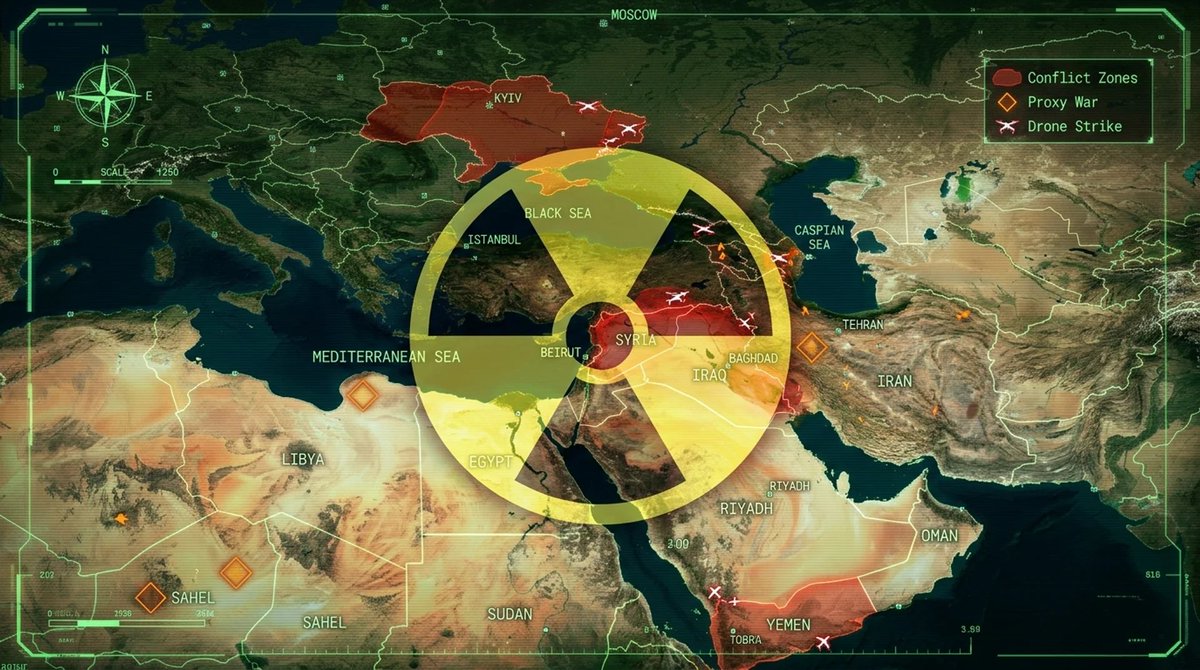
the ONLY thing preventing full-scale global war in 2026 is the same thing that's prevented it since 1945..
the mathematical certainty that if you start one.. your own country ceases to exist within hours..
> 9 countries have nuclear weapons
> those 9 countries have not fought a direct war against each other since acquiring them
> not once.. in 80 years
every proxy war.. every drone strike.. every sanctions package.. every cyberattack..
that's all theater compared to what WOULD happen if nukes didn't exist..
we'd be on World War 7 by now..
the question nobody wants to answer: what does it say about humanity that the only thing that created lasting peace was the promise of total extinction..
i don't post what's popular i post what's real.. follow if you're tired of the noise.
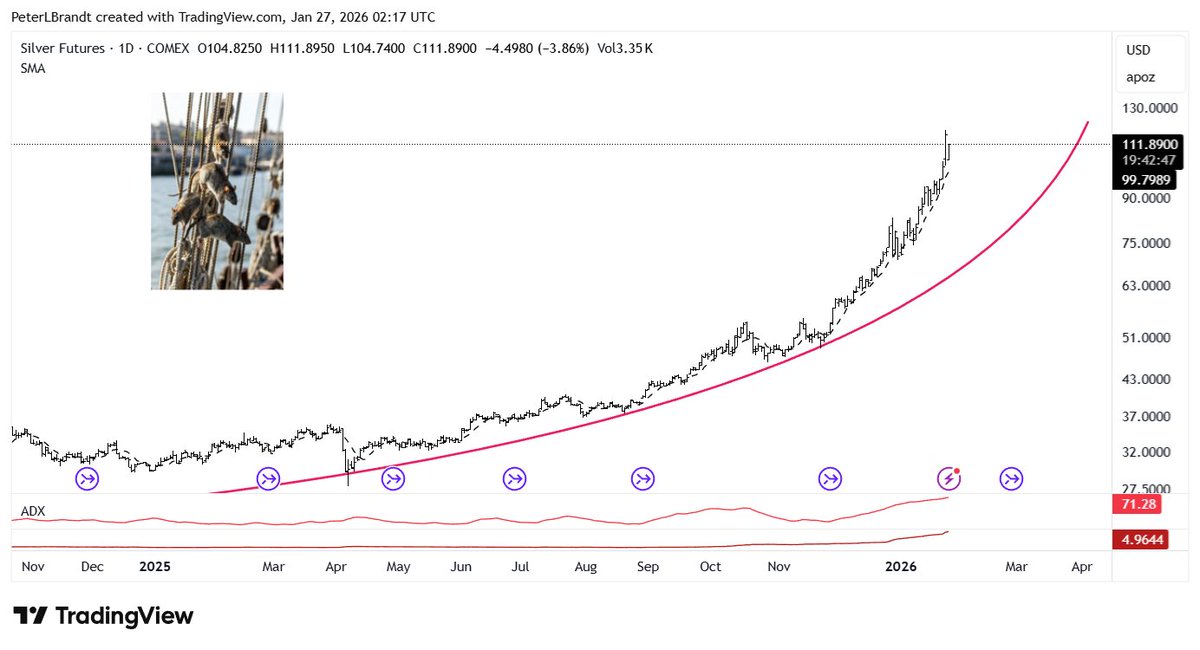
Silver bootie $SI_F
Today nearly 2years of world production traded on world exchanges
More than 1.5 billion ounces
The last time such a proportion traded was Apr 25, the day of the 2011 top
I called that top on Apr 24, 2011 here:
https://t.co/8FMXgAWtCU
Not this time though???
“The Art of Spending Money by Morgan Housel”
A brilliant continuation of The Psychology of Money. With wit, clarity and powerful storytelling, Morgan Housel helps us rethink our relationship with money, why we spend and how to do it wisely.
7 lessons from the book:
The updated Silver-to-S&P 500 ratio chart increasingly suggests the early stages of a major cycle where silver outperforms U.S. equities.
While many investors have been conditioned to expect the opposite, this chart highlights just how early we might be in a broader trend of capital rotating into hard assets.
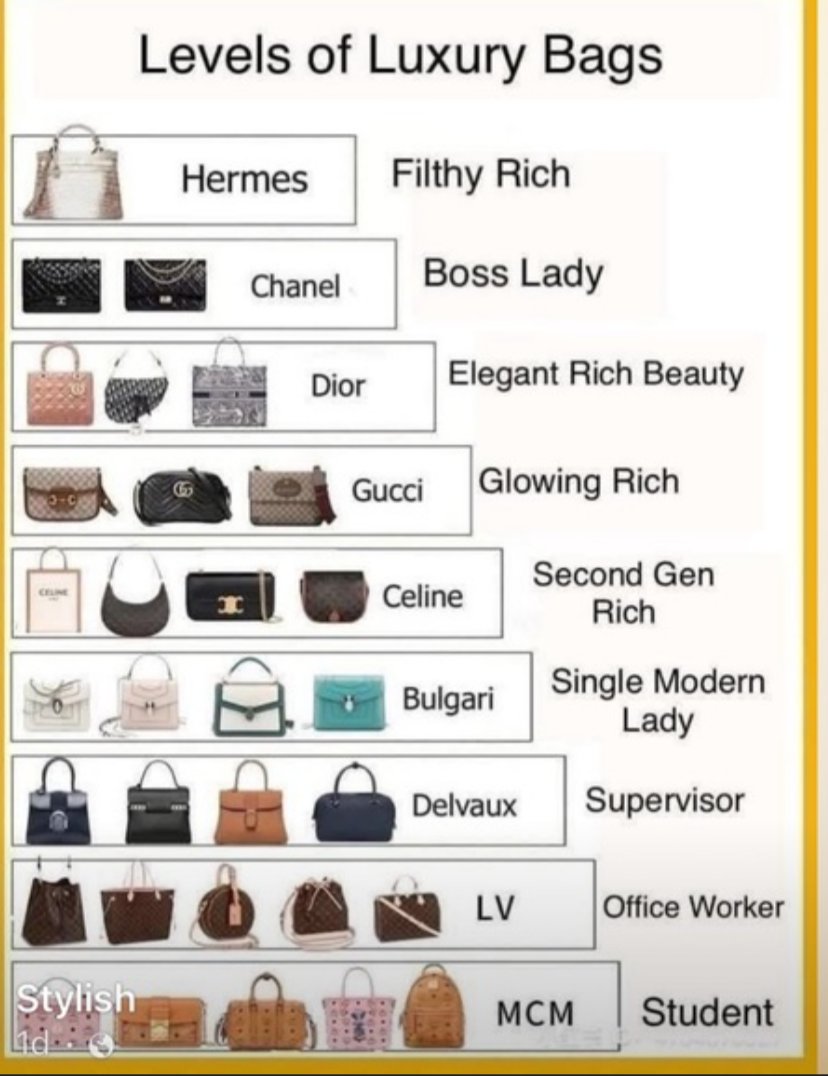
After my column on why humans buy luxury brands, someone who supplies accessories to these brands told me that no designer bag in the world costs more than $40-50 to make - and they sell for lakhs of rupees.
And all the branded t-shirts that sell for $50 or more are made for $3 to 4 in Bangladesh. The factories even put the $50 price tag and ship 😊
In fact in the name of vegan leather and being against animal cruelty, the bag sellers are doing even better as inputs are even cheaper there.
Most luxury brands have got patents on various versions of painted canvas which is actually a very inexpensive ( bahut sasta kapda hai) material but they are selling the bags at the same old inflated prices 😊
What you are buying is not great materials or 'quality' but simply bragging rights - at least be clear about that.
The kind of categorisation here is what you're trying to signal (Graphic source not known)