"The monopoly of government of issuing money has not only deprived us of good money but has also deprived us of the only process by which we can find out what
would be good money"
Hayek, A Free-Market Monetary System (1977)
https://t.co/ttGZPvaZ3q
Marx died in 1883 with two volumes of Capital unwritten and one fatal contradiction unanswered. Eugen von Böhm-Bawerk noticed.
In 1884 he published the first volume of Capital and Interest, a history of every interest theory ever floated, and he treated the exploitation theory the way a pathologist treats a corpse: methodically, and without sentiment. Marx claimed that labor alone creates value, that the capitalist pockets "surplus value" by paying workers less than their product is worth. Sounds tidy. Then Böhm-Bawerk asked the question that collapses the whole structure. Why does a worker accept $90 today instead of waiting a year for the $100 his labor will eventually fetch in the finished good?
Present goods are worth more than future goods. That is interest. Not theft, not a parasite skimming off the top, but the price of time itself. The capitalist who advances wages today for output that sells next year performs a service, and he earns the spread for bearing the wait and the risk. Böhm-Bawerk laid this out in 1889 in The Positive Theory of Capital, and the exploitation story had no reply.
But the real execution came in 1896. Engels had finally dragged Volume III of Capital into print in 1894, and there Marx quietly admitted that commodities do not actually sell at their labor values: they sell at "prices of production" governed by an average rate of profit. Böhm-Bawerk pounced in Karl Marx and the Close of His System. Volume I said value comes from labor. Volume III said prices systematically deviate from labor. Marx had spent twenty years building a cathedral on a foundation he himself dynamited in the back pages. You cannot assert that labor determines value on Monday and that competition overrides it on Thursday and call the result science.
A century of central planners ignored this and proceeded to starve Ukraine, wall off Berlin, and empty the shelves of Caracas. The theory was dead in 1896, but the bodies just kept arriving anyway, because nobody reads the footnotes before they reach for the gun.
"The people gave the congress the power."
I think the Founders would have thrown their hands up in the air in disgust at the Supreme Court's interpretation of "..only gold and silver.." to mean "and whatever amount of paper". Especially having come off the recent disaster of the Continental dollar.
The "people", through the Founders, designed the Constitution, limit "the power" of the Federal government. This decision centralized power and "changed the character of our government". It transferred sovereignty from the individual to government. It changed the rules!
It should have gone through the amendment process! "The people" would have been better represented in open debate.
2. I didn't say "weight means value". I said to regulate the value pertained to the QUALITY and WEIGHT of gold coin being overseen and verified. (No fraud!)
An Indecent Proposal: How to Complete Chartalism and End the International Dollar System
On Pegs, Rates, Governance, and the Only International Monetary System That Avoids All Three
https://t.co/2144sEoVHY
"to 'coin money', regulate the value thereof,.."
"to regulate the value" pertained to the quality and weight of gold coin being overseen and verified.
Slavery was "LEGAL"!
and Congress didn't have "the power"
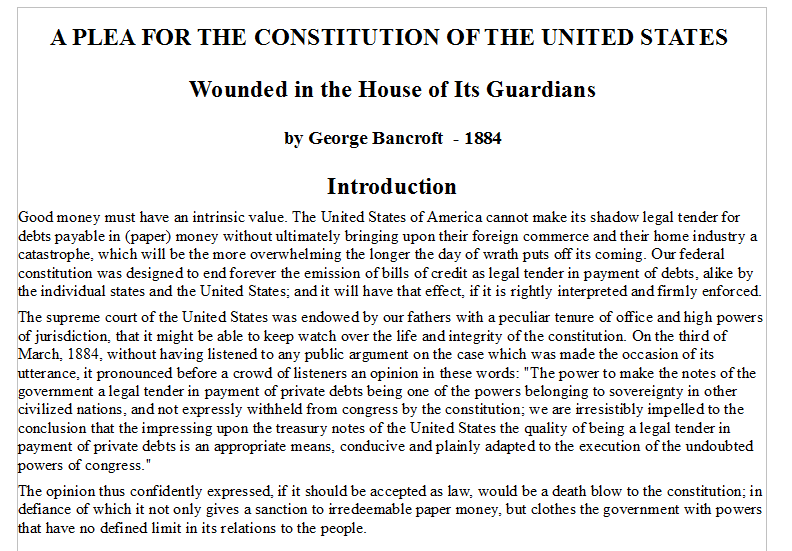
Justice Stephen Field's dissent in Leagl Tender case Juilliard vs Greenman 1884;
"The power to .. compel the receipt of promises to pay in place of money, may be exercised, as it often has been, by irresponsible authority, but it cannot be considered as belonging to a government founded upon law.
But be that as it may, there is no such thing as a power of inherent sovereignty in the government of the United States.
It is a government of delegated powers, supreme within its prescribed sphere, but powerless outside of it.
In this country, sovereignty resides in the people, and congress can exercise no power which they have not, by their constitution, intrusted to it; all else is withheld.
The doctrine that a power not expressly forbidden may be exercised would, as I have observed, change the character of our government.
If I have read the constitution aright, if there is any weight to be given to the uniform teachings of our great jurists and of commentators previous to the late civil war, the true doctrine is the very opposite of this.
If the power is not in terms granted, and is not necessary and proper for the exercise of a power which is thus granted, it does not exist." https://t.co/O2jbSLQR4D
Gold was money as established in the marketplace of free exchange, not dictated from on high, but codified by the Founders in the Constitution "..only gold and silver..".
"Continentals" were "LEGAL too but did not conform to the Laws of Economics, as was the case with U.S. Treasury notes.
LEGAL tender could not hold their "promise to pay" in money (gold). It was conjured by the bankers in collusion with government to concentrate power in the Federal government and Wall Street!
Public be damned!
"Taxes" assumes receipt of something of value. When 'paper' runs its course Justice Field's warnings will come to fruition.
"Money has no intrinsic meaning"..
"..who gets to shape those rules, and whether the monetary system serves the broader public purpose or primarily the interests of private finance."
The Supreme Court 'set the rules' in violation of the Constitution. "But be that as it may, there is no such thing as a power of inherent sovereignty in the government of the United States.
It is a government of delegated powers, supreme within its prescribed sphere, but powerless outside of it." https://t.co/O2jbSLQR4D
"Wanted: Economic Literacy" highlights a severe lack of fundamental economic understanding in modern society."
"The economics of old sought to uncover how the world works. It showed, or even proved, that there is a natural order to it.
There is structure to the apparent chaos.
The economy has something of a life of its own: it has a nature.
This means not only that we can study it and learn about its ways, but also that we are not free to tamper with it at will and cannot make it work in ways that we might prefer but that are not in line with its nature.
There are “laws” by which the economy works, and they are immutable. Economics over the past three centuries has been about identifying, learning, and understanding those laws." https://t.co/xYiVy3FxS5
It was a Constitutional Republic.
Capitalism involves profit/loss, not too big to fail!
"People power" ended when the Supreme Court gave Congress a money ("legal tender") monopoly.
The 'legal tender' decision "not only gives a sanction to irredeemable paper money, but clothes the government with powers that have no defined limit in its relations to the people." https://t.co/mt590xsA07
According to AOC and Bernie Sanders, it is impossible for someone to obtain a billion dollars of income by any means beyond theft. How much of a mega-income is due to entrepreneurial profit and how much is a wealth transfer? | Clifford F. Thies
https://t.co/aqfmN4LrN3
Kim Jong-un imports $30 million worth of Emmental and Gruyère every year while the citizens he owns boil tree bark into soup. You should understand exactly why this happens. This system works as designed.
Socialism never abolishes scarcity. It relocates it. In a market, prices ration scarce goods toward whoever values them most and can produce something others want in return. Strip out prices and private property, and you don't get equality. You get a single decision-maker (or a small clique around him) allocating everything by command. The cheese flows to Pyongyang. The grass goes to the provinces. Ludwig von Mises explained the mechanism in 1920: without market prices for the means of production, no central planner can calculate whether any given use of resources creates value or destroys it. So the planner stops pretending to calculate. He simply takes.
Consider the famine of the mid-1990s, when somewhere between 600,000 and 2.5 million North Koreans starved. The regime kept exporting, kept importing luxuries, kept feeding the army and the Party first. Kim Jong-il reportedly ran a personal cellar of Hennessy that ran into the hundreds of thousands of dollars a year. His son upgraded the menu to Swiss dairy and Bordeaux. Meanwhile the official food distribution system, the one that was supposed to make hunger impossible, delivered nothing to people it had already forbidden from farming or trading on their own.
This is the part the Western admirers of central planning never sit with. The man with the cheese and the man with the bark are not separated by bad luck or insufficient foreign aid. They are separated by a wall of guns that exists for one reason: to keep prices, ownership, and exchange from ever returning. Every gram of imported Gruyère is a receipt. It records who controls the guns and who does not.
You don't fix this with better intentions or a kinder dictator. You fix it by letting the farmer own the field, sell the harvest, and tell the Party to go buy its own cheese.
Yes! Capitalists can be capitalism's biggest enemy.
“Consider the testimony of William Simon, who was Secretary of the Treasury under Nixon:
“‘I watched with incredulity as businessmen ran to the government in every crisis, whining for handouts or protection from the very competition that has made this system so productive.
I saw Texas ranchers, hit by drought, demanding government-guaranteed loans; giant milk cooperatives lobbying for higher price supports;
major airlines fighting deregulation to preserve their monopoly status; giant companies like Lockheed seeking federal assistance to rescue them from sheer inefficiency;
bankers, like David Rockefeller, demanding government bailouts to protect them from their ill-conceived investments; network executives, like William Paley of CBS, fighting to preserve regulatory restrictions and to block the emergence of competitive cable and pay TV.’”
“And always, such gentlemen proclaimed their devotion to free enterprise and their opposition to arbitrary intervention into our economic life by the state.
Except, of course, for their own case, which was always unique and which was justified by their immense concern for the public interest.” https://t.co/yzYLPr0IHZ
They told you Obamacare would discipline the insurance giants. Force them to compete. Drive down premiums through the magic of an online marketplace with a clean government website.
Then you watched the website crash in October 2013, and you watched UnitedHealth, Aetna, and Anthem post record profits while your deductible climbed past $6,000.
Here is what the exchanges actually built. The law forced you to buy a product under penalty of the individual mandate, then handed the insurers a fountain of taxpayer cash to make the product look affordable. Premium tax credits flowed straight to the carriers, not to you. In 2017 the federal government paid roughly $42 billion in subsidies, and that money landed in corporate accounts. The cost-sharing reduction payments did the same thing. The risk corridor program promised to backstop insurer losses outright, which is to say it socialized the downside while the executives kept the upside. Guaranteed customers. Guaranteed revenue. A captive market created by statute. Any cartel in history would have killed for terms like that.
Free market economists have a plain name for this arrangement: rent-seeking. When a firm earns its money by extracting subsidies through political channels instead of by serving customers who choose freely, it stops being a business and becomes a tax farmer. The insurers lobbied for the mandate because they understood the arithmetic better than the voters did. America's Health Insurance Plans spent millions backing the bill, then acted shocked when premiums on the individual market more than doubled between 2013 and 2017 in many states. They were not the victims of the law. They wrote the parts that mattered.
Strip away the subsidy and the whole structure collapses, because the prices were never real prices. A real price emerges when a buyer who can walk away meets a seller who can lose the sale. The exchange killed both conditions. You could not walk away without a penalty, and the seller could not lose because Washington covered the gap. This is not a market. The people who keep calling it one are counting on you not noticing who cashes the check.
The moment someone tells you Elon Musk should solve world poverty with his wealth, you're listening to someone who fundamentally misunderstands both wealth and poverty. Musk's billions exist almost entirely as Tesla and SpaceX stock, not cash sitting in a vault waiting to be redistributed.
The real issue runs deeper than liquidity. Poverty is fundamentally a productivity problem, not a resource shortage. If throwing money at poverty solved it, the $4.3 trillion the US government has spent on welfare programs since 1965 would have eliminated American poverty decades ago. Instead, the poverty rate has remained virtually unchanged since the War on Poverty began.
You can't redistribute your way out of poverty because wealth isn't a fixed pie that rich people hoard. Musk created his fortune by building companies that produce electric vehicles, rockets, and satellite internet. His wealth represents the market's valuation of those productive assets. When politicians demand he liquidate those holdings to fund welfare programs, they're demanding he destroy the very capital that generates ongoing prosperity.
The countries with the lowest poverty rates didn't achieve that through foreign aid or wealth transfers. South Korea went from Third World to First World status in two generations through property rights, free markets, and rule of law. Meanwhile, sub-Saharan Africa has received over $1 trillion in foreign aid since 1960 and remains impoverished. Poverty reduction requires institutions that enable production, not redistribution schemes.
Real poverty reduction happens when entrepreneurs like Musk build productive enterprises that create jobs, generate tax revenue, and drive down costs through innovation. But that requires you to understand that capitalism creates wealth rather than just moving it around.
Hasan Piker is the latest in a long line of socialist figures—from Marx and Lenin to Castro and Chávez—who denounce capitalism while prospering from it.
cc: @EmmaRincon
https://t.co/9otwvkGGci
Not sure I say precisely that! But ok, major critic of cronyism and rent seeking which I see as pervasive. And I want to instead see an Opportunity Economy. ‘The System Is Rigged': Why The Wealth Gap Will Explode | Peter Boettke https://t.co/4CFwIJ1xp2 via @YouTube