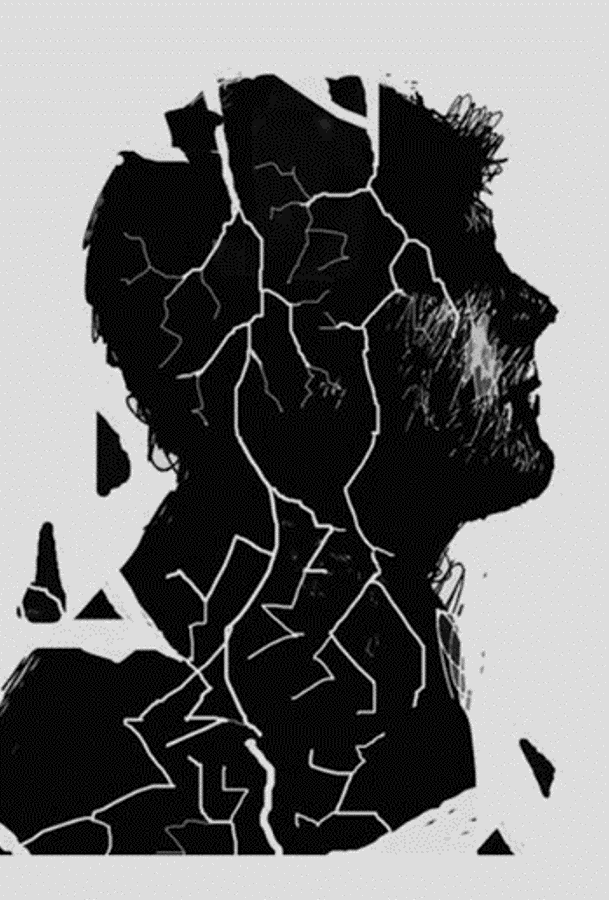
You are three times more like to kill yourself than your wife is.
40% of men have reported needing to experience suicidal ideation of self-harm before seeking help.
75% of people who commit suicide in the UK are male.
79% of people who commit suicide in the USA are male.
Here's something you didn't expect:
There is a positive correlation with poor mental health and conformity to masculine norms.
So what's going on here?
This was the question that my colleagues and I decided to research.
This is what we found.
Suicidal ideation follows an identifiable pattern:
1. Men are exposed to masculine values and expectations - usually when they're younger
2. These values were introjected as conditions of worth
3. Failure to live up to these expectations caused emotional and psychological pain
4. Pain then leads to development of coping strategies
Lets look at these in more detail:
1. Exposure to masculine values and expectations:
a. 'Macho' behaviour was a huge theme.
We need to define this first: Somebody who distances themselves from loved ones, or somebody using violence as a way to express their emotions.
One of our participants said "I know that some people, some men feel that they have to be violent in order to assert their masculinity.”
This suggests that men need to find ways to express their emotions and masculinity in more productive, healthy ways.
b. Emotional stoicism
A couple of quotes from participants to sum this up:
"I know that some people, some men feel that they have to be violent in order to assert their masculinity. My dad wasn't good at showing them”
“My deep core belief still is to not show emotions, to get on with it, you know, put up, shut up, provide… and just take whatever is thrown at you”
There is an intergenerational aspect to this as shown by the fact he mentioned learning this off his dad.
There also a sense of pride in being able to "take whatever is thrown at you" which betrays a sense of not feeling valued enough to say what we need as men.
The undertone here is to 'control' our emotions, but at what point does control become 'repress'?
And as men, do we really have control over our emotions if we cannot access the stuff we don't like when we need to feel/process it?
Does it make you less of a man to be upset at something and show it?
2. Values were internalised, creating a self-concept informed by conditions of worth:
This part was split into two sections:
Two roles.
One 'way of being'.
a. Provider
"My dad was like - I can still hear him now - when you get older you'll get a trade and then you can always put food on the table for your wife and kids."
This suggests that the role of provider is a deeply held belief that was thrust upon him, and to reject it would be selfish.
b. Protector
“But I mean, don't be a man, just be tough. Like the world is a difficult and dangerous place. And anyone who thinks that is not is ultimately just lucky enough not to be exposed to it and they can't be trusted”
He talks about being a protector as something outside of masculinity. Being tough in this context is for everyone.
But he is still operating within a binary - the initiated vs the uninitiated.
c. Self-reliance
“And I remember calling my girlfriend and being like, if my situation doesn't change within a year… there's no living through this, this is rubbish. And I really, I really would have done it, like I was planning on doing it, I'd figured out how I was going to do it, in a way that would leave the least mess”
This is the 'way of being' value that underpins the previous two.
He speaks of killing himself in a way that leaves the least mess.
Again betraying a lack of self-worth and disregard for his loved ones in some fundamental sense.
Ignoring any of the emotional and psychological turmoil he would leave behind.
3. Failure to live up to these values led to emotional and psychological pain
Again, this could be split into two main themes
a. Shame, guilt, and inadequacy
“It was when like, I’ve been found out in my weakness. Now, the shame and the guilt has got me because they have shamed me. That’s why I’m gonna attack now. I want you to feel the same way I’ve just felt”
A lot of things going on here: "found in my weakness" implies 'not a man' which is shaming in itself.
He talks about attacking and making you feel the same way as a means to regain control.
This also highlights how shame and guilt are contagious.
This part is more destructive.
b. Meaninglessness
“It’s difficult to persist in a landscape in which you can contribute nothing. And that you have nothing to give. Like that sucks, it’s awful”
This aspect is more of a hopeless despondency.
I can't help but feel depressed just reading it.
4. Development of dysfunctional coping strategies
These were largely about regaining power and control over their lives
a. Substance abuse
"I was a heavy drug user for many, many years, many years. So I think that was also pushing all the feelings down and coping to get through life really”
Drugs and alcohol gave this participant the power to control his emotions to a degree.
Until they ultimately betrayed him.
b. Suicidal ideation
“Then if I was always going to be trapped on Universal Credit, and if I if it went on for another year, that the dignified thing to do was to slip out the back door and just give up”
This again gives a sense of having ultimate control over his destiny. There was an endpoint for him so it made it slightly more bearable.
So that's how they got into trouble, how did they get out?
All of the participants reported overwhelmingly positive outcomes from therapy.
However, they saw it in two different ways:
a. A journey, something that is ongoing and integral to their lives.
b. A tool to be used in certain situations.
Essentially, it became a place that allowed them to process trauma, and redefine themselves.
A place to get the respect of somebody else, regardless of what they were saying.
Ultimately, it was a place for them to express their own idiosyncratic manifestations of masculinity.
So, is it the values themselves that are causing poor mental health for men?
Or is it the fact that men feel pressured into it and don't willingly take the responsibility of 'being a man'?
I believe its the latter.
Let me know what you think.
And just as importantly, what's the solution?
Lastly, thanks the @TheTinMenBlog for the inspiration to write this post.
As always, thanks for reading.
If you enjoyed this post, feel free to RT.
@JohnDavisJDLLM
It’s fair to say that given the impact Carrick had last season, he deserved a go at it on a permanent role.
That said, there are loads of people on X that pointed out the reasons he was effective and why that wouldn’t carry over if he was to get the job over the summer. So to give the club some credit, there will have been people at United who saw that too, they just weren’t listened to.
I don’t think City, Arsenal, or Liverpool would’ve been as sentimental as United which is why there’s now a huge gap between us and them.
I think the problem is that most of what people see as psychotherapy isn’t psychotherapy. Ultimately the goal of it is increased self-understanding, agency, and helping people see their role in the things that are happening to/around them, which ultimately leads to psychological change.
What you are criticising does actually happen but it’s not psychotherapy.
I was attacked by some guy with a knife in 2019. He was in a psychosis then and when it came to the court hearing about 18 months later he decided he wanted to defend himself.
He wasn’t allowed to question me so he had a defense lawyer do that bit, but I stayed after my interrogation in the viewing gallery and watched him question the police officers and other witnesses, and his entire line of defence was that the detective and me were in cahoots to stitch him up. Needless to say he was found guilty, but god knows why they let him defend himself when he was clearly still in a psychosis.
@Ankaman616 There’s a total solar eclipse somewhere in the world once every 18 months, but this, this has never happened before in history.
So yes, what a time to be alive.
@GuruAnaerobic The most interesting part was when ~94% of it was behind the moon and it was still light, and still quite warm. The only difference was that the light itself was like the camera effects you see in horror films. The fields and trees just looked washed out. Was amazing.
It’s AI.
Ignoring the actual substance of what he’s saying, which in this post at least seeks to be good, you can tell by the phrases, and the cadence in the writing.
“…sitting in the literature”
“…compound it produces has a name”
“…nobody had told him he was doing anything brave”
“It’s not this it’s that”
The short sentences. Things are spelt out. Often letter by letter. Like the reader is stupid. There is nothing ambiguous, anywhere, which looks like a deliberate play. (This sentence for example if I read I’d assume AI).
We have a complicated relationship with mavericks and geniuses, people who manage to escape the cultural and emotional melting pot where the rule is “you can only be our saviour/hero if we anoint you as such, and we can remove your crown at will” are all scorned and it makes people feel uncomfortable.
Look at people like Bellingham, Beckham, Rooney, Gascoigne. We like them if it’s going well, but if not, then they’re universally derided. They are not allowed to be better AND look like they know about it at the same time.
It’s a cultural problem. Look at the way we treat mavericks and people who take responsibility in moments like that (especially when we fail). Beckham post 1998 World Cup, Gascoigne, Rooney, Bellingham. They’re all reviled for their genius until either they fail, or it becomes clear that they’re aware of their greatness before we as a culture have bestowed upon them some sort of crown. Only the people can take it back from them. And they absolutely will if a mistake is made that ultimately costs the team.
It’s a type of cultural crabs in bucket thing where we don’t like to see people who have escaped this emotional limited that as a nation we have imposed on one another. The cultural message is contradictory - be brilliant, but do not appear too conscious of your brilliance. Stand out, but do not seem to believe that you are above the group.
So when you get to a position like last night, a lot of the players who would be able to take the ball under pressure and do something with it were either left at home or on the bench.
Plus we tend to value the player who looks busy over the one who prevented problems by making sure he was in the right place. It’s why Carrick didn’t get anywhere near as many England caps as he should have.
Another interesting aspect of this is when we compare it to Argentina and Spain, they’ve got the opposite approach to responsibility and genius, compared to ours which is ultimately to stamp it out.