Response to Defamatory Statements by JPTi
Joint, Public Statement by
SalvoScot Ltd with the Liberation Scotland Committee
This is a short account of our dealings with Geneva-based consultant JPTI. The full and detailed account with evidence for anyone interested can be accessed here: https://t.co/oi90aTivp1
In November 2025, the NGO ‘Justice Pour Tous internationale’, (JPTi), announced on its website and across social media, that it had officially terminated its relationship’ with the the Liberation Scotland Committee (LSC) and SalvoScot Ltd following "a material breach of contract and a profound act of disloyalty" - purportedly on our part. Our members and supporters were shocked. Some were dismayed. A very few repeated the claims against us as though these were factual, challenging us to prove otherwise. Constrained by legal considerations, we did not.
Much as we wished to tell our side of the story, we followed the rule book, initiating the mediation process as stipulated in the agreement made with JPTi. This is also required in Swiss law before, (for instance), any court order can be requested to enforce a retraction of defamatory statements.
We asked you to trust us in the meantime and suggested considering the situation in light of how and when the English state might be most likely to move against any international campaign to free Scotland. To all who did, and who have waited patiently for reassurance, please accept our deep and heartfelt thanks and appreciation.
With the conclusion of the mediation process we can now offer the proofs of where the real breaches occurred and why we, not JPTi, ended our working relationship following a dramatic shift in JPTi’s approach and dealings with us (refer to link above and full account for details). What influenced that shift, we will leave to others to decide. These are the facts.
1. The Objective: A Clear Mandate for Decolonization
Our agreements (Memorandums of Understanding) with JPTi were explicit. Our sole objective was to gain international recognition of Scotland’s status as a Non-Self-Governing Territory (NSGT) - a colony.
The goal was clear, to establish Scotland’s right to external self-determination, free from Westminster’s control.
This right formed the basis of our agreement with JPTi, who were hired as a navigator and representative, to help us achieve this within the UN system. This right, JPTs’s director, Sharof Azizov, publicly, unequivocally and resoundingly endorsed at the SSRG’s conference in May 2025 (video: https://t.co/kLtH3U6oym from 3m50s to 9m24s). There was no suggestion that he had altered his position on the feasibility or justice of this goal until October 2025.
2. The Breakdown: A Shift from Advocate to Adversary
• Failure to Deliver: Despite significant monthly payments funded by your donations, JPTi failed to secure Scotland’s place in the C-24 workstream for 2025 or to arrange any of the bilateral meetings contractually agreed.
• The ‘Bombshell’ at the UN: Our trust in JPTi finally collapsed in October 2025, when Sharof Azizov, proposed using his speaking slot at the UN in New York, where he was representing us, to argue for the French state’s position with respect to its colonies rather than supporting the independence movements of those territories. This new stance was a direct repudiation of the decolonisation principle and would have destroyed our credibility within the international liberation movement. He was only prevented when our own ambassador, Craig Murray, intervened.
• The New Agenda: It became clear Mr. Azizov no longer wished to advance the cause of Scottish decolonization. Instead, he sought to “guide” us toward a form of enhanced devolution (“Devo Max”) as a sufficient end-point for self-determination. This is the same argument used by the British and French states to maintain control over colonised peoples. Confronted with this fundamental shift - a paid representative advocating for the coloniser’s position - we exercised our right to terminate the agreement.
3. JPTi’s Response: Threats and Defamation
Following our termination letter, Mr. Azizov claimed we owed JPTi money for work done on our behalf. He threatened to destroy our reputation unless we paid the equivalent to a month’s fee.
The record shows we had overpaid by approximately CHF 4,000.
When we refused, he did not seek mediation. Instead, he made good on his threat, publishing his false accusations and sarcastically messaging us: "enjoy the ride". Mr Azizov, despite our lawyers demonstrating to him that he has been paid in full, has continued to demand payment in exchange for removing the defamatory allegations from the JPTi website and publishing a conciliatory statement.
4. Required Retractions & JPTi’s Refusal
We sought legal advice. Our Geneva based lawyers demanded that JPTi remove their false statements and publicly acknowledge the following:
• That we, not JPTi terminated the agreement due to a difference in political views. It was not terminated because of a breach by us.
• That JPTi threatened us with damaging statements if we did not pay them further monies.
• That JPTi broke the contractual clause for negotiation and mediation in breach of Swiss law, choosing instead to publish disparaging statements on SalvoScot.
• That our sole aim is decolonization, and JPTi was never authorised to steer us toward "devolution" or "autonomy" as a substitute.
• That JPTi’s current public position, arguing that internal self-determination (devolution) is equal to full independence, is irreconcilable with our mission and with the rights of colonized peoples.
Predictably, JPTi refused.
Where We Are Now
While we reserve our position, we have chosen not to spend further time and money pursuing a retraction. Instead, we are publishing an evidenced account of events to set against the claims made against us and laying bare JPTi’s intention to damage Liberation Scotland and the LSC. We have not been damaged in the way JPTi intended, however.
We are now planning the next stage of a campaign which is being adapted for the seismic shift in geopolitics, re-submitting Scotland’s case under the proper provisions and through the correct channels. We are working with effective partners, including the ECOSOC-accredited NGO, International Probono Legal Services Association (IPLSA), and building alliances with representatives of other colonized nations.
These are important relationships which both advance Scotland’s cause and help to establish Liberation Scotland’s solidarity with the wider liberation/decolonization movement.
In short, we have emerged wiser and more focused. The fight for Scotland’s right to liberation, to exist as a free and independent nation is stronger than ever. And we hope that you will continue to be a part of it.
ENDS
Sara Salyers deserves great credit for her inspired work. Each time she consults a legal eminence, her postulations come back validated.
There are so many hack constitutional lawyers out there - the Scottish Government knows a good dozen of them - who churn out the Diceyan orthodoxy of British (English, actually, straight from the English statute book by force of raw imperial state power) parliamentary sovereignty.
Sara questions the very foundation of this orthodoxy and proves it to be a legal fiction, a convenient construct riddled with contradictions of law and logic that only resolve by applying her thesis: Scotland is an annexed state, colonised by its English neighbour.
The best thing people can do to help is start saving Scotland here at home. We are going to go after the right of Scots to withhold permission for damaging land/sea use and establishing the location of legal ‘title’. That’s the Scottish Crown which still exists while the ‘British’ Crown is purely England’s. The Scottish Crown is the community of the realm - the people - and because the English decided to put their own crown over Scotland instead of creating a single crown and kingdom, legal title has never passed from the people. A deliberately buried but of constitutional reality but absolutely critical. (Btw that campaign at intnl. level will also reveal the true relationship between England and Scotland - annexation not partnership!) But there needs to be a big domestic campaign. That’s Salvo’s next undertaking. (You need a lot of people to drive the jobs of take back we’re looking for.) It only takes a handful to attend UN meetings and a committee to organise that. But if the handful are not the tip of the spear with the main part coming from the people it will not succeed. So join or set up a Salvo hub and take on a challenge that matters to you. Salvo is short for Salvo jure cujus libet- saving the rights of everyone. It will also be Salvo driving the case against the govt over the sisting of a judicial review of Starmers proscription of Palestine Action on the grounds that it breaches the law at in at least two fundamental respects under the Claim of Right Act. The CoR is condition precedent of treaty and union so bringing an international case on its force in law will also reveal the fact that if the UK was a genuine, unitary state, it would be based on a conditional agreement. So Scots already have the right to kick Westminster to the kerb and go their own way. It’s all about revealing the facts and then acting on them!
Maybe now it will be understood how important it is that the Scottish Crown wasn’t replaced by a joint British one! Title to Scotland remains with the crown and there’s no legal mechanism to give Charlie boy or his government or its administration access to that title. Time to fight for our rights, funnily enough rights based on hoary old historical facts!! (I know you already know that, Ian! 🙂)
Sara, congratulations getting Scotland formally acknowledged in the C‑24 process is a major achievement.
Securing space for Scotland to be heard is no small task.
Whatever comes next, the work you’ve done internationally in such a short time is impressive.
Hopefully others will recognise how important this is and support your efforts. ⚖️🤔☮️🏴🌎👏👏👏
Independence just went up a notch
“An independent Scotland is not a new state.
It is a continuing state resuming full sovereignty.
This gives Scotland.
automatic legitimacy
automatic continuity
automatic recognition
a legally intact Crown
a stronger position than any “secessionist” movement
a clean path to UN membership”
Which definition of the Union does the UN and international community recognise?
The UN does not recognise the British political narrative of “two kingdoms merged into one.
International law does not accept:
extension of a crown, renaming of a crown, continuation of one kingdom under a new label.
🌏🏴🤔☮️⚖️
International law recognises only two possible models for a union of states:
A-Incorporating Union (Annexation)
One state absorbs the other.
The absorbing state continues; the absorbed state ends.
B-Incorporating Union (Merger)
Both states dissolve and create a new state.
Both crowns end a new crown begins.
The UK claims B
The legal mechanics show A.
The true definition that the English Crown continued and Scotland’s Crown was never extinguished aligns with international state succession doctrine, not with the UK’s domestic narrative.
So the answer is:
The international community recognises the real definition,the Union functioned as an English continuation state, not a merger of equals.
This is why the UK is treated as the continuing state of England, not a new state created in 1707.
What does this mean for an independent Scotland?
It means Scotland is not a “new state.”
It is a continuing state whose constitutional identity was never extinguished.
This has major consequences.
A. Scotland would not be a “secession.” It would be a restoration.
In international law:
Secession = a region breaks away from a sovereign state.
Restoration = a previously sovereign state resumes full powers after a period of union.
The historical mechanics place Scotland firmly in the restoration category.
This is the same category as,
Baltic States (1991) restored after Soviet annexation
Norway (1905) restored after union with Sweden
Iceland (1944) restored after union with Denmark
The UN treated all of these as continuing nations, not new creations.
B. Scotland would inherit automatic state continuity rights
A continuing state has..
automatic recognition
automatic treaty personality
automatic right to membership in international organisations automatic right to its own crown and constitutional order
no requirement to “apply” for statehood
This is why the Baltic states did not “apply” to become states in 1991 they simply resumed their sovereignty.
Scotland fits the same pattern.
C. Scotland’s Crown remains legally intact
Because
the Claim of Right was never repealed
the Scottish coronation oath remains statutory
the Scottish Crown was never extinguished
the UK never created a new
“British Crown”
International law sees Scotland’s Crown as dormant, not dead.
Restoring independence would simply reactivate the Scottish Crown’s full jurisdiction.
D. Scotland would not be leaving the UK, the UK would be dissolving insofar as Scotland is concerned
This is subtle but important.
If Scotland is a continuing state
Scotland does not “leave” the UK
Scotland resumes the sovereignty it never legally surrendered
The UK continues as the continuing English state, not as a “broken” Britain
This is exactly how
Norway left Sweden
Iceland left Denmark
The Baltic states left the USSR
None of these were treated as “secessions.”
E. Scotland’s path to UN membership is straightforward
A continuing state
is recognised immediately
is admitted to the UN without controversy
does not need to negotiate its existence
does not need permission from the UK
The only step is formal notification.
The bottom line
The UN and international community recognise the real definition of the Union, an English continuation state with Scotland’s constitutional identity preserved, not extinguished.
And therefore,
An independent Scotland is not a new state.
It is a continuing state resuming full sovereignty.
This gives Scotland.
automatic legitimacy
automatic continuity
automatic recognition
a legally intact Crown
a stronger position than any “secessionist” movement
a clean path to UN membership
Let that sink in
🤔☮️⚖️🌏🏴
Why yesterday’s court ruling failed to uphold the full force of Scottish constitutional law.
The Constitutional Contradiction at the Heart of the 1707 Union
The Treaty of Union claimed to create “one kingdom of Great Britain” through the merger of the Scottish and English Crowns.
Yet the treaty contained a built in contradiction that made this outcome legally impossible from the outset.
Scotland’s condition precedent prevented the extinction of the Scottish Crown
Before agreeing to union, Scotland imposed a condition precedent.
🏴🤔☮️⚖️🌏
The Claim of Right (1689) must remain in force.
The monarch must continue to swear the Scottish coronation oath, a statutory requirement obliging the Crown to uphold Scotland’s distinct laws, liberties, and Presbyterian settlement.
These conditions meant the Scottish Crown could not be dissolved or merged.
And because a kingdom is defined by the territorial jurisdiction of a crown, the inability to merge crowns meant the kingdoms themselves could not legally merge.
Basically
The treaty’s primary aim a single kingdom under a single crown was constitutionally impossible under the terms Scotland required.
England never intended to extinguish its own Crown
England had no intention of dissolving the English Crown into a new, joint British Crown. Instead, it
Retained its own Crown intact.
Rebranded it as the “British” Crown.
Declared that this “extension” of the English Crown into Scotland fulfilled the treaty.
This reinterpretation pacified Scottish elites but nullified the treaty’s stated purpose.
It transformed a supposed merger into what was, in substance, an English annexation with a change of name.
The constitutional fiction persists but not universally
Within the UK, political and legal institutions have largely accepted the idea that the English Crown simply became the British Crown.
However, in international law where crowns, sovereignty, and state succession are treated with precision the notion that a kingdom can be “extended” rather than merged has never been accepted.
The continued existence of
The Scottish Crown,
The Scottish coronation oath,
The Great Seal of Scotland,
And the Claim of Right as a living constitutional instrument,
all reinforce the unresolved contradiction.
Therefore
The United Kingdom rests on a constitutional structure that does not match the legal mechanics required to create it.
The treaty promised a merger of equals,the conditions ensured that merger could not occur; and England proceeded as though it had.
The consequence is a state whose foundational act is internally inconsistent a contradiction that remains visible in both domestic constitutional practice and international legal interpretation.
☮️⚖️🌏🏴🤔
If it's a 'voluntary union' @JohnSwinney, show Scots the operational partnership agreement. There must be one, mustn't there? One which didn't omit to create a single crown out of the Scottish and English Crowns; one which led other than in pure fantasy to the great celebration of a coronation for the new Queen of Great Britain and her now unified kingdom of that name; one whereby Scotland wasn't 'extinguished' while England continued, as Professors Crawford and Boyle acting for the Anglo-British state propounded in 2012; a partnership agreement that therefore actually has the convenient, indeed essential ingredient of more than one 'partner'; an agreement that doesn't immediately bin the one condition of its own fulfilment, the Claim of Right; one which isn't overshadowed by the English Treason Act extended within two years to Scotland. Show us John because none of us had seen it, any more than we see a 'voluntary' 18th Century free from desperate serial wars of Scottish independence, brutal English suppression and over 400 Anglo-British military bases installed over the entirety of Scotland, Highlands and Lowlands both.
We are sick of your collusion in the pretence of a 'voluntary union' to hide the agony of our ancient state, annexed and colonised by a Power that has been and gone in over 70 colonised territories the world over. But which is still here in Scotland, killing our culture, hobbling our economic progress and stealing our resources with the help and collision of people like you, gaily 'confirming' the colony of Scotland is really a 'voluntary union'.
The world knows it; here at the UN Special Committee on Decolonization Regional Seminar this week in Managua, just as in Geneva, New York and wherever Liberation Scotland goes in the world to speak to representatives of foreign states: Scotland was annexed by England and is its single most important remaining colony. Are you going to be the last to know it or, rather, the last to admit it?
In recent posts I've discussed the unique place the Scottish Language (Scottish Gaelic) has in Scotland's history compared to the 'Scots' language (Inglis), and the countless historical reasons why Gaelic's proper place as the Scottish Language should be restored and maintained.
In light of recent events, and the joint declarations of the leaders of the three largest Celtic nations regarding their intention to work together for freedom, I'd briefly like to outline a much more practical reason why Gaelic restored as the Scottish Language is the only coherent choice for a Scotland seeking independence as a senior member of the family of Celtic nations.
The Scots language is not Celtic.
It is Germanic. It's "Inglis".
And that matters politically.
'Scots' has become a Trojan horse for English claims of early Scottish assimilation - claims then used against Independence to frame Scotland as naturally belonging to the "Anglosphere" and therefore rightfully politically bound to England.
It is an Achilles heel, an attack vector for every smirking, sniggering Unionist who points out that it is actually "Inglis" and essentially "Middle English".
Thus, even if its case as a foundational language for Scotland were not quite so weak, it remains a singularly unsuitable candidate as a national language for a Celtic nation. Especially one seeking freedom from its English neighbour.
Useful question; here is the answer
Because you can only have a say in the future of a state of which you are a part. This is the point in time in which the English state reaps the consequences of annexing Scotland instead of putting the ‘partnership agreement’ (treaty) into effect.
You cannot retrospectively rewrite the Treaty of Union which specified a single kingdom/crown and parliament. The imposition of the English Crown over Scotland meant that - even if every feature of the English state had not continued unaltered - two crowns and two kingdoms continued, Scotland’s in the position of a monarch-less institution while Scotland is administered by the foreign English Crown. (See, there’s the biter bit. If England had not been “perfidious” and had honoured the treaty instead of using it to get control of Scotland and to extinguish an ancient and sovereign state, there might be a real U.K. today and you’d have a say.)
To continue, as the Crown in Parliament was and is the English Crown there could only be an English, not a joint GB Parliament. Name is irrelevant.
English Crown and Parliament = English state. Treaty? Discarded and inoperative. Scottish state dismantled but its Crown continues as inextinguishable, Coronation Oath still on statutes (we observe the formalities but not their legal effects); Great Seal required for admin purposes so still in exists and the fundamental constitution (Claim of Right) also observed as statutory law but calso ignored.
All of which Justine, means that you may well *feel* that the U.K. is real and that you are part of it but this is just a convincing fiction. In terms of legal identity, (and this really matters) the U.K. is simply the English state with the nation of Scotland added as its ‘extension’ or dependency but with no agreement/treaty to legalise this. Scotland was never lawfully merged nor incorporated into England.
The passage of time not only does *not* normalise the annexed/annexer relationship but international law designates it an ongoing wrongful act.
Scotland’s liberation can’t break up England - which is the actual state calling itself the U.K. Scotland can’t leave England when it was never part of it. And only Scots get to decide if they want their stolen sovereignty, history, constitution, culture, territory and resources restored or not. Foreigners don’t get a say.
@TartanSeer It was impossible under the constitution of Scotland, to unite the Crowns in 1707.
The Crown of Scotland, aka the community of the realm, is therefore extant.
Scots need to poke and prod at this situation more because it means the people of Scotland own everything.
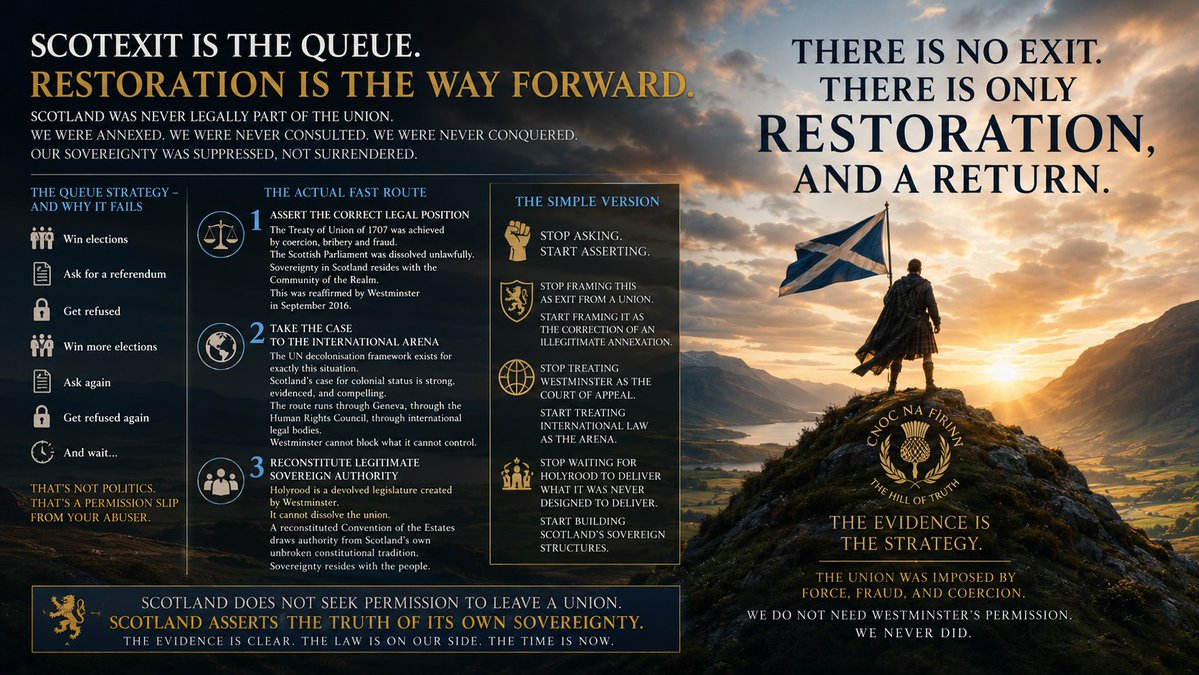
There Is No Exit. There Is Only Restoration, and a Return.
The fastest way forward isn't the one we've been sold.
Let me start with the word "Scotexit."
I understand why people use it. It's punchy. It conveys urgency. But it contains a hidden concession that costs us a lot before we've started.
"Exit" implies we entered. It implies the supposed union is a door we walked through and can walk back out of - when Westminster decides to unlock it.
That's not what the history shows. That's not what the law shows. And more importantly, that's not a strategy. That's a queue.
The Queue Strategy and Why It Fails:
For twenty years, the mainstream independence movement has been standing in a queue.
The queue works like this: win elections, ask for a referendum, get refused, win more elections, ask again, get refused again, and gradually - the theory goes - Westminster will have to say yes.
It hasn't worked. It won't work. Not because the numbers aren't there, but because the strategy contains a fatal flaw at its core.
It asks the entity that benefits from the union to adjudicate whether the union should end.
That's not politics. That's a permission slip from your abuser.
What the History Actually Shows:
Here's what years of serious historical and legal research - not campaigning, not lobbying, actual scholarship - has established:
The Treaty of Union of 1707 was not a voluntary merger between equal partners. The Scottish Parliament was not a legitimate signatory. It had been dissolved by Queen Anne under authority she derived from a Great Britain that didn't legally exist yet. Its members had been coerced, bribed, and threatened. The process violated the constitutional framework Scotland had operated under for centuries - a framework in which sovereignty resided not in the Crown, not in Parliament, but in the Community of the Realm.
That framework was never abolished. It was suppressed.
That's not a grievance or a myth. That's documented, evidenced, and - critically - it has a legal pathway attached to it.
The Actual Fast Route:
There is no fast route if "fast" means shortcuts. But there is a direct route, which is faster than the queue, because it bypasses the gatekeepers entirely.
It has three components:
One: Assert the correct legal position:
Scotland isn't seeking permission to leave a voluntary union. Scotland is asserting that a coercive annexation, carried out in violation of the constitutional order that governed the relationship between the Scottish Crown and the Community of the Realm, was and remains legally defective.
The claim isn't "let us go."
The claim is "what was done to us was unlawful, and we have never stopped saying so."
That's the position of the Claim of Right - reaffirmed by Westminster itself in September 2016, largely without its members understanding what they were reaffirming.
Two: Take the case to the international arena:
Westminster cannot block what Westminster cannot control. The UN decolonisation framework exists precisely for situations where a metropolitan power will not voluntarily relinquish a colonial relationship. Scotland has a stronger evidential case for colonial status - structural economic extraction, demographic decline relative to the incorporating power, suppression of legal and constitutional frameworks - than many territories that achieved UN recognition.
The route runs through Geneva, through the Human Rights Council, through international legal bodies where Westminster's veto doesn't operate.
This is the route currently being developed - quietly, carefully, and with serious legal preparation.
1/2
Continued 👇
Mark tells us that the Court of Session judged that Scots Law, in this case of malicious prosecution which did not ultimately result in a jail sentence, is incompatible with the European Convention for Human Rights. This has far greater consequence than the Anglo-British statute of 1995, the Criminal Procedure (Scotland) which led to Lord Lake's judgment.
Why? Scots law is not, historically, a creature of statute alone. Its true foundation is the Claim of Right (1689) — an entrenched constitutional document that is the very fount of Scots law and, through the Treaty of Union, of the United Kingdom's constitutional settlement as generally recognised. Without the Claim of Right, Scots law has no originating legitimacy. More profound still, without the Claim of Right, the entire edifice of the British Constitution lacks lawful meaning and agency.
Among the fundamental laws of the Claim of Right is this provision:
That the causeing persue and forefault persones upon stretches of old and obsolete lawes upon frivolous and weak pretences upon lame and defective probation as particularly the late Earle of Argylle are Contrary to law.
With thanks to Sara Salyers, this can be interpreted as follows:
Prosecuting people using obscure, outdated laws or vague offences undermines the rule of law.
Laws should be clear, current, and proportionate. Using archaic legislation or twisting or stretching the true purpose of legislation to fit modern political goals — or criminalising people on weak or politically motivated grounds — is unlawful.
Nothing could be clearer. The Claim of Right's prohibition is entirely consonant with the European Convention on Human Rights. Indeed, it anticipates the Convention by nearly three centuries.
So why did Lord Lake not refer to the Claim of Right? The answer lies not in any intrinsic deficiency of Scots law as written or interpreted, but in the constitutional settlement of 1707. That settlement preserved Scots law as a functioning legal system but in an act of decapitation it alienated, discarded and portrayed as a historical curiosity the Claim of Right instead of the directly enforceable constitutional instrument it was and remains, unless it is accepted that the Union is a constitutional fiction - the position of Liberation Scotland. Scotland's constitutional foundation was effectively set aside, replaced by the sovereignty of the Westminster Parliament. What remained was a truncated, expurgated version of Scots law — allowed to operate but severed from its own constitutional roots.
As Joanna Cherry KC has successfully argued before the Supreme Court, the Scottish constitutional tradition must be taken seriously. In her pleadings in the prorogation case, she submitted that where differences exist between Scots law and English law, the tradition "more limiting of the Executive's power to prorogue Parliament is to be preferred, the better to ensure the Executive's democratic and legal accountability." The same principle applies here.
Mark Hirst is right to take his case to the European Court of Human Rights. The reputation of Scots law depends upon this disgraceful prosecution being brought to justice. But for Scotland as a nation, something far more profound is at stake.
The Claim of Right — our fundamental constitutional document, admired internationally in its day, whose provisions found their way into the United States Constitution — has been sidelined. This has happened first through the political mechanics of the 1707 union, and second through the decapitated character of modern Scots law, which operates within an imposed constitutional framework that does not recognise its own origins.
That settlement must be challenged, not only in the Court of Session, but in the court of international opinion. Liberation Scotland is challenging it now.