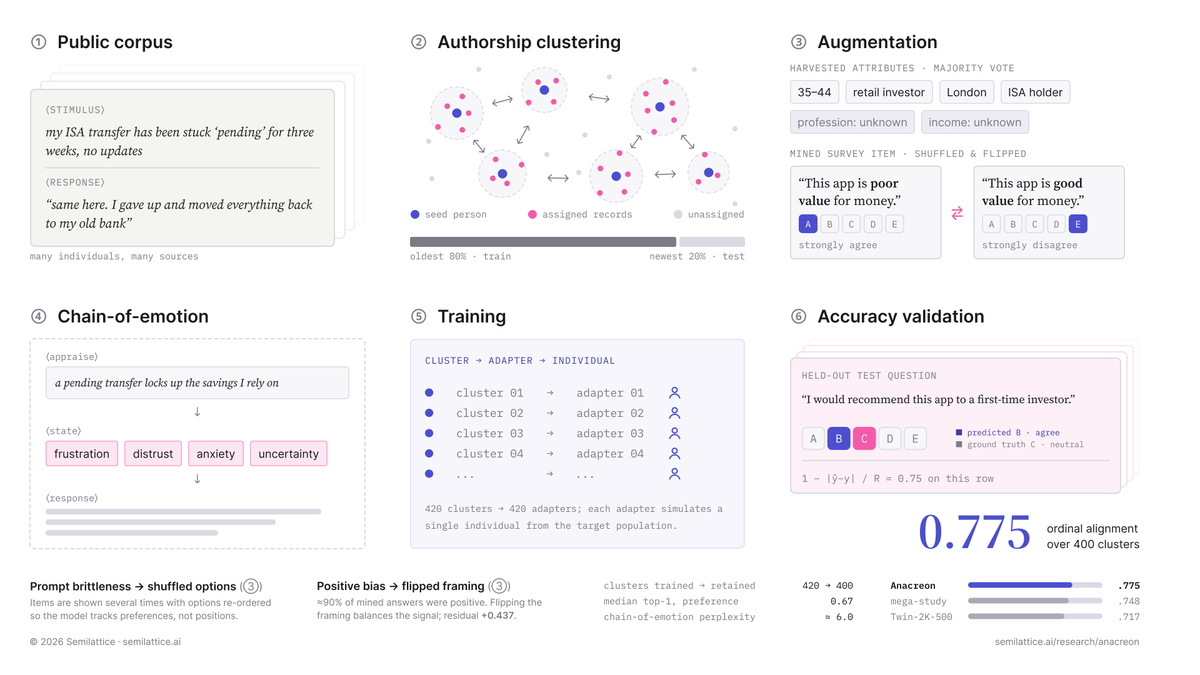
Anacreon, from @SemilatticeAI, trains separate models for groups of similar sellers. The median group matched 67.9% of multiple-choice answers in the company’s test; whether the full mixture predicts an audience’s opinion distribution still needs testing.
@lennysan@simile_ai@primitivelabsai@syntheticusers Hey - we (@SemilatticeAI) hosted the Lenny's meetup in London in July and gave a talk on this!
Lots of replies mentioning the problem of the "average user". That's only true of simple prompting-based approaches. Fine-tuning individual LLMs fixes it.
https://t.co/T6v7mC516Z
So good to meet all the product people at the Lenny's Newsletter meetup we hosted in London last week.
Drinks, pizza, and a lot of AI chat. We also gave a talk on predicting human behaviour.
Some highlights from the video:
• how representative sampling emerged in the 1930s
• how Simulmatics Corporation's "People-Machine" allegedly swung JFK's 1960 election
• why Thomas Schelling's segregation model counts as one of the first agent-based models
• why these methods and recent LLM-based approaches predict group aggregates but not individuals
• how Anacreon, our new human simulation model, closes that gap
We are excited to announce Anacreon, a new kind of human simulation model which achieves state-of-the-art accuracy at predicting individuals’ answers to new questions.
Existing methods of predicting populations are accurate at the aggregate level but break down at the level of the individual. Further problems persist around prompt brittleness and bias, making answers inconsistent across differently-worded questions and skewing results towards the preferences of majority groups.
Anacreon solves these problems by focusing on the individual. A large corpus of real human data is clustered around a target set of seed people, augmented with synthetic chains-of-emotion, and used to train individual adapters on a Gemma 4 12B base.
The result is a mixture of minds model of models—a population of hundreds of distinct LLMs which each represent different people in the original target population.
On person-specific sets of held out test questions, Anacreon achieves a state-of-the-art ordinal alignment of 0.775, the individual-level accuracy measure on which the field has converged.
Read the report to learn more: https://t.co/NY2NTay1AA
@claudeai > 1 skeptical user deliberately scrolled past
There's always one. We put this tweet in front of simulated developers: 4/5 watched the video
https://t.co/o4Mx0usLHK
We’ve made simulation titles better. They were pretty bad before, so this wasn’t hard!
They’re now set automatically based on all the context we have about the simulation, e.g. “Pricing information findability from the homepage” for a simulation testing if pricing information is findable.
Before it was taken down(!), we gave Claude Fable a single prompt: build a free personal finance product for UK consumers from scratch, plus access to Semilattice, and then left it alone. It shipped a working debt repayment planner, and every meaningful decision behind it traces back to a simulation it ran on our UK Consumer Finance model.
Before writing any code, it ran a discovery study and found that budgeting was the top money frustration by a factor of five, that 39.7% of people complain existing apps give them data instead of advice, and that 93.8% prefer a tool that doesn't connect to their bank. So the product keeps everything on-device and leads with a concrete plan rather than charts.
A concept test put three of Fables ideas to the audience. The Debt Freedom Planner won at 45.8%, even though only 11% were actively paying off debt, because a debt-free date and exact payments appeal broadly. That settled what to build, and surfaced one-tap sharing as a core feature off the back of an 84% word-of-mouth signal.
A headline test ranked five options. The winner took 46.7% in forced choice, and the same study killed every speed claim once 62.7% found "60 seconds" promises unbelievable.
Then a user journey simulation sent five simulated users through the live site. All completed the flow in under two minutes, and it caught three friction points: non-standard strategy labels, a hard-to-find example button, and confusion over where to find APRs, which it fixed before shipping.
Four simulations stood in for the rounds of user research a team would normally run (or not run) across weeks. Fable had the findings in minutes, each one specific enough to act on directly.
https://t.co/MgQHoQ0FZi
Big update to our MCP! You can now simply describe a product change you want to validate and it will plan a simulation, run it, fetch the results, interpret them, and give you options for next steps.
Use it to run simulated discovery, concept exploration, spec validation, feature prioritisation, message testing, conversion flow optimisation, UX comprehension, or usability testing in minutes.
All simulation data can be exported as markdown so your LLM can easily parse the findings into the next iteration. It gets very powerful when you run multiple simulations and merge the results!
https://t.co/19NVh9GiPj
Semilattice gives you an AI model of your audience which answers questions like they do in seconds.
Generate new user and market knowledge for every decision without delaying execution.
Try it now for free: https://t.co/1xCQ7LfcJH