I think this understates the stakes. The market is not just “tokens.”
Whoever has a truly frontier model can attack SaaS, search, cyber, consumer software, autonomous driving, robotics, enterprise workflows, and eventually physical AI.
So I don’t buy the idea that this becomes a normal commodity market. Maybe it is not one winner, but the final cohort will be ultra small — probably 3–4 players.
That’s why the spending can look irrational from the outside. For the frontrunners, there is almost no choice: overpay now to build the mega-model, or lose control of your future later.
I think this understates the stakes. The market is not just “tokens.”
Whoever has a truly frontier model can attack SaaS, search, cyber, consumer software, autonomous driving, robotics, enterprise workflows, and eventually physical AI.
So I don’t buy the idea that this becomes a normal commodity market. Maybe it is not one winner, but the final cohort will be ultra small — probably 3–4 players.
That’s why the spending can look irrational from the outside. For the frontrunners, there is almost no choice: overpay now to build the mega-model, or lose control of your future later.
@bennpeifert Benn, thanks for the clear and honest write-up. Rare to see a PM share this level of detail.
My take: QVR didn’t lose because one trade was dumb. They lost because many “uncorrelated” dislocations quietly became one meta-trade: short persistent convexity-demand repricing
I’d separate “filters” from “state conditioning.”
A filter that just removes historical losers is usually curve-fit bait. But entry-time state conditioning is different: vol regime, RV/IV, liquidity, trend/chop, event risk, etc.
The point isn’t fewer trades — it’s avoiding regimes where the payoff profile becomes structurally adversarial
You came across something in your manipulated algorithm with market data input feed, something that jived with your implicit biases and served your confirmation bias, and subconsciously applied your emotional filters and called it proof.
#0DTE#SPX500#algotrading
I've done transactions in fiat and bitcoin. I haven't done transactions in gold, Apple stock, or anything else.
I can send bitcoin to anyone with an internet connection globally, within the hour on-chain, or within seconds via Lightning, with no centralized party capable of blocking it. Meanwhile, my international fiat wire transfers take days and often get blocked by centralized parties and then I have to sort through layers of bank customer service to figure out which side the blockage occurred on and why. Happens all the time.
And recipients of international dollar transfers that don't have access to eurodollar accounts often get forcibly converted into local currency at fake exchange rates, whereas sending bitcoin can reach them directly, around their local banking system.
Bitcoin can be brought across borders in unlimited size, whereas fiat and gold are very limited at ports of entry. That doesn't matter much to most Americans but it can matter a lot for people in the 160+ other currency monopolies in the world that often want to leave one country for another with their savings intact. It's not theoretical- I personally know people that have done this and have fled hyperinflationary jurisdictions thanks to it. That's a monetary use case.
I've spoken with plenty of human rights advocates in authoritarian countries who turned to bitcoin when their bank accounts were frozen. It helps them keep receiving donations, keep their funds from getting arbitrarily taken, etc. That's another monetary use case. It's the fallback for financial de-platforming, confiscation, censorship, etc.
When I travel globally, which I do many times per year, I can't access any of my physical gold in the United States, and all of my modes of payment (other than a small wad of physical cash) are reliant entirely on an international chain of credit- I have to trust my U.S. banking institutions and their various counterparties to keep my cards working. But I can customize some of my bitcoin setup so that I can access self-custodial bitcoin anywhere, which could be helpful in a pinch. In some countries I can spend it directly on merchants, while for others there are peer-to-peer marketplaces to convert it to local currency, which greatly increases my options if need be rather than making me entirely reliant on my institutions back in the US.
So, what someone gets by holding bitcoin is optionality and global availability that their other monies can't provide them, and in a package that has less ongoing supply dilution than fiat or gold (and ultimately with zero dilution).
And then on top of that, there is an investment thesis that this money will continue to catch on due to having the above-mentioned characteristics, and thus reach closer to its total addressable market (which is basically anyone who wants to hold some nonzero percentage of their net worth in self-custodial and globally portable money that can't be diluted). Even if one is in a jurisdiction where they don't feel those attributes are helpful to them and thus doesn't directly hold it for its monetary properties, they might instead hold it within an investment vehicle because they view those attributes as being attractive to others and thus likely to continue gaining adoption.
The majority of bitcoin doesn't move very often, because it's held for savings or a long-term investment outlook. But the fraction that does move, can move with very high velocity due to how efficient it is. Due to the fact that modern monies get rapidly diluted, we tend to treat money and investments as separate, whereas with bitcoin, some portion of it can be locked away as savings/investment, while another portion can be used for spending or working capital.
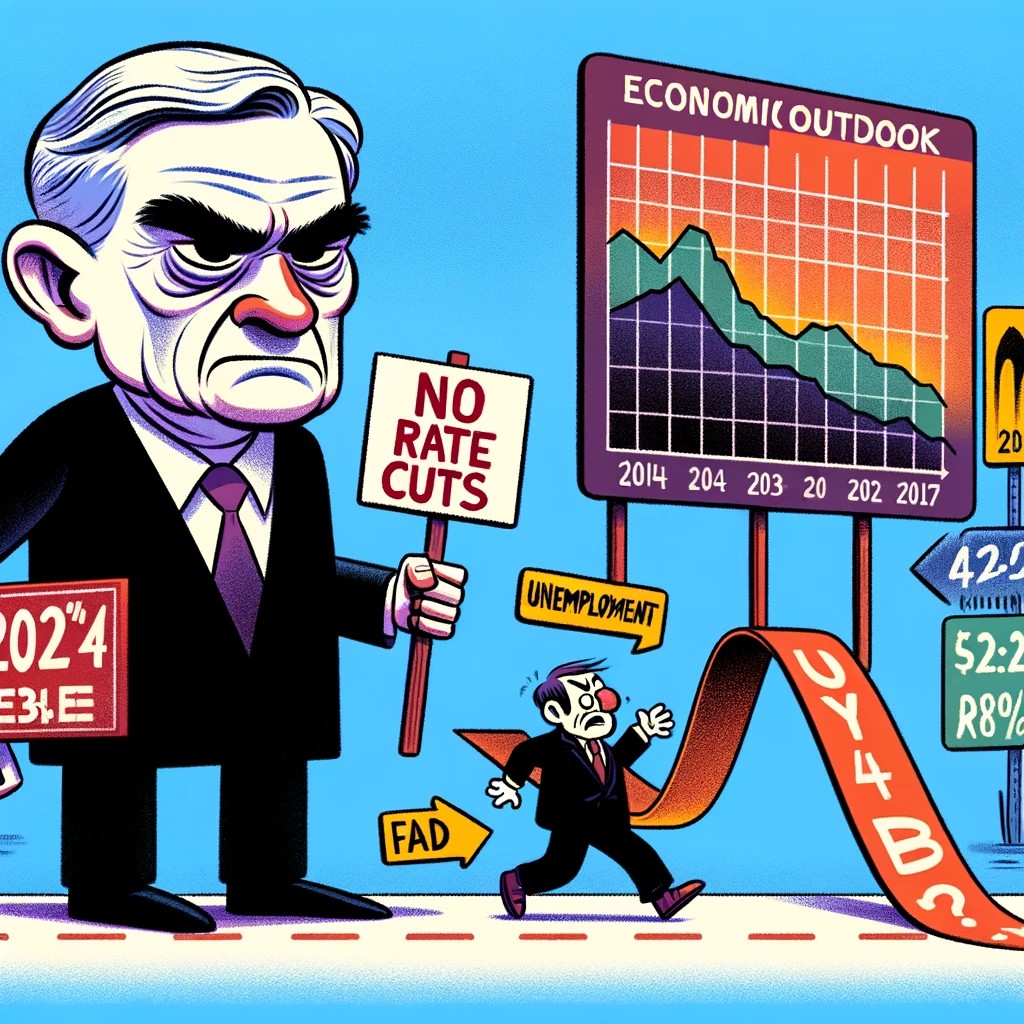
Contrarian Economic Outlook 2024: No Fed rate cuts expected in first 7-9 months. CPI and unemployment rates to show minimal fluctuations, maintaining near-current levels. #Economy2024#FederalReserve
2/ Market Predictions: S&P 500 anticipated to remain range-bound, fluctuating within a 4550-4850 band. Indicating a year of limited directional movement in the equity markets. #SPX#MarketTrends2024
1/ Contrarian Economic Outlook 2024: No Fed rate cuts expected in first 7-9 months. CPI and unemployment rates to show minimal fluctuations, maintaining near-current levels. #Economy2024#FederalReserve
3/3: This complex financial tapestry weaves together a narrative of optimism and caution. It's a dynamic dance of market forces, where confidence and wariness coexist, shaping the intricate rhythm of investment decisions.
1/3: In an unprecedented financial landscape, the market shows a vibrant, bullish face with record November gains and surging investor confidence. A rare blend of robust economic indicators and soaring equities paints a picture of optimism.
2/3: Yet, beneath this surface, there's a hint of speculative excess, suggesting a potentially overbought market. The rush towards riskier assets, coupled with low volatility, might mask underlying vulnerabilities.
Conclusively: "maximum bearish equities" for 2023; next two months dominated by macro factors rather than seasonals; any seasonal premium in the market to evaporate quickly due to market positioning #SPX#SPX500
I vote for 4500 by EOY
Let's try this again
Santa is not supported by the flows at these levels. Here's the DSR "Dead Santa" that I wrote in October. It's outdated and positions were covered on 10/31 but still relevant to why I re-shorted last week
https://t.co/4JAkKJjlzk
Casting my line to catch the bottom...🎣 Awaiting a tradeable reversal on the horizon. SPX November expiration -> at 4600. 📈 #TradingOutlook#SPX#SPX500#SPY#TLT#0DTE
Thread 1/5 📈 Market Outlook 11/18: Exploring current trends with a focus on seasonality as a firm market driver. Delving into Fed rate perspectives, economic signals, and strategic positioning. #MarketAnalysis#Investing#SPX
Thread 4/5 3️⃣ Market Positioning: CTA's shift from a record short to overbought signals potential market turning points, yet the absence of strong fear/greed indicators adds complexity. #MarketDynamics#InvestorSentiment#SPX