Today, EIP-8025 was DFI'd for the Hegota hard fork.
On the surface, some may interpret this as a rejection of execution proofs as a concept. However, my experience has been quite the opposite.
Over the past year working on this EIP, I've witnessed overwhelming support and collaboration from across the Ethereum community.
Over the next few days, we'll be shipping execution proofs on Sepolia.
Onwards!
I feel like we're misinterpreting what DFI means here. We are not throwing away anything. Today's decision changes nothing; we're still going to work on optional proofs. Many (including myself) are very supportive of the EIP and want to see it in production. The primary reason it was DFI'd is because it would complicate the specifications for Hegota. This EIP doesn't need to be associated with an upgrade; it can exist as an experimental/optional feature.
I can't understand how Optional Proofs got DFI'd.
Usually, ACD wheights urgency, risk/complexity & upsides.
For this EIP, there's no risk at all (doesn't drive consensus), it's not complex (as per protocol, the complexity is outside), and the upside is fostering the research path further and acknowledging is worth to keep porsuing with the expectations of giving productive fruits in a couple years.
As someone working on state-related topics, this is ofc an EIP that makes me consider hard questions, many for which I don't yet have answers. Makes me unconfortable sort to say:
- Who is gonna keep the state when ZKEVM becomes real?
- How do we incentivize holding & serving state?
- How do we lower the entry-barrier to nodes participating in the network and being seeders?
- How do we make holding state long-term viable?
- Can we marry state <-> zkemv somehow?
- Can we keep the network decentralized enough?
I don't have answers. But it's IMHO better to work on this, and try to get to good results, improvements etc.. Than simply closing the door onto it and moving to the next thing.
We have to stop throwing fucking work to the bin. Work that was fully prepared, tested and ready in clients. Specially when the work isn't changing almost anything now, but potentially a lot in the future if it's good. And if not, there's gonna be plenty of time to kill it in the future (as happened today).
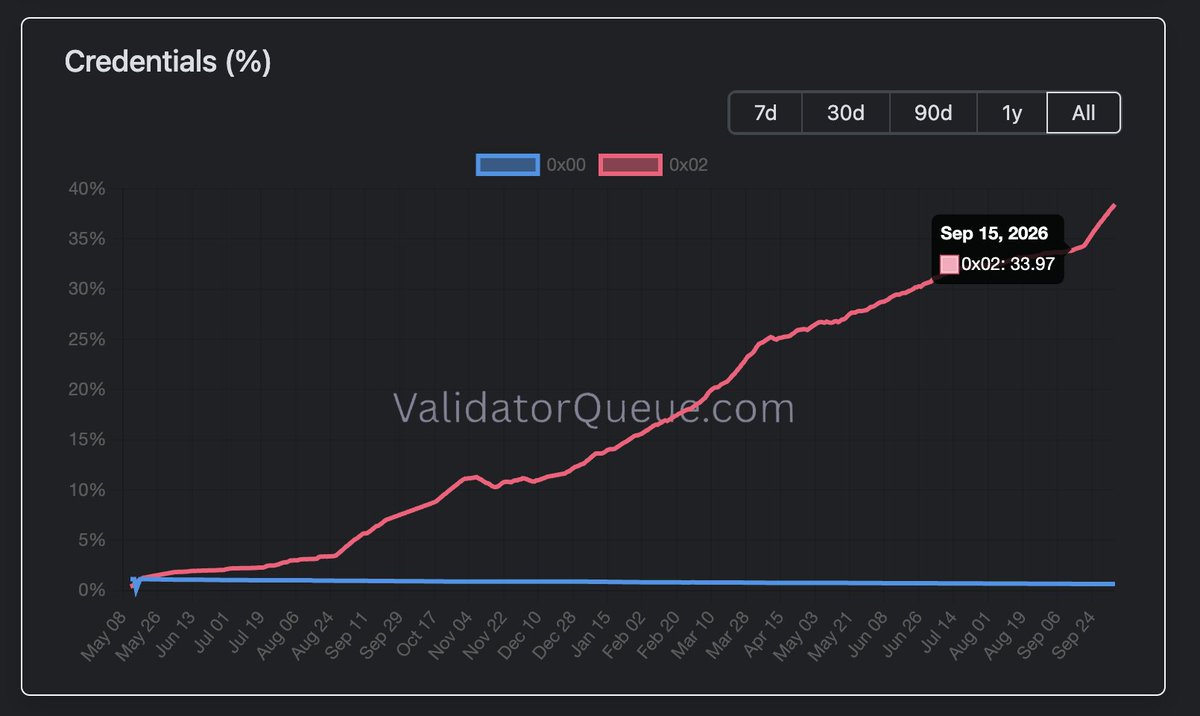
Can you see this steep increase in 0x02 validators' share? Right when @LidoFinance started mainnet consolidations.
50% of @ethereum stake under 0x02 validators soon!
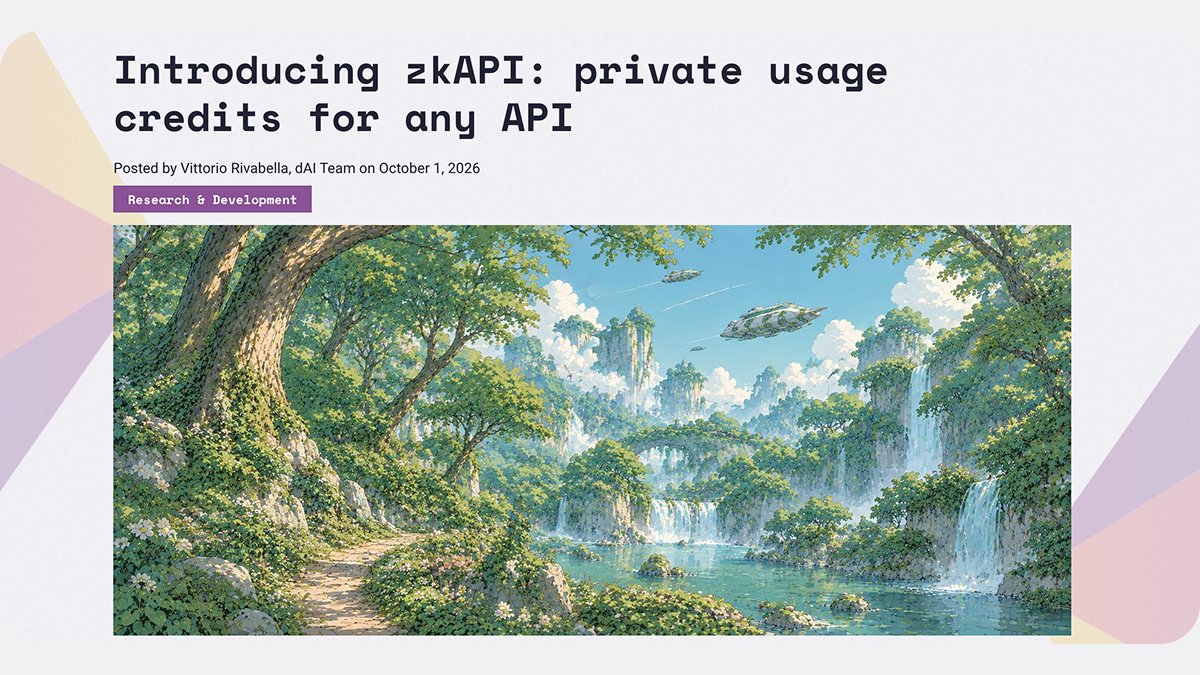
Today the EF and OA announce zkAPI—a new means for private AI
Picture this: deposit ether into a vault, sign a zk proof, get a fixed amount of private inference. Advances like these help us move past middlemen's requirements that we link our data and identities.
Read more below
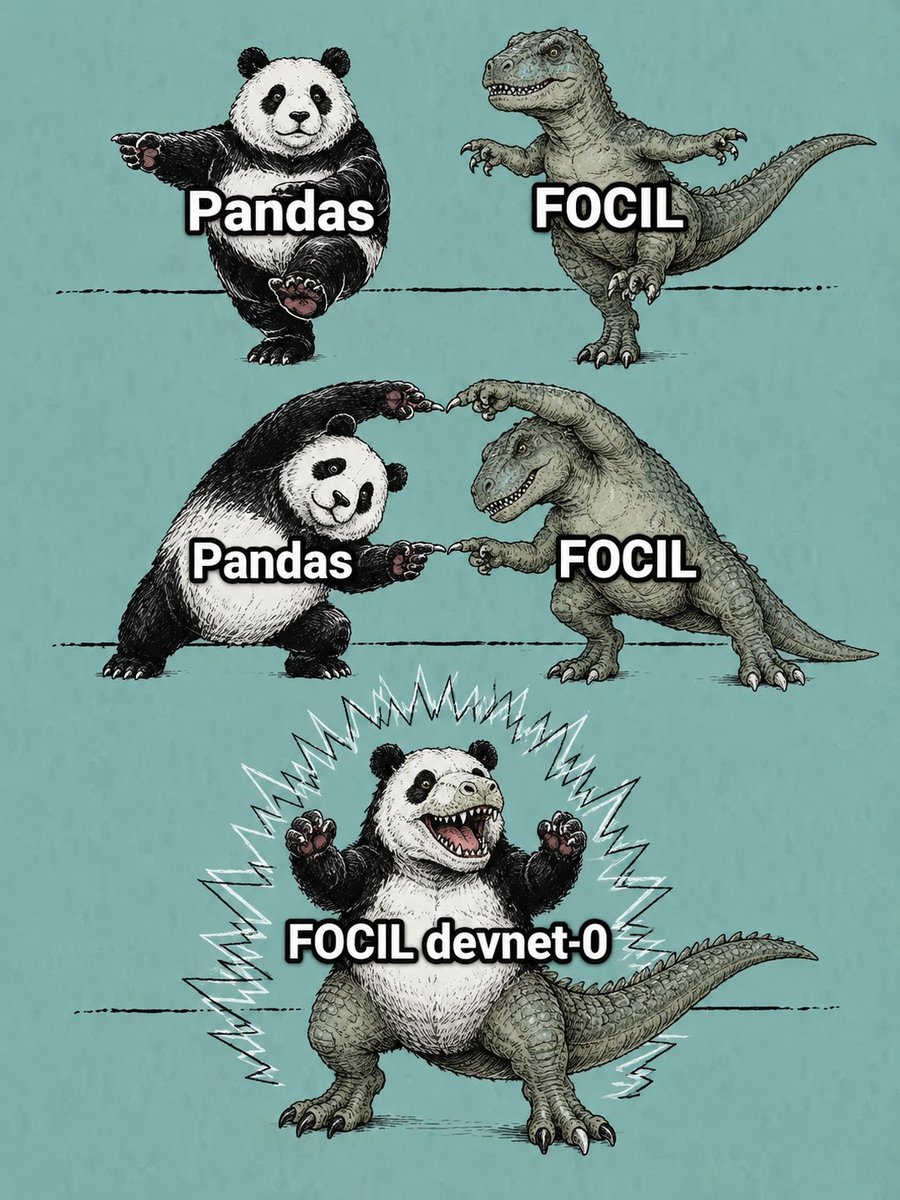
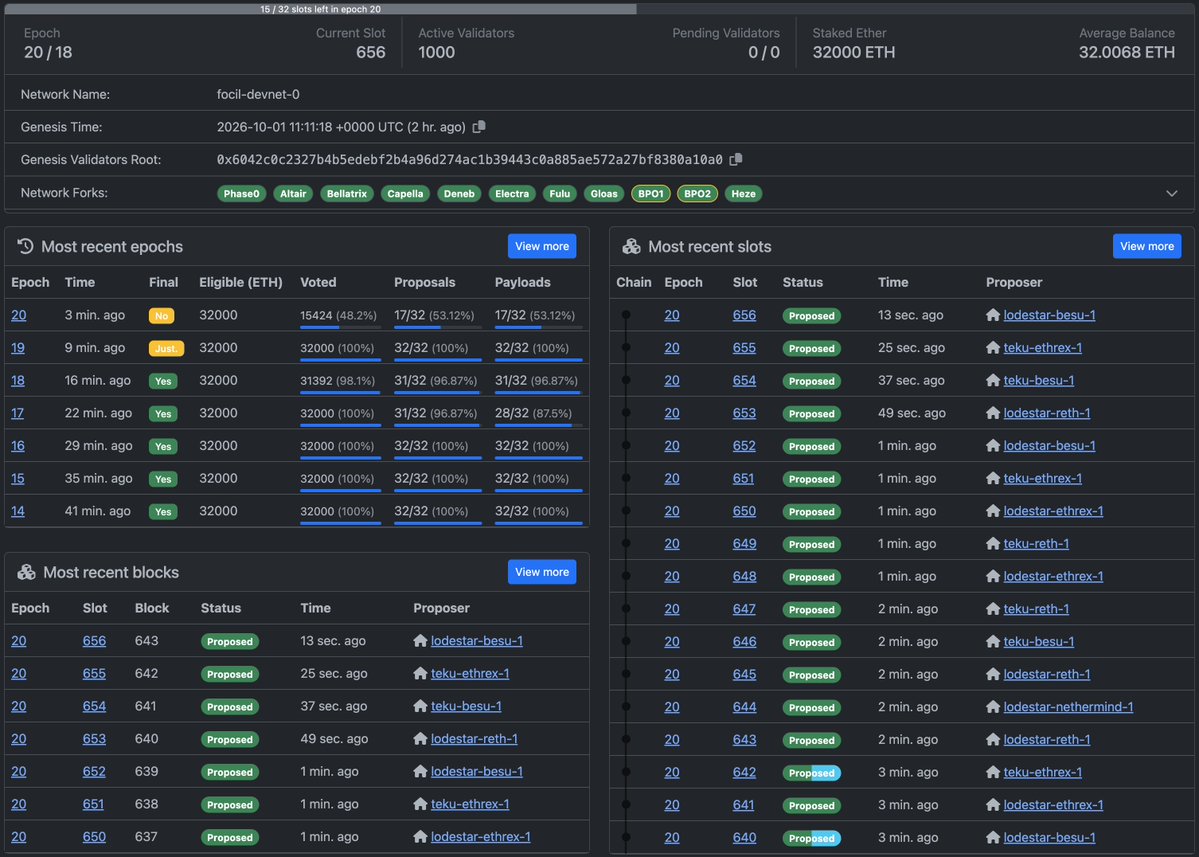
Finally, FOCIL devnet-0. It took around 5 years to go from an insightful idea to an actual devnet. Advancing the most decentralized network takes a tremendous amount of work: exploring the design space to find a solution that solves the problem without sacrificing the properties Ethereum cares about, writing down the specification and building a prototype, iterating to improve the design, finding and handling edge cases, and the list goes on.
Just like being able to travel across a country using only cash, we sometimes take things for granted and forget that they might not be guaranteed. But we shouldn't. You should be able to do what matters most using only the protocol’s most basic functions.
FOCIL strengthens Ethereum as a freedom technology. It’s a big step forward but not a silver bullet. More features are in the pipeline.
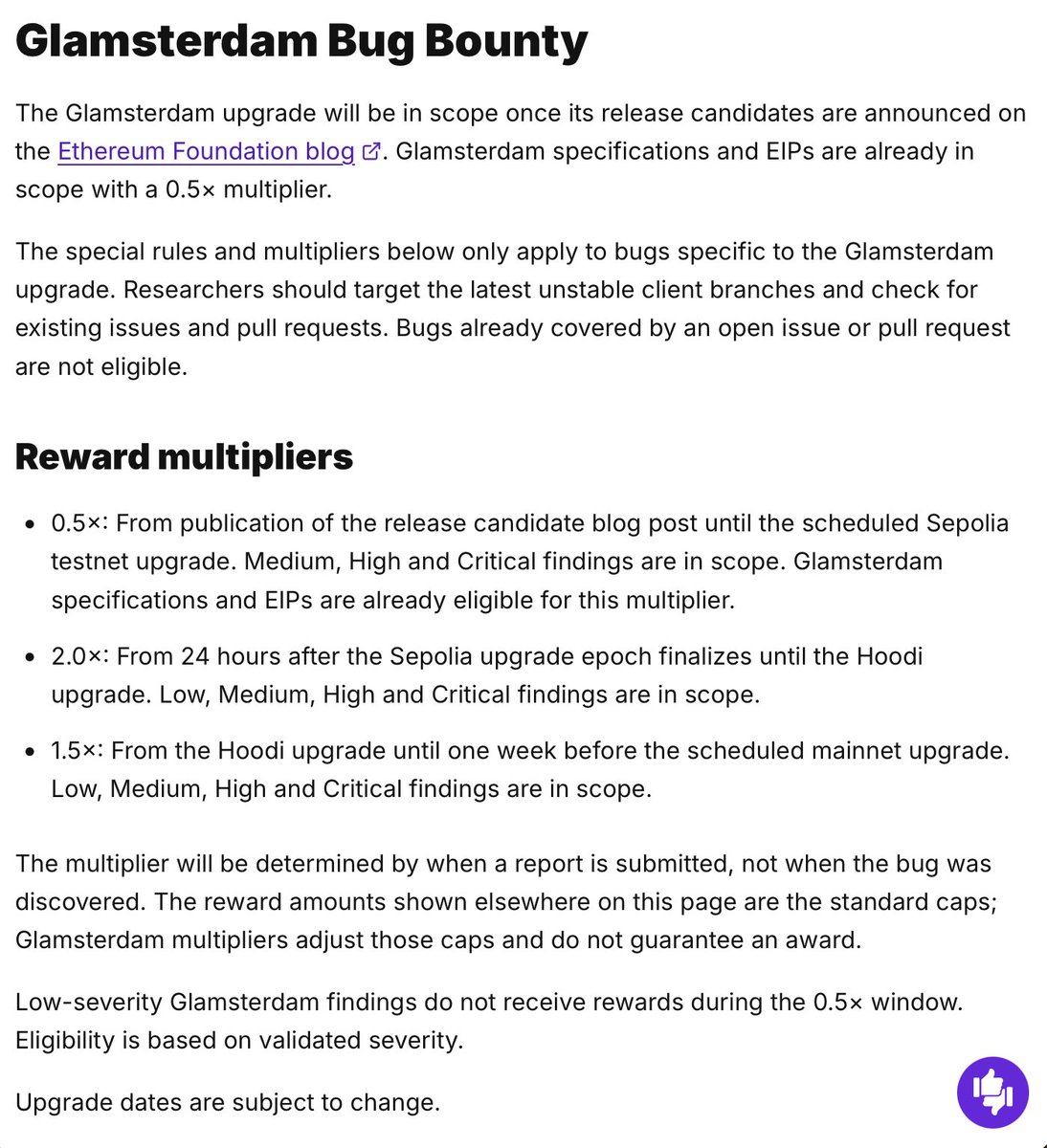
Glamsterdam security vulnerabilities are now in scope for the Bug Bounty Program (https://t.co/MaBGlzTJ9S)
Come help us secure Ethereum to earn rewards and your place on the leaderboard alongside legends like @revofusion@mhswende and @GuidoVranken
Glamsterdam is coming, and it is bringing blocks built without trusted relays (and a lot more)!
The Sepolia testnet upgrade has been scheduled for 6 October of this year. Hoodi and mainnet dates will be announced separately. Activation table, client releases, and info on the bug bounty program can be found here: https://t.co/MofsBXr4ID
It's an underappreciated triumph of Ethereum client developers that PeerDAS has now been running for nearly a year with basically no problems.
PeerDAS was a complex task: it's the first large-scale instance of a blockchain that achieves consensus on the availability of data without needing any single node to download the entire block. Decentralized consensus without replication.
And yet, it worked.
The Fast Confirmation Rule is a new rule that may soon be relied on for millions of $$$s in bridging volume. Here is how we keep it secure.
- FCR is an algorithm clients run locally instead of something they read from the chain (like finality). It's more complicated to implement. That is why we advise all users to leverage client diversity and rely on the output of at least two different consensus clients. For example, only fast confirm a block if both Lighthouse and Teku fast confirm the block.
- @fradamt is working on formal verification of FCR. That would mean FCR's safety guarantee is proven against the Ethereum consensus spec's FCR implementation (under the regular FCR assumptions).
- Both the consensus spec as well as client implementations are now covered under the Ethereum Foundation's Bug Bounty Program. That means bugs found by security researchers could lead to good payouts!
@thybead Maybe. If you find a fairly simple bug which you expect others will also find, there’s an incentive to report it before the 2x multiplier. Some money is better than no money 😅
Security researchers, get ready! The Glamsterdam upgrade is approaching. The Ethereum Foundation’s bug bounty program will begin accepting reports for Glamsterdam bugs once the Sepolia upgrade blog post is published. And take note of the reward multipliers!
https://t.co/kd8nURQfwR
The first validator consolidation on Lido Core has successfully landed 🎉
This marks the beginning of migrating ~8.4M staked ETH from the legacy Curated Module to the new CMv2.
@SerenitaIO@serenita_luca Your rankings look very reasonable 👌 And I’ve suggested the same thing (tick-tock model, like Intel) within my team a few times too 😄
We believe Ethereum upgrades could benefit from a tick-tock cadence.
Glamsterdam is the big upcoming "tick": ambitious, complex, and feature-heavy. With it shipping shortly, we think Hegotá should be the shorter "tock" focused on maintenance, cleaning up technical debt, and making a few targeted improvements ahead of the next major upgrade.
Alongside FOCIL, we favor proposals with clear near-term benefits and low implementation and testing complexity. More ambitious changes should wait for the next "tick".
Our consensus-layer EIP rankings are below. For more details on the reasoning behind each ranking, read the linked article 👇
https://t.co/RIH4IrBX6l
The Protocol Cluster has published two new posts:
Hegotá EIP Opinion Post and Tier List evaluates and grades all 62 EIPs proposed for Hegotá, providing the cluster’s first unified tier list for a network upgrade
Current and Emerging Priorities covers commitments and research arcs, anchored on a quantum-resistant Ethereum L1 by Dec. 2029
Offered as one input to Hegotá scoping, roughly 60 researchers, engineers, and individual domain experts across all 9 teams in the Protocol Cluster contributed to the Hegotá tier list, providing 397 tier grades before discussing contested items live.
The plan, commitments, and shared set of cluster-wide priorities covered in the companion post provide the context behind the final tier grades.
The Protocol cluster will host a Reddit AMA on r/ethereum on September 16 at 2pm UTC to talk through these priorities, the Hegotá tier list, and anything else on your mind.
→ Submit questions ahead of time here: https://t.co/KyX3uu8qqZ
Read the articles here:
→ EF Protocol - Current and Emerging Priorities: https://t.co/4OuNa2nnId
→ EF Protocol - The Hegotá EIP Opinion Post and Tier List: https://t.co/vBOWQnztcd
I realise talking about specific fork upgrades, EIP numbers and technical arguments doesn't always help get the message across to people that are not spending their life in the weeds of all this, so here is one attempt:
Today, physical cash lets you pay someone without telling the world or trusting a middleman. This level of privacy and freedom should be the baseline. We shouldn't settle for less.
So the first, and maybe most important, goal is to bring this level of freedom to the digital world, so we don't need to meet in person and hand over pieces of paper to benefit from these privacy guarantees.
Beyond that, what Ethereum can uniquely enable is private DeFi beyond transfers and payments. I honestly don't think this exists in the world just yet, and the idea of letting anyone lend, borrow, vote and trade without publicly linking those actions to them, without asking permission, and without relying on a trusted middleman is very powerful.
This is one of the reasons I'm so passionate about working for Ethereum. There are challenges, but digital independence is a future worth building towards.