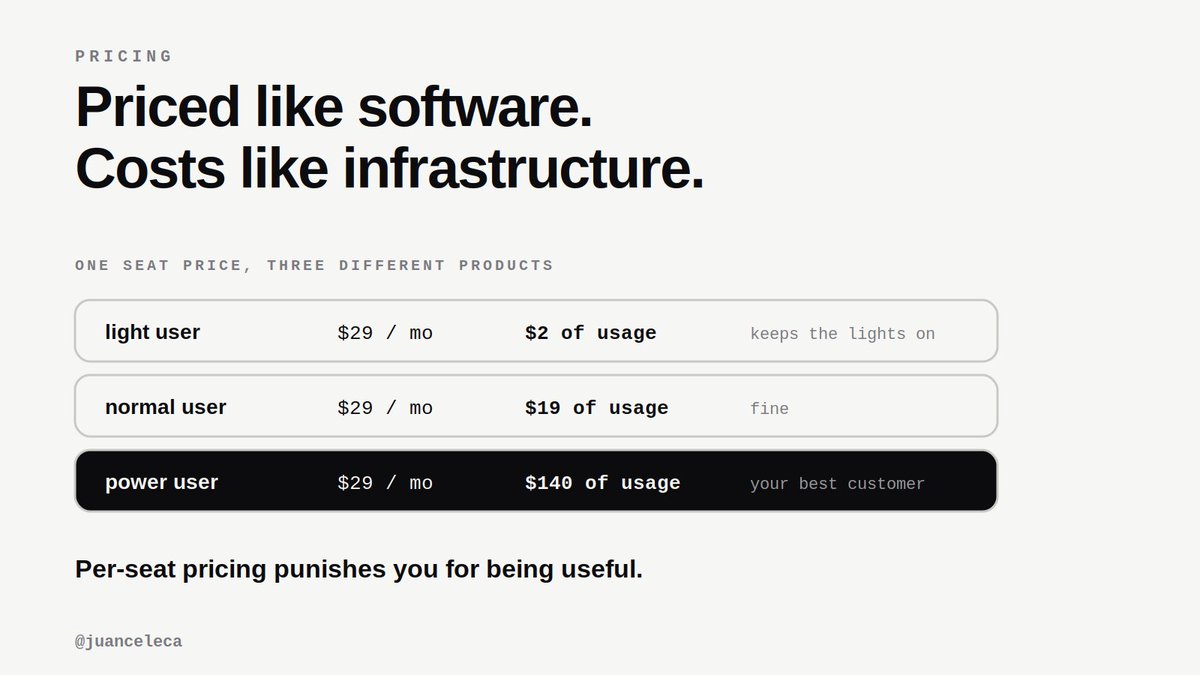
Most AI products are priced like software and cost like infrastructure.
Same $29 seat. One user burns $2 a month, another burns $140.
The second one is your best customer and the one losing you money.
Per-seat pricing punishes you for being useful. Charge for the work done, not for the login.
Free idea: a grader that tells you if your landing page looks AI-generated.
Paste a URL, get a score and the three things giving it away.
Every founder shipping this year needs it and none of them can see it on their own site.
@lucas_builds Nope, I think we share because we want to say something that’s more important than search for impressions. That’s real and not that ai slop
The best distribution advantage is timing.
Pick a shift people are already arguing about, ship the smallest useful thing in days, and let the conversation carry it. You're not buying attention, you're standing where it already is.
Forced marketing is what you do when the timing was wrong.
The model is not your moat. Neither is your code. Both are one prompt away from being copied.
What's left is the stuff AI can't generate: trust you earned over time, a community that shows up, a database nobody else has because it took years of real usage to fill.
Everything cheap to build is now free to copy. Build the expensive parts.
Thanks to @marclou for this exceptional ideas video here: https://t.co/sMqS55MJgq
A Berlin artist built a shirt that AI cameras can't see.
The interesting part. It's how he made it. Simon Weckert (@simon_deliver) put the detector in the loop: generate a pattern, show it to
An object-detection system, measure how confident it still is that there's a person, adjust, repeat until the confidence collapses.
He didn't design something and hope. He optimized against a score.
That's the same loop you should be running on your prompts, and almost nobody does. Most people write one, eyeball the output, ship it.
He also says plainly that it fails in some frames and guarantees nothing, which is more honesty than most AI demos give you.
The shirt is art. The method is engineering. Cool stuff
Image from: https://t.co/wqvALbdxsZ
Opening access for developers to build Muse connectors. You bring the API -- Muse brings the agent, the browser, and the context of what the person actually wants. People reach your service just by asking for it, and their agent takes it from there.
New connectors are live today. Come build with us. https://t.co/o6oTf1Sj9y
Everyone's talking about Jev. Almost nobody explains what it replaces.
It's not an LLM. It doesn't generate text at all.
You send it two things: a state and a set of typed questions.
The state is just whatever your code already has in hand at that point in the flow. A support ticket. A call transcript. A diff. The user's last message plus their plan and their usage this month.
Unstructured, no schema, you dump it in. The questions are what you need to know about it. Is this urgent. Which tier is this user. How risky is this tool call.
Jev answers all of them in one parallel pass. Not sentences: a choice, a score, or a yes/no, each with a probability.
is_urgent → true, 0.99
Three things follow.
It's fast. 70 to 500ms
It can't hallucinate.
And the confidence is usable.
So what it replaces is the LLM call you were making for a decision that was never open-ended. Keep the LLM for reasoning and writing. Give Jev the small calls your agent makes constantly: which model routes this, is this action safe, did this call go well.
Frontier intelligence as an if-statement.
@PaulKlayVC what’s your day looks like? I’m starting to post on X and keep working on my side project while working. what’s the most important thing that you do?
7 MCP servers I use to ship products:
Supabase → query the real DB
Vercel → deploy + read logs
GitHub → PRs without leaving the chat
Playwright → test the flow in a browser
Apify → live data from any site
Excalidraw → diagrams from a prompt
Context7 → docs I should use more
Grok Bot can now do all your email marketing
Introducing our official integration with Grok Bot 🎉
Design, segment, and send high converting email campaigns natively.
Introducing Memorable (YC S27): PROCEDURAL MEMORY FOR AI AGENTS
AI agents today are born, work, and die inside a single context window. They solve a hard problem once, then start from zero when it returns.
Memorable turns successful runs into a graph of reusable procedures.
So every task makes the next one:
- Faster.
- Cheaper.
- More deterministic.
We’re excited to share that Memorable is joining Y Combinator’s S27 batch.
Try it: https://t.co/DUAVdejTzZ
My favorite AI tools right now:
coding + orchestration → Orca, Claude, GPT assistant → Grok research → Gemini Deep Research images → Higgsfield diagrams → Excalidraw tasks → Google Tasks deploy → Vercel