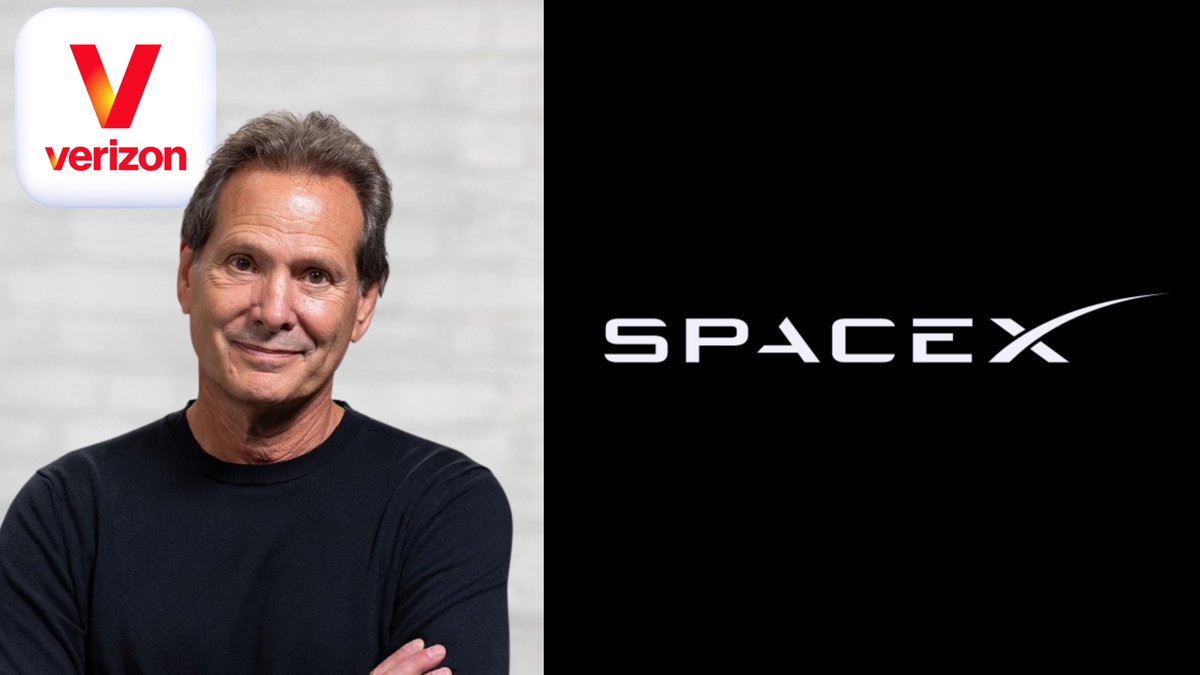
Verizon's CEO said today that SpaceX will need at least 4-6 years and $300B-$500B to fully build out its @Starlink Mobile U.S. carrier network:
"Their service just can't compete with a terrestrial network. In suburban and urban areas, where 98% of our revenues are, we're somewhere between 100x–1,000x more efficient than they are. We know exactly what they're going to do. We know who they're talking to on towers. There's no magic wand. There's no secret sauce. There's no shortcut.
They're going to look at 65,000–80,000 macro sites. They're going to need backhaul, RAN, and a tremendous amount of spectrum. It's going to take a minimum of four to six years to fully build that out. It's going to cost hundreds and hundreds of billions of dollars, I assume somewhere between $300 billion and $500 billion.
Then they need to build retail, customer service, back office systems, et cetera. All of that gets them basically the same network and same capabilities and same cost structure as what we have today. Then sometime over the next four to six years, they have the possibility of becoming the sixth, not the fourth, the sixth competitor in the market.
You can be sure over these next three to five years or six years, we are not going to be standing still. Four to five years from now, we will be two to three generations better than where we are today. We will have high-speed broadband gig-plus coverage across the country with our millimeter wave. We are ahead of most people and already experimenting with what 6G applications will look like."
(via Verizon's Q3 earnings call earlier this morning)
Check out Voxborn, a stylized voxel action RPG where destruction and combat shape a dark, evolving world. Fight your way through dangerous encounters with your loyal dog companion by your side!
Warren Buffett’s Investing Rules: When to Buy, Hold, and Sell
📉 When a stock drops:
• Down 5% → Do nothing
• Down 15% → Increase your position by 10%
• Down 25% → Increase your position by 25%
📈 When a stock rises:
• Up 5% → Hold
• Up 15% → Keep holding
• Up 25% → Sell 10%
• Up 35% → Sell 20%
• Up 45% → Sell 30%
• Up 60% → Sell 40%
• Up 100% → Sell everything
Long-term investing requires discipline, good timing, and a well-defined plan.
There are no reliable shortcuts to building wealth.
here's why you should play my Zelda-inspired MMO:
📜 go questing in co-op with 3 friends
🛡️ upgrade gear and deck out your knight
⚔️ optional open-world faction PvP
I made a cozy fishing game alone with Claude Opus 5.5, Blender, a 3D model generator and Unity 6, and the whole method is one rule: every tool gets one job and never touches another.
The setup:
Step 1 -> Tripo Smart Mesh P2 generates every model: palms, rocks, the pier, the boat, the hut, the character.
Step 2 -> Claude Code hooks into Blender through MCP.
Step 3 -> Opus 5.5 preps each model in Blender: scale, pivots, materials, clean export.
Step 4 -> Opus handles the animation in Blender as well: the walk cycle, the cast, the rod, the boat bobbing on the water.
Step 5 -> Everything lands in Unity 6 and the world gets built: forest, river, waterfall, beach, pier.
Step 6 -> Systems arrive one at a time: walking, fishing, bait choice, time of day.
Step 7 -> After every step I play it and fix exactly one thing.
The split:
> Tripo: the 3D models.
> Opus 5.5 + Blender: setup and animation.
> Unity 6: the world and the game.
One person, one stack, and a game you would actually sit down and play.
🚨NEW EXPERIMENT 🚨
Playground is an experimental gaming platform that lets you create your own games with zero coding experience. If you can think it, you can play it.
Go to https://t.co/fRUukpuoqM to learn more! Available to users 18+ in the US.
Today we’re introducing Gemini 4 Argon.
It delivers frontier performance in complex workflows across real-world software engineering, knowledge work, and cybersecurity defense with an industry-leading 1M token output limit.
Para que este maravilloso dispositivo pudiera ser implantado, tuvieron que pasar más de 20 años de investigaciones. El dispositivo BiVACOR Total Artificial Heart es la posible compuerta a una era en la que los corazones mecánicos sean una alternativa más viable que los trasplantes humanos.
Jason Mamoa gets it: "I don't need anything more than a surfboard, a grill, and the people I love nearby. I'm not interested in fame, expensive suits, or luxury cars. I'd rather climb a tree, watch the sunset, and have a whiskey on the beach. My wealth is in my simple life. Because at the end of the day, what really matters can't be bought."
Before dating any woman,
I asked my mom what I should look for in a woman.
I thought she would say:
Low body count
No guy friends
Don’t go to clubs
But instead she said this:
I used Cursor to vibe code a simple fishing game prototype on the Unity Engine. Here's my learnings:
- I did not use any Unity MCP for this. The game was built entirely by Cursor models (Sonnet 4.6 for execution and Opus 4.6 for planning)
- The model was able to set up the game, getting the basic game mechanics working fairly quickly
- I had to use the Unity Game Editor UI to attach components to the in-game objects manually, but it was quite easy to follow the instructions given by the Cursor model
- Unity Editor is huge and slow! Compared to Godot, I find the UI really clunky I feel tired looking at it
- Unity Assets Marketplace is amazing, there are so many amazing art assets there (like the ones I am using for this game). This is probably the biggest strength of Unity.
- I had some issues with restoring checkpoints, probably because of how Unity Game Editor UI being really clunky and I had to manually adjust things in the Editor, which the model doesnt have knowledge of
Overall, the results turn out pretty decent, but it was a rather frustrating experience, especially when I had to debug issues or rollback changes.
I'll explore more vibe coding on Unity but for now, I think I prefer Godot as a game engine. I just wish there is a Godot Asset Marketplace!