🇲🇽🇺🇸 ⛽️ El huachicol fiscal ya no se explica con una toma clandestina y una manguera.
Es una red de dinero, aduanas, empresas y combustible que cruza fronteras.
México compró Deer Park como símbolo de “soberanía energética”.
Ahora, una investigación de la FGR señala que más de UN MILLÓN de litros de gasolina salidos de esa misma refinería de Pemex terminaron en una operación de presunto contrabando hacia México.
La paradoja es brutal: Pemex produciendo en Texas combustible que presuntamente entraba ilegalmente a México.
La pregunta ya no es quién ordeñaba los ductos.
Es quién permitía que funcionara toda la cadena.
México quiso convertir el Istmo en un gran corredor industrial. El Estado puso tierra, trenes, puertos, infraestructura, estímulos fiscales y millones en estudios. Tres años después, el dato es brutal: 14 polos de desarrollo y, según la información disponible, cero empresas operando en ellos.
Lo más preocupante no es sólo el retraso. Concesionarios han salido, el Gobierno ha tenido que modificar el modelo para permitir venta y arrendamiento de lotes y flexibilizar los incentivos fiscales. Algo en el diseño original claramente no está funcionando como se prometió.
Y aquí aparece el verdadero problema de Estado: no basta inaugurar obras, firmar concesiones o presumir inversión. El artículo 134 constitucional exige eficacia. Un parque industrial sin industria no genera desarrollo. México necesita menos indicadores de papel y más empresas, empleos e inversión real. Ahí es donde se mide una política pública.
Twenty-five years ago, a woman stood in the hole an airliner had punched through the North Tower and waved for a hundred minutes.
She is in dozens of photographs and several video clips. People have been arguing about her for a quarter century. Her name, almost certainly, was Edna Cintrón.
She was 46. She worked as an assistant billing administrator at Marsh & McLennan, on the 97th floor.
Flight 11 hit that building at 8:46 and tore open floors 93 through 99. It went through her company. Marsh lost 295 employees and 63 consultants that morning, more than any other firm in the North Tower.
Minutes after the impact, people on the street and photographers on rooftops started noticing movement in the gash itself. A woman had made it to the torn edge of the floor slab, where the aluminum had peeled the wall open and there was outside air. She was leaning against a piece of the ruined exterior column, and she was waving her right arm.
She kept doing it.
Here is the part that is hard to sit with. Nobody was coming. All three stairwells in the North Tower were severed at impact. The roof doors were locked and the smoke made a helicopter landing impossible. Not one person at or above the 92nd floor of that building survived, 1,355 people in total, and that was already true at 8:46, before she ever reached the opening.
She had no way of knowing that. So she stood there in the wind, 1,300 feet up, and signaled for help to a city that could see her perfectly and could not reach her.
Witnesses and footage put her still there, still waving, until roughly ten seconds before the tower came down at 10:28.
She was never formally identified. Her remains were never recovered, and the identification rests on video and photographic analysis and on the people who knew her recognizing her. Her husband William believed it was her. They had been through a lot together, including a period without a home, and she had carried him through his drinking.
So the honest way to say it is this. We are nearly certain who she was, and we are completely certain what she did, which was refuse to stop asking for help for a hundred minutes on the worst morning in American history.
Her name was Edna Cintrón.
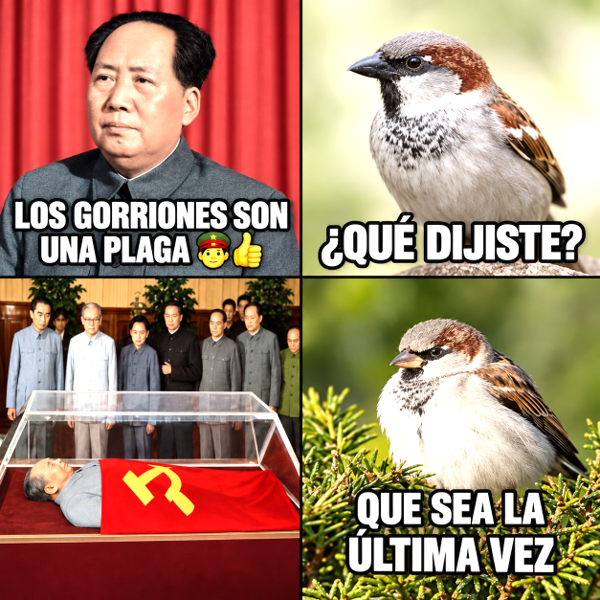
Durante el Gran Salto Adelante, Mao Zedong impulsó en 1958 la campaña de las Cuatro Plagas, dirigida contra ratas, moscas, mosquitos y gorriones. A estos últimos se les acusó de comerse el grano, por lo que millones de personas fueron movilizadas para destruir nidos, romper huevos y espantar a las aves hasta agotarlas.
La matanza redujo drásticamente la población de gorriones, pero produjo un efecto inesperado: también desapareció uno de los depredadores naturales de insectos que atacaban los cultivos. Las plagas agrícolas se multiplicaron y agravaron una situación ya desastrosa por las malas políticas económicas, las requisas y las cosechas deficientes.
Poco después, el gobierno retiró al gorrión de la campaña y trató de corregir el daño, incluso importando aves desde la Unión Soviética. El episodio quedó como uno de los ejemplos más conocidos de cómo una intervención política masiva sobre el medio ambiente puede desencadenar consecuencias opuestas a las buscadas.
Subnormales.
Vine al que probablemente será el último negocio a prueba de IA de México: la Parisina. Entre 3 filas distintas para pedir, pagar y recoger tu pedido. Entre lápices, calculadoras y tijeras, la resistencia contra Skynet empezara aquí. Será el último bastión de resistencia humana.