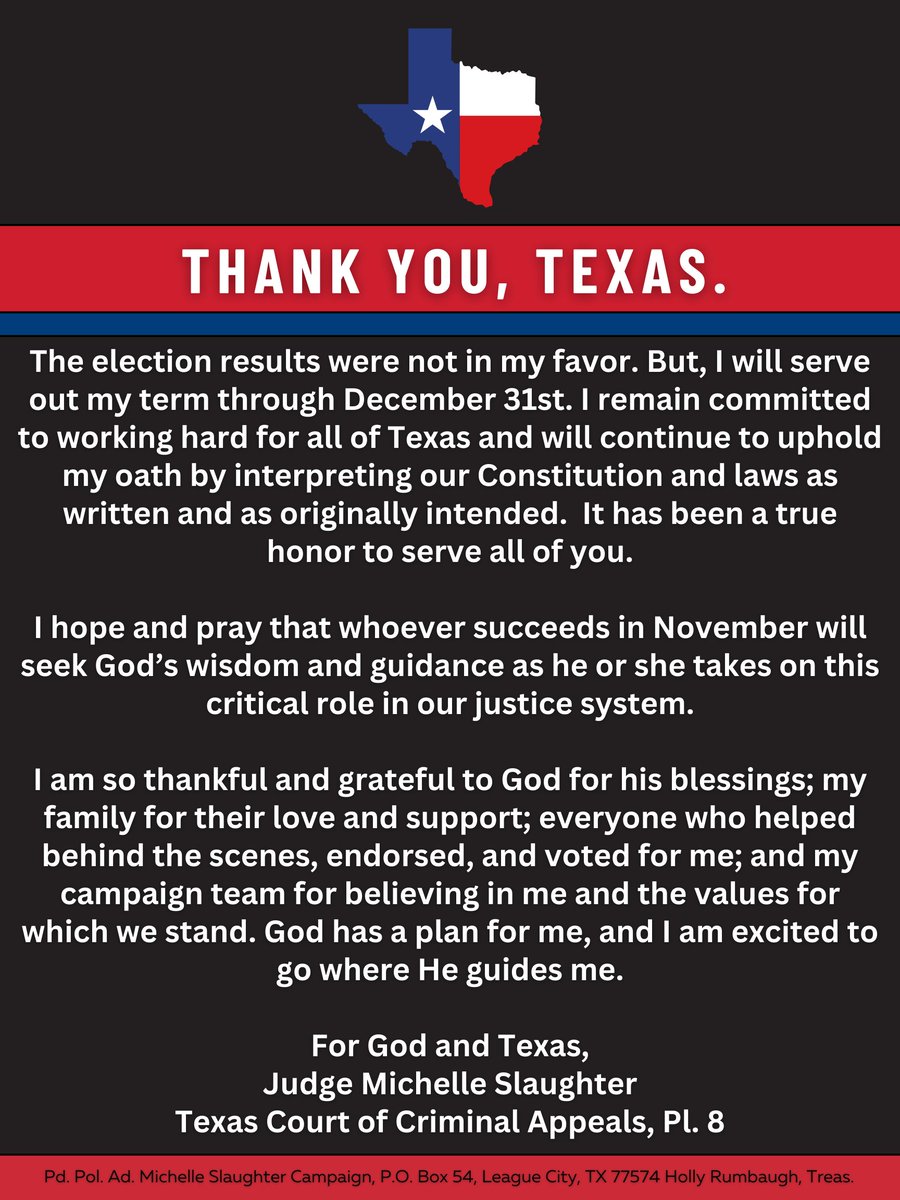
Despite my loss, the outpouring of love and support for me has been so incredible! Thank you to everyone who called, sent me messages or emails, and those who have prayed for me. I am blessed!
Happy Texas Independence Day! As a native Texan, I absolutely love Texas history. That's why it was a joy to research and write about it in my 73-page originalist opinion on rehearing in the State v. Stephens case. You can read it here: https://t.co/F9oLex9zoq
Having participated in deciding more than 25,000 criminal law matters, VOTE TODAY for the proven and uncompromising Constitutional Conservative and Originalist judge for Place 8 on the Texas Court of Criminal Appeals!
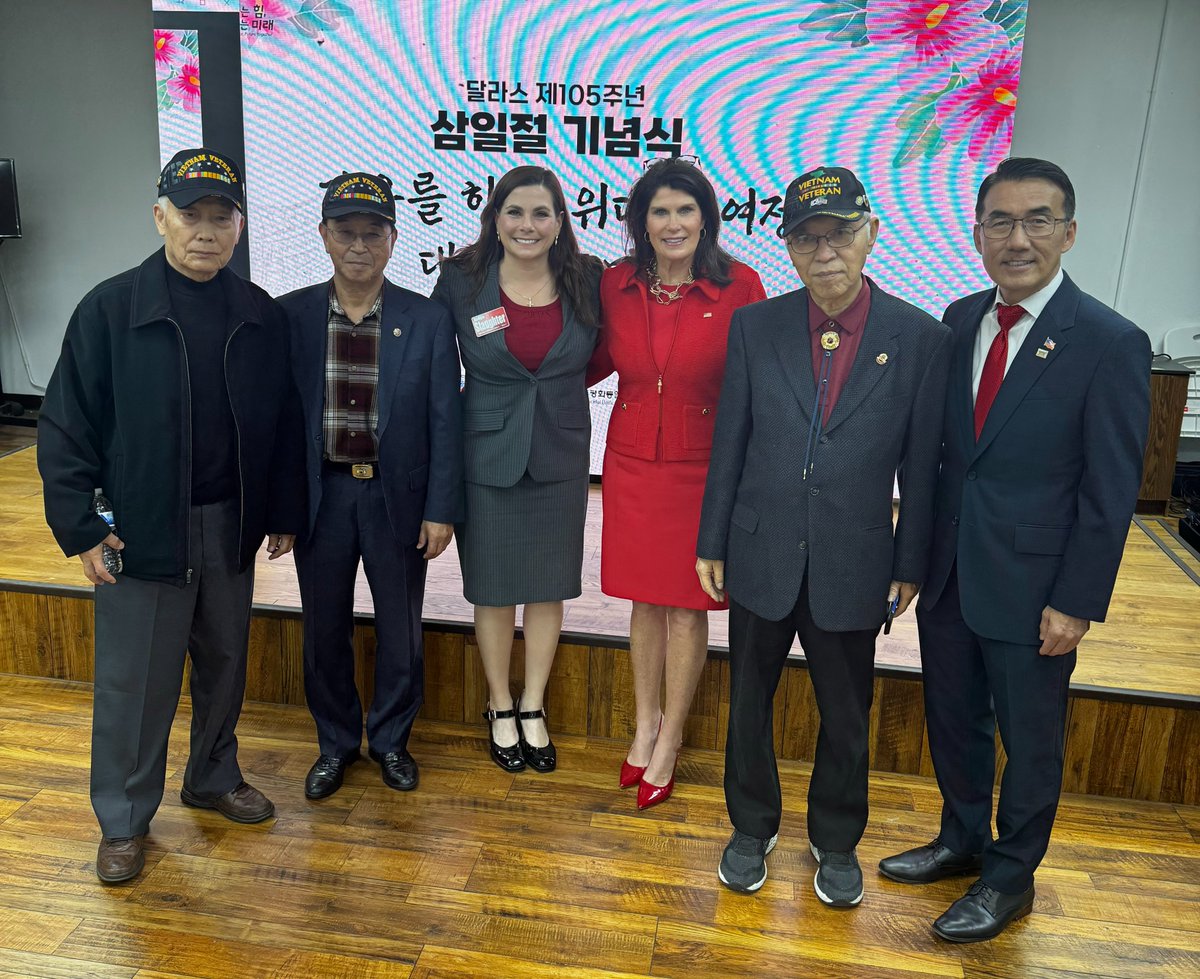
Today, at the Korean Cultural Center of Dallas, I learned the history of Samiljeol, which is the Korean Independence Movement Day and is celebrated every March 1st. It was a wonderful celebration with terrific people! It was truly an honor to be welcomed there. My grandfather fought in the Korean War, and I was able to meet and thank other Korean War veterans for their service. I'm also so glad I got to meet the very impressive @JohnJunCoppell (Coppell, TX Mayor Pro Tem and State Rep. candidate)! And it was wonderful to see Dallas GOP Chair @JenniferHajduTX and @AkerlyShelly, President of Dallas County Council of Republican Women there!
Couple of ranchers from Marfa shared a story while stopped in Andrews on their trip up to the Panhandle to bring a load of hay for livestock impacted by the wildfires. This is the way.
It bears repeating that the Texas Constitution (ratified by the voters in 1876) assigns only civil law duties to the AG:
"The Attorney General shall represent the State in all suits and pleas in the Supreme Court of the State in which the State may be a party, and shall especially inquire into the charter rights of all private corporations, and from time to time, in the name of the State, take such action in the courts as may be proper and necessary to prevent any private corporation from exercising any power or demanding or collecting any species of taxes, tolls, freight or wharfage not authorized by law. He shall, whenever sufficient cause exists, seek a judicial forfeiture of such charters, unless otherwise expressly directed by law, and give legal advice in writing to the Governor and other executive officers, when requested by them, and perform such other duties as may be required by law." Art. IV, Sec. 22
In 1882 (only six years after the ratification of the Texas Constitution), the Texas Supreme Court held in State v. Moore that the catchall phrase "perform such other duties as may be required by law" does NOT “confer . . . power upon the legislature to give to the attorney general power to perform those acts which the constitution itself conferred upon [district and] county attorneys[.]”
Instead, phrase was intended only “to give the legislature power to confer upon the attorney general such powers as might be deemed necessary in regard to matters which had not been expressly conferred by the constitution upon some other officer.”
It “must be presumed that the constitution, in selecting the depositories of a given power . . . intended that the depository should exercise an exclusive power, with which the legislature could not interfere by appointing some other officer to the exercise of that power.”
“Any other construction would lead to the doctrine that the constitution had empowered the legislature to alter the constitution itself, without an express grant of such power.” “[T]he power must be given in express terms, and it cannot be implied.” State v. Moore, 57 Tex. 307 (1882). #txlege
The Texas Constitution (ratified by the voters in 1876) assigns only civil law duties to the AG:
"The Attorney General shall represent the State in all suits and pleas in the Supreme Court of the State in which the State may be a party, and shall especially inquire into the charter rights of all private corporations, and from time to time, in the name of the State, take such action in the courts as may be proper and necessary to prevent any private corporation from exercising any power or demanding or collecting any species of taxes, tolls, freight or wharfage not authorized by law. He shall, whenever sufficient cause exists, seek a judicial forfeiture of such charters, unless otherwise expressly directed by law, and give legal advice in writing to the Governor and other executive officers, when requested by them, and perform such other duties as may be required by law." Art. IV, Sec. 22
In 1882 (only six years after the ratification of the Texas Constitution), the Texas Supreme Court held in State v. Moore that the catchall phrase "perform such other duties as may be required by law" does NOT “confer . . . power upon the legislature to give to the attorney general power to perform those acts which the constitution itself conferred upon [district and] county attorneys[.]”
Instead, phrase was intended only “to give the legislature power to confer upon the attorney general such powers as might be deemed necessary in regard to matters which had not been expressly conferred by the constitution upon some other officer.”
It “must be presumed that the constitution, in selecting the depositories of a given power . . . intended that the depository should exercise an exclusive power, with which the legislature could not interfere by appointing some other officer to the exercise of that power.”
“Any other construction would lead to the doctrine that the constitution had empowered the legislature to alter the constitution itself, without an express grant of such power.” “[T]he power must be given in express terms, and it cannot be implied.” State v. Moore, 57 Tex. 307 (1882).
Our heartfelt condolences are going out to @JCSO_Texas on the loss of K9 Mygo. 🙏 Please join us in praying for the department and Mygo's partner, CLEAT member Deputy Brigette Morse, as they grieve and remember the life of a great K9. 💙 🐾 https://t.co/5bAGc7Yo8z