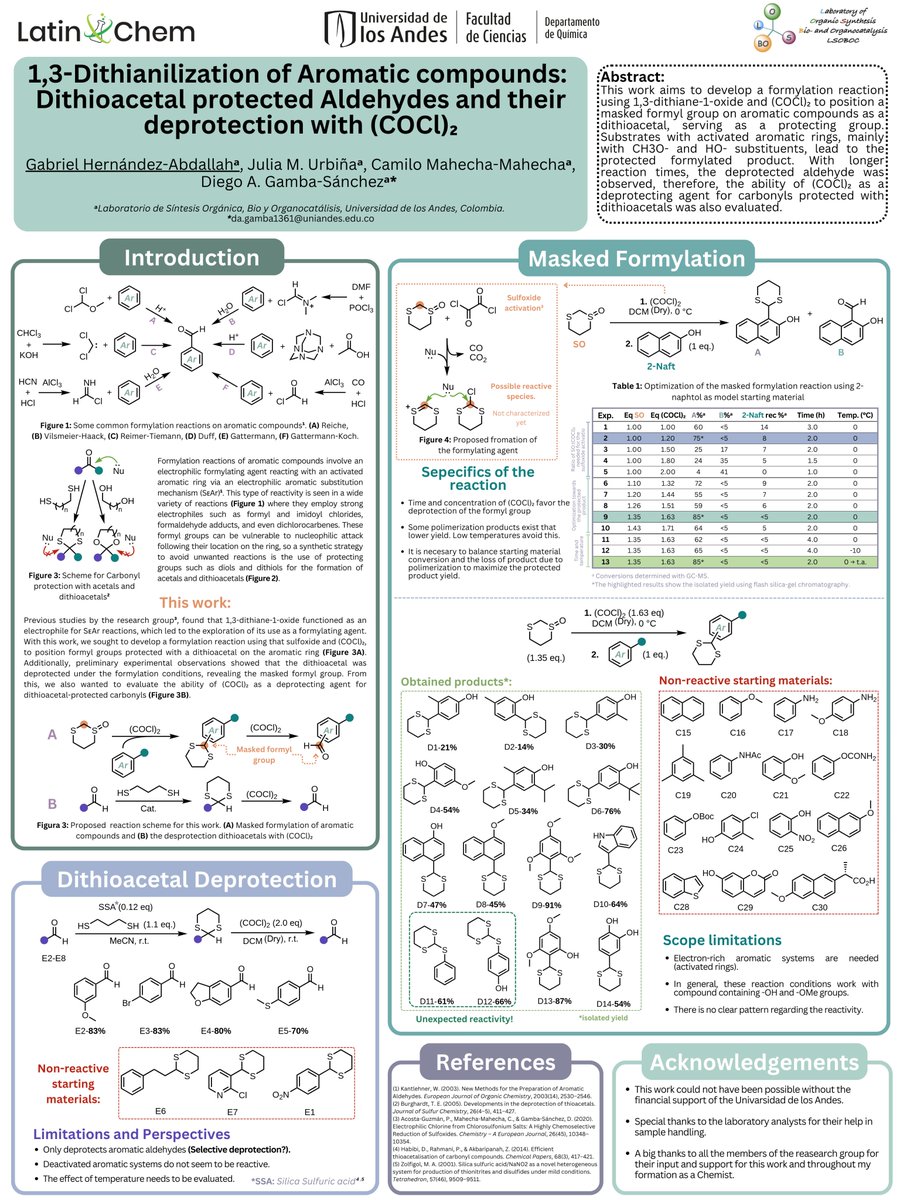
@jamalrafique Thank you! In fact, in the deprotection reaction to obtain 1, we recover the protecting group 2 for later use in other reactions, this is an advantage because it is not wasted as in other deprotection methods and we do not use transition metal catalysts or purification by CC.
@OCortezano@LatinXChem@GroupGamba@OrgBiomolChem@EurJOC Gracias! Sí funcionaría, pero usamos sales de amonio como fuente de NH3 ya que facilita el trabajo con el mismo y evita el trabajo directo con NH3 gaseoso por las dificultades técnicas que supone.
@OCortezano Gracias por su pregunta. Nosotros no encontramos un relación entre el rendimiento de la reacción y la naturaleza electrónica del grupo sustituyente. La limitación está asociado a que cuando tenemos esteres, obtenemos también el producto de transesterificación.
Safety data sheets are occasionally worth a quick skim if only so you can tell the firefighters what coloured smoke to look out for #HealthAndSaftey#Explosions
@ramsastrys@GroupGamba Hello! Thank you for your question.
We have a hypothesis as to why it does not work with aliphatic amines. However, we are doing some experiments and checking mechanistic issues to have a final conclusion.
@ACOjedaP @GambaGroup We have not yet done so. But of course, it is one of the next experiments to be carried out. Thank you for your interest in our work!
Looking forward to the latest #RSCPosterlive webinar "Obtaining grants: the struggles academics face in financing their research"
Don't miss it. 👀
It's been an exciting 24 hours of great science 🧪
Great job @RoySocChem#RSCPoster
@AlanAguirreSoto @GambaGroup Hi, Thank you for your question. The entries highlighted in green, correspond to the conditions selected as optimal not only in terms of yield but also taking into account temperature, reaction times and ammonia source solid (cost).
Excited to see so many scientists from around the world sharing their research on #RSCPoster Twitter Conference 2023.
What a great event @RoySocChem 🎉👏🏼
#networks 👩🏼🔬🌎