Tenured researcher at @CNRS
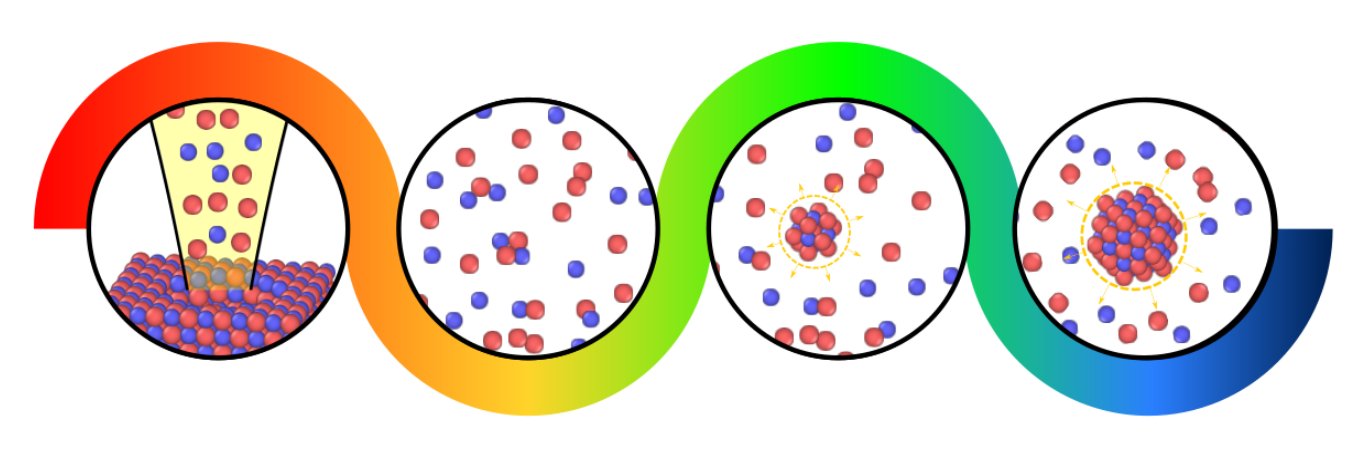
Run atomistic simulations to probe nucleation in nanoparticles using machine learning interactions and free energy sampling.
I have funding for a PhD student to work on atomistic ML, method development & application to atomic-scale study of solid-liquid interfaces (esp. batteries). Now accepting informal enquiries by email. Senior researchers, please let me know if you know of suitable candidates.
We extend our "crystalike" concept (i.e. when hydroxylation causes amorphous and crystalline nanosystems to behave alike) to titania nanoparticles with diameters up to 3.5 nm. #compchem#nanoparticles@MRecioPoo@AngelMorales83 https://t.co/aSYvkm6PGv
Happy to share this new paper published in Comp Phys Comm on Steinhardt Gaussian Mixture Analysis which enables us to identify crystal and defects in complex materials. Massive thank you to my collaborators at UMET @univ_lille
https://t.co/7UkvYywXdm
📢 Paper + code release 📃💻
After 2 years of work, I'm excited to announce our newest paper, MatterGen, has been published in Nature!
https://t.co/Mjd0DKX57y
Come and join the team to work on some cool research linked to Atomic descriptors for MLIP. We have a 18-24 months postdoctoral position in partnership with Geneviève Dusson between Lille and Besançon. More info:
https://t.co/eQ26P7DxQd
Excited to share a paper recently accepted in @Nature_NPJ Comp. Mat. Massive thank to all the students and collaborators for the huge effort!
https://t.co/vcu4kA7H7u
Ever wanted to use Python and recreate the first Monte Carlo simulations that were made on an IBM 701 in the 50s? That's just 1 of the goal of "Learn molecular simulations with Python". Here, the EoS of argon is computed and compared to experiments: https://t.co/YIHOTaI7bK
Best of atomistic machine learning list, major update. 60 new projects added. Seven universal potentials enter the list, along with an equal share of new generative, active learning, and electronic structure models, datasets and community resources. https://t.co/MGckjnWvbm
New paper! With Arthur France-Lannord, we combined different rare event sampling techniques to isolate nucleating structures in nanoparticle crystallization. We focused on metallic systems but the method can surely be transferred to more complex systems ;)
https://t.co/tHI1HZD2Sm
Just got selected by the ANR for a simulations project on fluid transport in nanoporous polymers. I will soon be hiring a PhD student and a postdoc. @AgenceRecherche
The Abstract submission for the 2024 edition of the Traffic and Granular Flow conference is open. We look forward to welcoming you in Lyon! https://t.co/TqwJNl3xYC
#TGF2024 Lyon, France, 02-05 Dec. 2024.
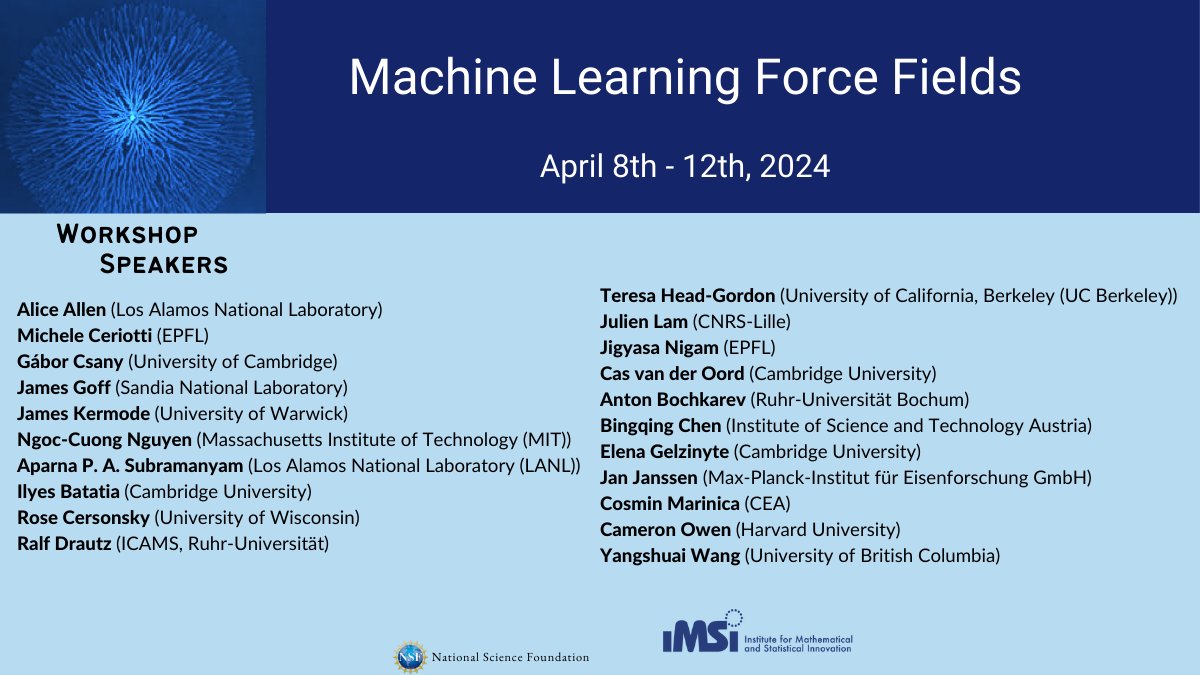
Our first workshop of April, Machine Learning Force Fields, begins next week, 4/8, and is organized by Geneviève Dusson, Risi Kondor, Christoph Ortner, and Danny Perez: https://t.co/gLwCdvMgn7
We have a PhD opening within ht-MATTER - High-throughput modelling of Molecular crystals out-of-equilibrium - @uclchemeng!
If you are interested in molecular simulations, crystal nucleation, & statmech, get in touch!
RTs (RPs?) appreciated!
Details:
https://t.co/U1LuHH13Wz
See below an excellent opportunity to work with me and other researchers at NanoGUNE in a vibrant and international environment in the beautiful city of Donostia-San Sebastián. Contact me if you are interested in applying. The topic will be ML applied to molecular simulation.
Forgot to talk about this paper in collaboration with @_RossiKevin, @zany_cloud and G. D. Förster published in #CarbonTrends. We combined data-driven approaches with molecular dynamics simulations to observe the formation of carbon nanoparticles.
https://t.co/Z3TAdK5oNV
Ab initio molecular simulations suggest that previous pioneering experiments relating water's liquid-liquid transition to the shape of the melting lines of ice polymorphs may require reinterpretation. @PiaggiPablo@tgartner_3@CcscCsi@PrincetonChem https://t.co/kI7f4e29OB
Delighted to announce the first paper of our PhD student Q. Gromoff published in @nanoscale_rsc. Experiments and simulations were coupled to study the formation of AuAg nanoparticles
https://t.co/TVXmYIW4WN