Comment j'ai failli ne pas revenir vivant de Medellín 🇨🇴
- Ne pas suivre quelqu'un la nuit
- Ne pas Aller dans un Barrio la nuit
- Ne pas monter dans la voiture de deux inconnus
Oups c'est ce que j'ai fait...
Ma nouvelle vidéo vient de sortir !
J'ai divisé par 70 la consommation de tokens de mes agents IA.
Sans changer de modèle.
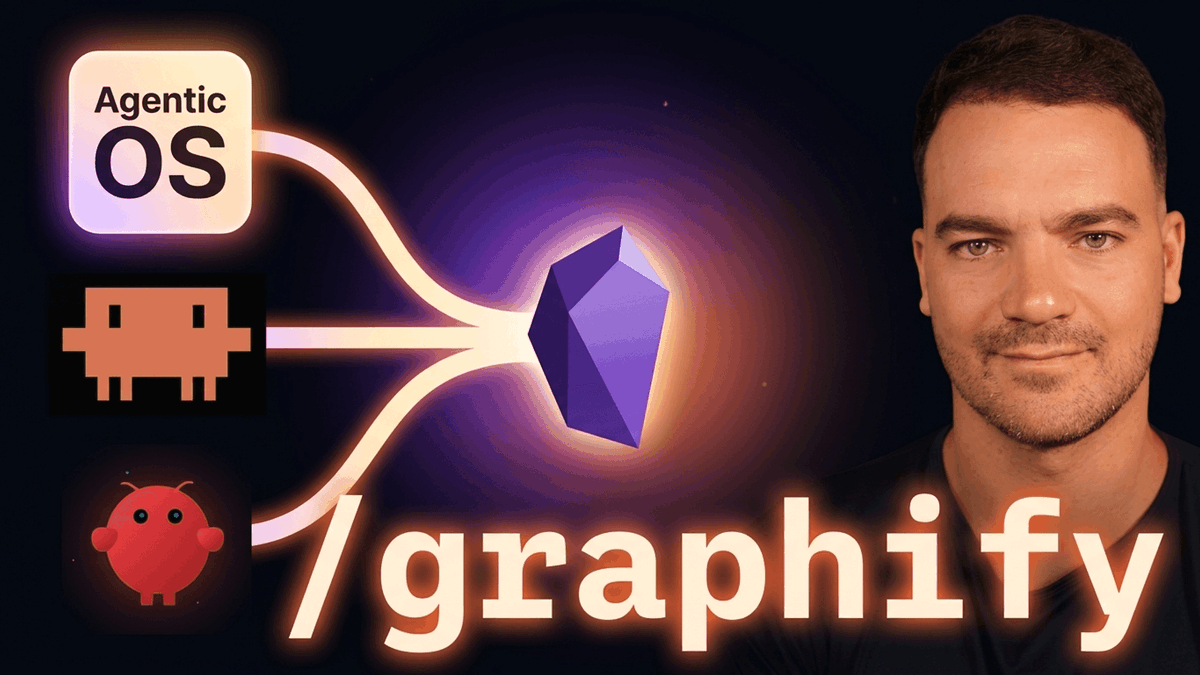
Le truc : un seul Obsidian + un graphe Graphify, partagé par Claude Code, Codex, Hermes & mon Agentic OS.
Ils interrogent le graphe (~280 tokens) au lieu de relire 40 fichiers (~20 000).
🔗 https://t.co/dYhvcG1Eoc
Avec les boucles et les workflows, c’est fini l’époque d’aller prompter Claude taché par tache comme en big 2025
Exemple de loop de lancement / maintenance de projet
- créer un projet Asana et filer le token à Claude Code puis lui demander d’organiser le projet
- utiliser /interview dans Claude pour le brief global du projet
- demander à Claude d’utiliser le skill « nouveau projet » pour qu’il crée un GitHub et les autres tools nécessaires à ce projet
- grouper les tâches asana grossièrement définies qui seront les étapes et features du projet et seront qualifiés par le skill Claude « coach agile »
- demander à Claude de lancer une loop à intervalles d’une heure pour utiliser son skill « dépiler backlog » avec en condition d’arrêt d’avoir fini les tâches du backlog
- chaque tâche déclenche les tests unitaires, fonctionnels via navigateur et les conventions de la CI/CD et devient une merge requête (ou est automatiquement déployée en prod)
- alimenter le backlog via Claude lui meme via la lecture des logs et de Sentry pour toujours avoir un projet clean et identifier les bugs serveurs / utilisateurs
- la dernière tâche du backlog c’est de lancer un skill « moins con chaque jour » qui debrief le backlog et suggère des améliorations de process que tu valideras le lendemain matin si tu penses être plus intelligent que Skynet
Voilâ t’es facilement au dessus de quasiment tous les devs que je croise et t’as même pas transpiré
(Bouclé détaillée pour ce tweet mais aussi largement automatisable et perfectible à chaque étape)
> OpenRouter got free models
> Step 3.7 Flash is free on Nous Portal
> BlockRun provides free DeepSeek v4 Flash
Literally cost almost nothing to start building your Hermes agent
We open-source Qwen-AgentWorld-35B-A3B (MoE, 35B/3B active, 256K context) and AgentWorldBench.
Two routes, one roadmap:
🔬 Build the simulator — scalable, controllable, surpassing real environments
🧠 Internalize world modeling — predict before you act
Qwen-AgentWorld is our attempt to investigate how language world modeling can further expand the boundaries of general agent capabilities.
Go build on it 🏃🏃♂️
📑 Paper: https://t.co/Jx2l5RKq71
📖 Blog: https://t.co/7tVcKyhsx2
💻 GitHub: https://t.co/B5Lvb1UZCn
🤗 HuggingFace: https://t.co/Kw3QBL1TM5
🧩 ModelScope: https://t.co/YBnGYgMWWI
Apple just made Docker Desktop optional on Mac.
And it is completely free.
This is apple/container. 26.5k stars no Github.
You can now run Linux containers natively on your Mac without installing Docker Desktop, without a background daemon hogging your RAM, and without paying $21 a month per developer for a commercial license.
Here is what it does:
→ Runs Linux containers as lightweight VMs directly on Apple Silicon using macOS 26 virtualization
→ Fully OCI compatible. Pull any image from Docker Hub, GitHub Container Registry or anywhere else
→ Written in Swift and optimised specifically for Apple Silicon. Faster and lighter than anything Docker Desktop does on Mac
→ Standard container CLI syntax. If you know Docker commands you already know how to use this
→ Push images you build to any standard container registry and run them anywhere
Docker Desktop charges $21 per developer per month for commercial use. Apple's version costs nothing and ships as open source under Apache-2.0.
Microsoft made Docker Desktop optional on Windows with WSL Containers last month.
Apple just did the same on Mac.
Docker is not going anywhere. But the era of paying for a GUI wrapper around containers on your own machine is quietly ending.
Repo here: https://t.co/uFJ867sul6
Vous êtes totalement à la ramasse @ici_officiel@franceinfo ? Non seulement vous présentez au public un site qui permet de fouiller sans limite des bases de données volées, mais en plus vous vous faites promener par ses créateurs de 18 piges !
Le "logiciel qui fouille automatiquement 127 sources publiques" (searcher) vous y croyez une seconde ???
Et la réponse de la CNIL, vous êtes fabuleux.
Là, on a des millions de données volées de citoyens publiées dans la nature !
J'ai jeté un oeil, le site tourne sur Elasticsearch, un moteur d'indexation, chargé de centaines de bases de données volées agrégées. Pas de crawl live, pas de sources publiques. Ils possèdent physiquement les bases, qu'ils agrègent ou volent eux-mêmes !
Ce que personne dans votre rédaction n'a pris le temps de vérifier : n'importe quel compte inscrit peut interroger la totalité de la base sans aucune restriction technique.
Le moteur de recherche accepte la syntaxe Lucene brute, directement, sans filtre. email:*@gmail.com retourne 50 résultats. city:Paris retourne 49 fiches complètes. firstname:* dump des enregistrements aléatoires. La base entière est extractible champ par champ, domaine mail par domaine mail, ville par ville.
Un enfant de 12 ans peut tout récupérer !
Les forums cybercriminels qui diffusent des bases volées les publient dans des coins peu accessibles d'internet. Ce site rend ces mêmes données requêtables en temps réel via une interface, gratuite, ouverte à l'inscription. C'est objectivement plus dangereux que la publication initiale sur le dark web.
Et alors chapeau la @CNIL , toujours à côté de ses pompes : "ça n'apparaît pas conforme à la législation".
Putain, vous bossez ou pas ? 👉 Recel de données volées (321-1 CP), collecte déloyale de données personnelles (226-18 CP), traitement sans base légale (226-16 CP). On est dans du pénal, pas dans une zone grise.
@Interieur_Gouv
Google just dropped an AI tool that makes reading massive codebases feel illegal 🤯
It’s called CodeWiki.
Paste any GitHub repo… and it instantly transforms the entire project into interactive documentation.
Not just summaries either:
• Generates architecture diagrams automatically
• Explains every file, function, and dependency
• Creates step-by-step walkthroughs
• Understands the full system flow
• Builds an AI chatbot trained on the entire codebase
So instead of spending DAYS trying to understand someone else’s messy project…
You can navigate it in minutes. 🚀
This changes everything for developers, startups, and open-source teams.
Link below 👇
i spent 9 hours studying the source code of openclaw and hermes side by side.
here's everything i learned.
post 1/n: skills
@NousResearch hermes first. the hook is that the agent self-improves by writing its own skills.
the system prompt has a nudge baked in: every N tool calls, consider saving a skill. after task completion, a background review scans for skill-worthy patterns. before context compression kicks in, durable knowledge gets flushed to disk. the prompt is blunt - if an existing skill covers this, patch it in place. only create new if nothing matches.
and it works. i watched it create a extract-social-testimonial skill on its own and its proven useful. I had a /save command in OpenClaw that'll do this when prompted, but this is the kind of skill I never would have thought to create. first time seeing this worked like magic.
---
the other half of why hermes feels productive out of the box: the opinionated bundled library is massive.
i counted 123 SKILL.md files shipped on my install before hermes wrote a single one of its own. github PR workflows, obsidian, google workspace, linear, notion, typefully, perplexity, deep research, minecraft modpack server (lol) - huge surface area of "somebody already figured this out for you."
this is what opinionated actually means. you're not getting a blank agent and a framework, you're getting an agent that already knows how to do 100+ things on day one and a self-improvement loop that learns more as you go.
strong defaults as a product. when the opinions are good, the leverage is massive. (think tailwind or rails)
and they literally just doubled down on this with a "tool gateway" yesterday - one subscription, 300+ models, plus first-party web scraping, browser automation, image gen, cloud terminal, text-to-speech. one accounts.
hermes' direction is unambiguous: more batteries, fewer decisions the user has to make. this is the rails move - own the whole stack so the default path is the happy path.
---
so here's the thing I don't see anyone talking about yet with hermes: self-authored skills have a skill explosion problem.
real example from my own ~/.hermes/skills/ directory. the agent wanted to read an image from my desktop. Tried browser read and vision skill, nothing worked. so it wrote a third skill read-local-image skill lol. these are 3 skills all adjacent to "image + local filesystem + model can see it." the skill grows and become mutually non-exclusive very quickly.
this is the long-tail failure mode. the agent is great at spotting "i should bottle this up." it's less great at spotting "I already bottled this up three folders over." you end up with a corpus that grows faster than it consolidates.
net impact over time: you accumulate a lot of skills. some brilliant, some redundant, some that overlap three other skills nobody remembers exist.
i'm sure @Teknium already knows this and it's just a product prioritization decision right now. (this is my favorite part, more on this later) they'll prob solve this soon as more users turn into power users and their skills accumulate - something like consolidation pass with invocation metrics + stronger dedupe on skill creation.
---
@openclaw doesn't have this problem. partly because it doesn't auto-generate skills at the same rate, so there's less to dedupe in the first place. and partly because it has more mechanisms to solve it structurally.
what it does differently:
openclaw takes the opposite stance on skills. from their VISION.md: "we still ship some bundled skills for baseline UX. new skills should be published to ClawHub first, not added to core by default. core skill additions should be rare and require a strong product or security reason." anti-bloat by policy. cleaner, but the authoring is on you.
so their skills are explicit artifacts with governance at every layer. five sources ranked by precedence (workspace > user global > managed > bundled > extra), so you always know what is loaded. when something breaks at 3am, you can trace it in one grep instead of guessing which skill the agent triggered.
discovery is bounded at multiple levels - byte caps, candidate caps, symlink rejection, verified file opens. eligibility checks separate from discovery, different agents can see different subsets - your coding agent doesn't need your email skills in its context.
smaller surface area = cheaper runs, sharper responses, less drift on long tasks.
and the governance piece is explicit product policy: bundled skills are baseline only, new skills go to clawhub first, core additions should be rare. the corpus doesn't rot because nothing gets added without user intention - every skill has to earn its spot.
this is what primitives actually means. you're not getting defaults, you're getting guarantees. openclaw does exactly what you told it to do, nothing more, nothing less. boring in the best way. when you're shipping this in production or running it inside a team, boring is the whole product. (think linux, kubernetes)
---
and here's the practical thing that shipped results for me on @openclaw: i combined the TOOLS.md with vercel's AGENTS.md optimization pattern. tool activation correctness is better on openclaw than hermes for me on tasks where the agent has to pick the right cli/api from ~50 options.
vercel has a nice writeup on this, send it to your agents: https://t.co/IRQZ2kYLwU
tldr is explicit > implicit. the agent doesn't have to decide "is this skill-worthy enough to load," because the routing rules are already in the system prompt.
---
so my current read:
both harnesses will do everything you want. pick either, you'll be fine. but if you're picking fresh:
> getting started quickly → hermes. opinionated defaults mean you're productive on day one and stays productive with little maintenance overhead.
> users who want 100% control→ openclaw. legibility and scope control matter more than self-improvement does.
> builders → it depends.. and i'm here. some things openclaw does better, some things hermes does better. honest move is to use one daily and steal patterns from the other.
---
but the more interesting question isn't which to pick - it's what you can learn from each:
@steipete gave the world a new layer in the stack and put a claw in everyone's hand. that's foundational work. you don't even need to use openclaw to benefit from openclaw - the patterns will show up in everything downstream for years. (plus the way he does agentic engineering should really be studied by everyone writing software right now)
@NousResearch is giving a masterclass in product positioning live right now. and this is the part that deserves its own post, but briefly:
openclaw had the audience. the mindshare, the github stars, the "it's basically the standard now" energy.
look at what happened to everyone who tried to fight that fight head-on. nanoclaw. nullclaw, picoclaw, zeroclaw. i can name ten more. all of them trying to out-openclaw openclaw - smaller, lighter, more minimal, more composable, better governance, whatever. none of them got hermes's traction.
because when you compete with a category-definer by being a cheaper/cleaner version of them, the category-definer just wins by default. you're playing their game on their board.
hermes made their own game. self-authoring. bundled-by-default. maximalist on purpose. the tool gateway as lock-in. every launch reinforces the same thesis: we are not the minimalist primitives company, we are the batteries-included agent-as-a-product company.
this is textbook product positioning. every single release - and the way they release it - should be studied.
that's the founder lesson. the user lesson is simpler.
pick either. learn from both. then go make something useful.
Si vous devez apprendre un mot ce week-end, c’est le « harness ».
En bref, c’est tout ce qui permet à un agent de passer de la compréhension à l’action.
Un modèle d’IA peut être très bon pour répondre de manière stricte ou utiliser des outils spécifiques, mais ça ne veut pas dire qu’il sait bien agir. Le harness de chaque solution, c’est ce qui fait la vraie différence.
Par exemple, depuis quelques mois, des personnes qui pensent "tout connaitre" sur l’IA disent sur ce réseau : « Copilot, Claude Code, Codex, OpenCode, c’est pareil, et on peut utiliser GPT-5.4 ou Claude depuis OpenCode ou Copilot, donc aucun intérêt de payer ».
Or, c’est faux et c'est tout l’inverse.
Le harness et les outils de chaque solution sont différents (et on l’a encore vu avec le leak de Claude Code). Chaque solution n’a pas les mêmes intégrations ni les mêmes capacités de réalisation d’une tâche.
De plus en plus, les IA strictement conversationnelles vont devenir des agents, car avoir uniquement des réponses à des questions, c’était la première étape.
On passe progressivement à des IA qui agissent dans le software, mais aussi dans le hardware (→ Physical AI, comme dans une de mes dernières vidéos YouTube).
@aleksihara@GoFYerSelf17@TansuYegen France 🇫🇷
•homologation (enfer administratif si tu l'as monté toi-même)
•immatriculation (carte grise) et 1 plaque
•assurance spécifique
•Le port d'un casque moto (casque vélo ne suffit pas) et de gants
• Le Permis voiture B
• Interdiction d’utiliser les pistes cyclables