PANGEA ’26 is officially in motion.
A global online hackathon bringing together builders, founders, engineers, mentor's, and creatives from across the world to solve meaningful problems through technology.
72 hours.
250 selected teams.
195+ countries open.
AI, fintech (Web3 & Blockchain), climate, infrastructure, and PANGEA x 👀
African problems are not niche problems. They are global problems, solved first by people closest to them.
The vision for PANGEA '26 is:
Building the kind of platform and ecosystem many of us wish existed when we first started building. One that gives ambitious founders visibility, opportunity, mentorship, community, and a real shot at building globally relevant companies.
So, if you know organisations, operators, investors, ecosystem players, brands, media houses and individuals who care deeply about the future of technology, innovation, and entrepreneurship, and would be interested in supporting, collaborating, sponsoring, mentoring, or contributing to PANGEA ’26, please comment below and tag them 👇🏽
Would genuinely appreciate the support in bringing the right people into this.
The goal is bigger than a hackathon.
The goal is to help shape the next generation of global founders.
Did someone say a free end-to-end robotics workshop with the SO-101 robot? 👀
Join us on Wednesday, April 22 at 11 AM PT for Robotics Office Hours, where NVIDIA experts will demo an end-to-end robot learning workflow using NVIDIA Isaac Sim, Isaac Lab, Cosmos, and Omniverse for sim-to-real manipulation.
Learn how to get started. 🦾
📆 Add to calendar: https://t.co/INIKSKejc7
1/ We just released π0.7 — a steerable generalist robot model with emergent capabilities.
I want to share a bit of the backstory, because π0.7 taught me something surprising about where robot learning is heading. A thread on bittersweet lessons 🧵
From simulation to reality 🤖
Robotics creator @SkyentificTweet built a walking bipedal robot using a simulation-first approach to design, test, and iterating in virtual environments before deploying in the real world. Powered by the NVIDIA Isaac platform and NVIDIA Jetson for on-device AI and control. 📖 https://t.co/wklfMzuMEK
#NationalRoboticsWeek
Introducing Claude Managed Agents: everything you need to build and deploy agents at scale.
It pairs an agent harness tuned for performance with production infrastructure, so you can go from prototype to launch in days.
Now in public beta on the Claude Platform.
After 8 months of building in stealth and testing our infrastructure on 10000+ hours of real-world data and hundreds of unique environments, we're bringing @fpv_labs into the open today.
FPV Labs started with the following bet - if human data proves to be the underlying factor that determines scaling laws in general-purpose robotics, it will trigger the largest economic transformation in human history, and the underlying infrastructure that captures that data will determine how fast we get there.
We will achieve this by building the full-stack infrastructure for capturing, processing, transferring, and evaluating human experience into spatial, temporal, and semantic knowledge for machines.
Despite all the research novelty behind ChatGPT, its success can be attributed to one foundational fact - the scaling law of transformers. We believe the same dynamics have made their way into robotics.
Recent studies showed task completion rates jumping from 30% to 70% when human demonstration data scaled from 1,000 to 20,000 hours, a log-linear trend that mirrors exactly what we saw in language and vision. Seeing these emergent signs of scaling law curves in robotics, we believe we are entering the era of general-purpose robotics policies, which makes the next few years the most exciting time in the history of this field.
But the library of physical interactions required to train general-purpose robot policies does not exist yet. Over the last 8 months, we've seen dozens of companies emerge in this space. We were really happy to see new companies pushing this space forward, but we also saw the same pattern repeat: every egocentric data company was making some tradeoffs between quality, scale, and diversity.
We have built FPV labs on the core principle that high-quality data is orders of magnitude more valuable than sheer volume. Case in point, self-driving cars collect thousands of hours of data per day, but only a small fraction of that data is actually useful for training better models. Several studies, like RT-2, have shown that as little as 1% of data improves as much as 25% on task success. The quality and diversity of data matter a lot more than scale, so there is clearly a power law curve in the downstream impact of data.
We've spent months obsessing over data quality by building our stack, discarding it, rebuilding it, and iterating until we found a formula that doesn't compromise downstream quality at scale.
We believe the downstream impact here is far more profound than most people realize. Workers globally are paid around $60 trillion per year in aggregate, and a lion's share of that compensation goes to physical labor - tasks that require navigating real spaces, manipulating real objects, and negotiating the infinite variability of the physical world.
Human-to-robot transfer will be one of the most important infrastructures that will shape our society in the near future, and if it works, the economic impact will dwarf every technology transition that came before it in an exponential manner and lead to the creation of goods and services we can’t imagine today.
Our mission is to lay the groundwork for us to transition into this future - the future of abundance. We are deeply grateful to our earliest believers, @paraschopra and @lossfunk, who played a critical role in shaping our thinking.
Claude Code 2.1.90 just dropped with a new /powerup command
Run it and you get interactive lessons that teach you how to use Claude Code right inside the tool.
It's solid and has a lot of potential for learning directly in the terminal. Curious how the UI will look in VSCode and Claude Code Desktop.
Going to keep digging into this new release!
Claude seems to be fixing a super annoying developer problem.
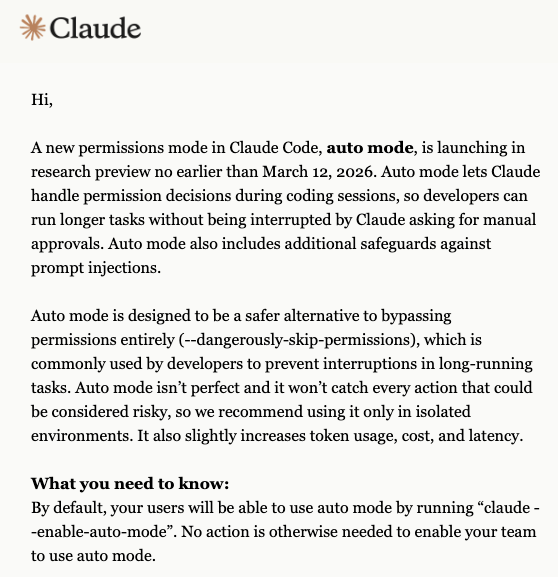
Anthropic announced a research preview feature called Auto Mode for Claude Code, expected to roll out by March 12, 2026.
The idea is simple: let Claude automatically handle permission prompts during coding so developers don’t have to constantly approve every action.
Sstops those annoying permission prompts during long coding sessions.
Before this, you had to use `--dangerously-skip-permissions` to work without interruptions.
That method worked fine but took away all your safety nets. This new auto mode gives us a smarter option.
Claude will take care of the specific permission choices on its own while still blocking threats like prompt injections.
You can finally let long tasks run without watching your screen the whole time.
Since it is still a research preview, you should run it inside isolated setups like sandboxes or containers for safety.
Expect a small jump in token usage and delay, because the model needs extra time to process the security checks.
Once available, you just type `claude --enable-auto-mode` to start.
If you manage a team and need people to manually approve actions, you can restrict this feature using Mobile Device Management tools like Jamf and Intune or through configuration files.