@GurushaJuneja@arnavkj95@deepaknathani11@xwang_lk@WilliamWangNLP Very cool work! I’m wondering whether this approach could be applied to optimization tasks like those in TTT-RL (https://t.co/ZSRE96YTrC), which require a large number of execution logs—512 rollouts across 50 epochs.
Here are the papers we'll be presenting:
Didactic to Constructive: Turning Expert Solutions into Learnable Reasoning
@EthanMendes3 , @jungsoo___park, @alan_ritter
arXiv: https://t.co/8cwRyNTEDA
Poster: Wed, Jul 8 • 5:00–6:45 PM KST, Hall A (#2502)
Safe and Scalable Web Agent Learning via Recreated Websites
@hyungjoochae , @jungsoo___park, @alan_ritter
arXiv: https://t.co/5b4ujsHDND
Poster: Tue, Jul 7 • 10:30 AM–12:15 PM KST, Hall A (#1714)
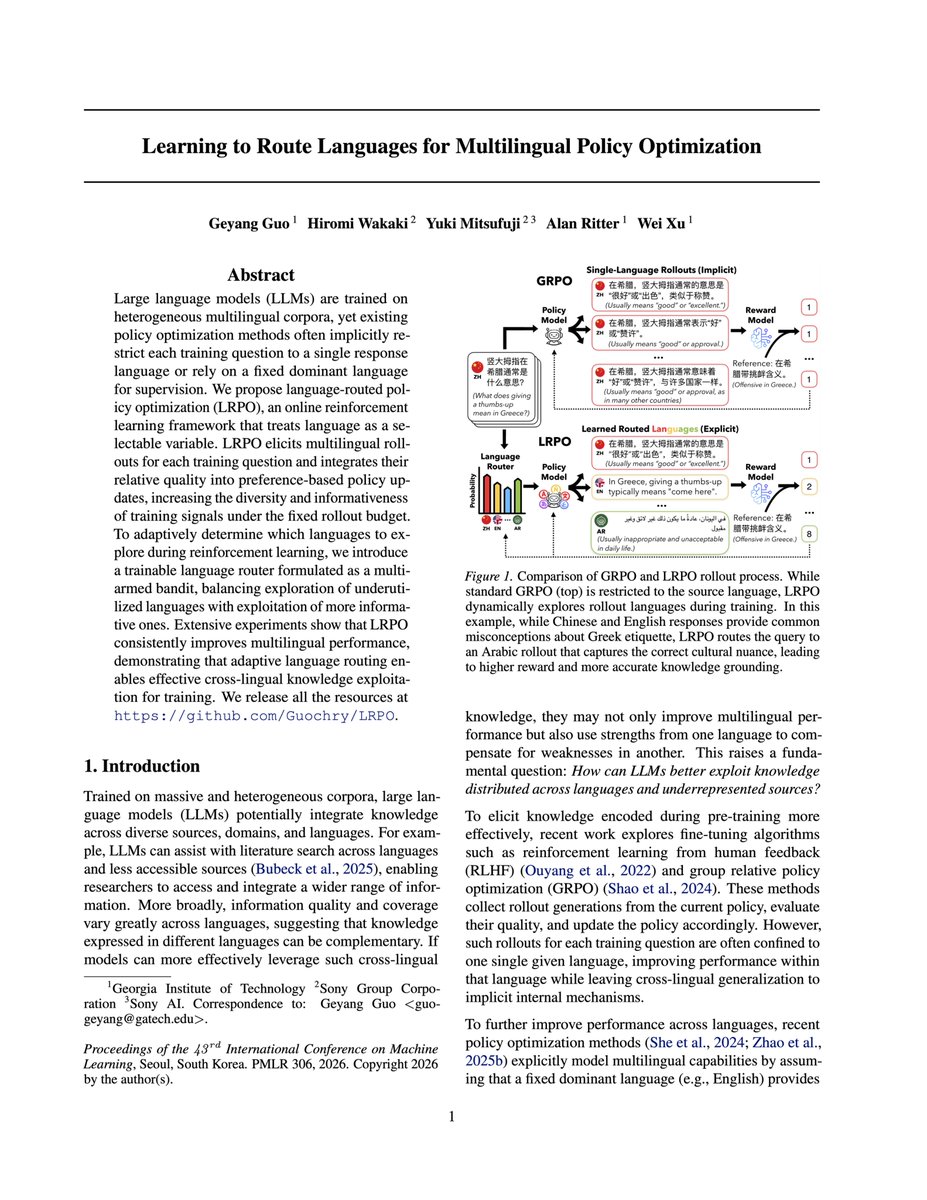
Learning to Route Languages for Multilingual Preference Optimization
@CherylolGuo, Hiromi Wakaki, @mittu1204, @alan_ritter, @cocoweixu
arXiv: https://t.co/c2Pkl191kZ
Poster: Tue, Jul 7 • 10:30 AM–12:15 PM KST, Hall A (#402)
Knowledge is not evenly distributed across languages. For a given question, what if better information comes from another language?
🔥 We propose Language-Routed Policy Optimization (LRPO), an online reinforcement learning framework that lets LLMs explore and learn from cross-lingual generations during training.
#ICML2026
📣 New paper by my Ph.D. student @hyungjoochae
How can we build a safe, scalable learning environment for web agents?
Paper: https://t.co/jtndyaCKKQ
We introduce VERIENV, which clones real websites into executable synthetic environments using coding agents.
It's difficult to learn with RL on hard problems: (1) they can be non-verifiable, (2) models fail to generate correct completions that can be rewarded
❌ SFT on raw human solutions hurts performance
💡 We propose DAIL to effectively learn directly from high-quality solutions
Super excited about @wenjie_ma's work on verifying math proofs!
✅ 24 competitions, 3 SoTAs (o3, Gemini-2.5-Pro, R1)
✅ Strong evaluator -- a carefully designed evaluator with simple ensemble beats agentic ones
✅ Strong best-of-n performance
Check out the paper & website!
@sanmking Thanks for the interest! To mitigate contamination on PRECOG, we use a custom search that excludes result-/dataset-source papers. But leakage can still arise (model memory, related work). Thus, we also run streaming predictions on fresh, unseen datasets/configs.
What if LLMs can forecast their own scores on unseen benchmarks from just a task description?
We are the first to study text description→performance prediction, giving practitioners an early read on outcomes so they can plan what to build—before paying full price 💸
@gneubig Thank you for the interest and for sharing the cool work!
From what I can tell, their focus is forecasting how new ideas/methods will perform on existing benchmarks.
Our focus is forecasting how standard methods will perform on new benchmarks.
Appreciate you sharing this work!
Building new NLP apps is time-consuming and costly.
Our approach gives practitioners a quick preview of the expected performance range—an initial step toward anticipatory evaluation.
This was an exciting project with @EthanMendes3@GabiStanovsky@alan_ritter@mlatgt.
10/11