Excited to be heading to ICML! I will be presenting our paper on rethinking how to train models with expert solutions using self-distillation.
🗓️ July 8, 2026, 5:00 PM – 6:45, Hall A #2502
User simulators are only as faithful as the user representations they are conditioned on.
Missing details force simulators to fill gaps with assumptions, leading to generic behavior⚠️
Introducing UserRepGen-4B, which generates representations optimized for simulation fidelity.
User simulators are trained to talk like users. But users don’t just talk, they judge.
We introduce simulators that model both: what users say and what they think of the assistant.
WildChat, LMSYS, ShareChat… each human-LLM chat dataset aims to capture "real-world" AI use. But do they paint the same picture?
Not quite. From user messages alone, a classifier can name a chat's source dataset, and user models trained on them inherit these signatures 🧵👇
Thrilled that Nemotron-Cascade has been accepted as an Oral at #NeurIPS2026! 🎉
It's our fully open-source RL recipe for LLM post-training. Huge thanks to all my amazing teammates at @NVIDIA.
model+data: https://t.co/XM7LWMz3Vd
Slated to give a tutorial on “Multilingual and Multicultural LLMs” 🌍 at EMNLP 2026 with @davlanade@vinodkpg@sarahookr@alan_ritter.
See you in beautiful Budapest — looking forward to connecting with everyone! 👋
#emnlp
Glad to share that our paper Gavel was accepted to EMNLP 2026 Main! 🎉
We study frontier LLMs on legal case summarization with inputs exceeding 500K tokens. Models struggle beyond 256K tokens and are much more likely to omit key information than hallucinate.
We also built Gavel-Agent, an agentic, reference-free evaluator that searches source documents for evidence.
More details: https://t.co/ZVYrwcgCDq
https://t.co/fbVb7PeHum
Blogpost on context summary generation for long horizon agents. With threads I found interesting at the bottom of the blog!
Thanks to @kartik_goyal_ and @alsuhr for your mentorship! and Thanks to my coauthor @a_lidayan! and @satvikgolechha!
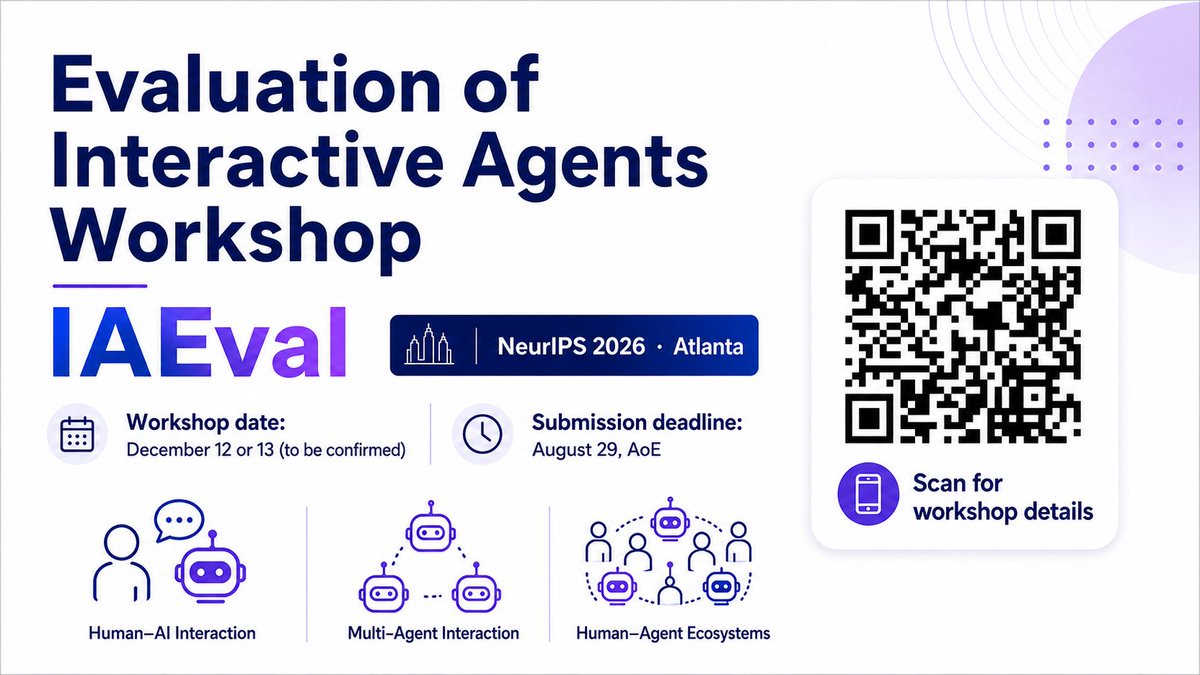
We are excited to announce Evaluation of Interactive Agents Workshop (IAEval) at NeurIPS 2026 in Atlanta.
As AI agents become more capable and engage with users on long, open-ended tasks, static benchmarks are no longer enough. We need evaluation methods that capture how agents behave in realistic, multi-turn interactions.
If your research is relevant, we invite you to submit. More details below.
Excited to share my first work after joining @MSFTResearch!
LLMs have entered the agentic era, and we now collaborate with agents on complex tasks over many turns of interaction.
But does your agent actually follow what you intended?
We show where agents get lost: LLMs Get Lost in Evolving User Intent.
📄 https://t.co/XpberQ2BL7 🧵 1/N
It’s great to see so much excitement around self-distillation!
However, some recent work highlights an important failure mode: when the teacher is given the solution, it can suppress verification, backtracking, and exploration, which make reasoning models effective.
We encountered a closely related issue. A teacher conditioned on an expert solution may skip crucial steps, or rationalize its way to the provided answer.
We just got back from presenting this work at ICML 🇰🇷. Our method combines mixed-policy generation with a contrastive objective to discourage shortcuts while still learning effectively from expert solutions on the most challenging instances.
Excited to be heading to ICML! I will be presenting our paper on rethinking how to train models with expert solutions using self-distillation.
🗓️ July 8, 2026, 5:00 PM – 6:45, Hall A #2502
Excited to attend #ICML2026 in Seoul 🇰🇷 together with my Ph.D. students: @EthanMendes3, @hyungjoochae, @CherylolGuo!
We’ll be presenting work on:
- Multilingual reasoning
- Self-distillation from expert reasoning
- Cloning synthetic web environments
Poster info + paper links below. Looking forward to catching up!
As task horizons grow, LLM contexts can’t scale forever. Self-summarization enables concise, interpretable contexts but at a significant performance cost.
Our solution: isolate and *supervise* the information content of summaries in the form of natural-language belief states 🧵
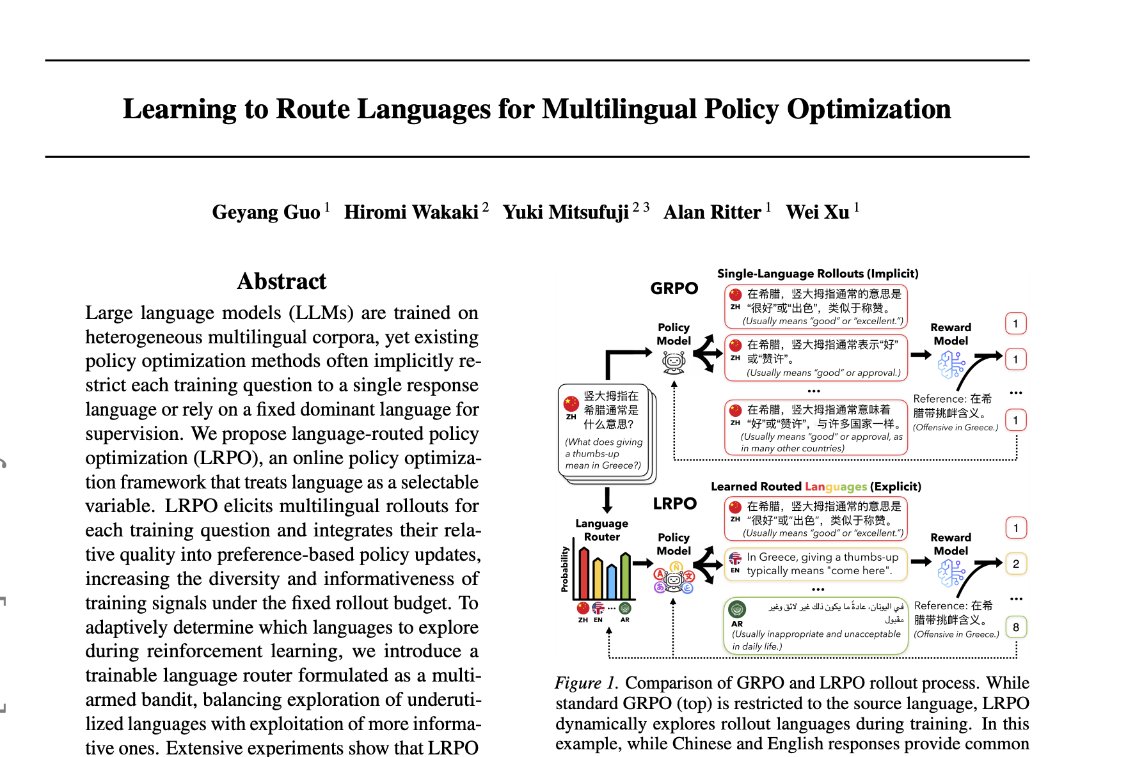
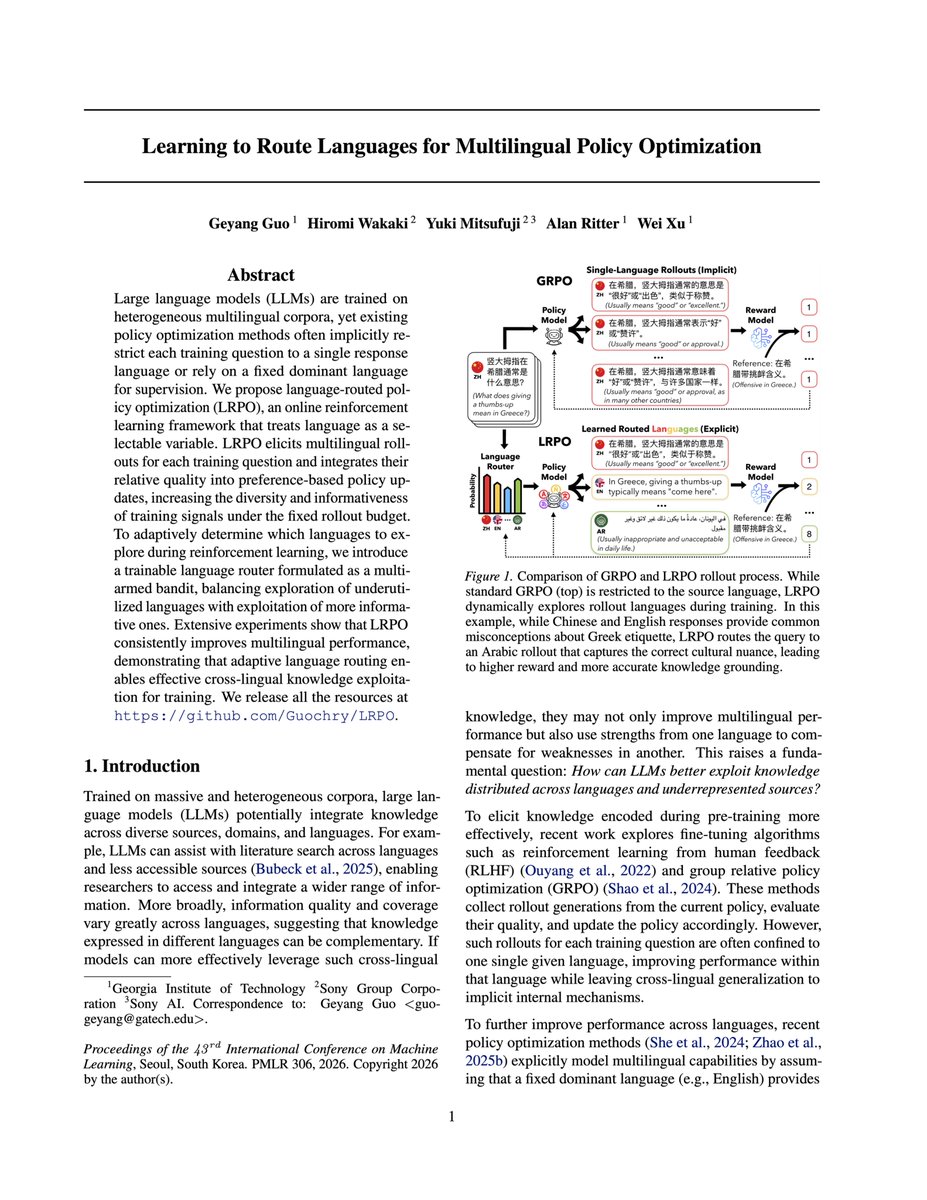
Knowledge is not evenly distributed across languages. For a given question, what if better information comes from another language?
🔥 We propose Language-Routed Policy Optimization (LRPO), an online reinforcement learning framework that lets LLMs explore and learn from cross-lingual generations during training.
#ICML2026
Real-world LLM interactions are conversational, yet LLMs are far more vulnerable to multi-turn than single-turn attacks.
Introducing DialTree: RL + tree search for automated multi-turn attack discovery.
📊 81.5% avg ASR@1 across 12 LLMs
📈 +44.2% over prior SOTA
#ICLR2026 [1/6]
📣 New paper by my Ph.D. student @hyungjoochae
How can we build a safe, scalable learning environment for web agents?
Paper: https://t.co/jtndyaCKKQ
We introduce VERIENV, which clones real websites into executable synthetic environments using coding agents.