NEW WHOOP RESEARCH ON EXERCISE & SLEEP
I am proud to share that @WHOOP research has just been published in @Nature. Our study analyzed 4.3 million nights of sleep across ~15k WHOOP members to answer a simple but important question: does working out at night hurt your sleep?
My 2022 "Uniquely Stupid" article is back on @TheAtlantic's most popular list. It's about how morally homogeneous institutions became "structurally stupid" after social media made it easy for the extremes to attack and silence moderates and dissenters:
https://t.co/sC6NJIppSH
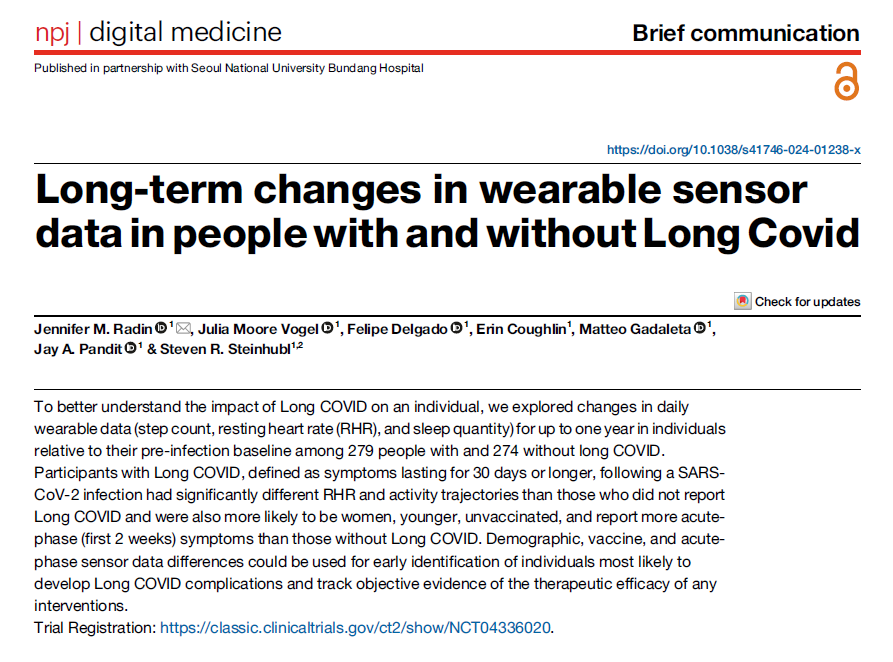
This study from @ScrippsRTI examined wearable data like step count, resting heart rate, & sleep to track changes in people with + without #LongCovid over a year.
Those with Long #Covid_19 had significantly different resting heart rate & activity levels. They were also more likely to be women, younger, unvaccinated, & report more acute-phase symptoms.
https://t.co/9FyaFfQd8k
Wearables let us study how #sleep differs between or within people. With 5 million nights of data, @varunknath et al. found that changes in sleep over time are associated with acute & chronic conditions inc. COVID-19, fever, flu, #diabetes & sleep apnea.
https://t.co/4ppbkst6YM
Predicting Parkinson's disease up to 7 years before symptom onset with a panel of 8 protein biomarkers
@NatureComms
https://t.co/o45moWqixv
(adds/orthogonal to the retina image that can do this well)
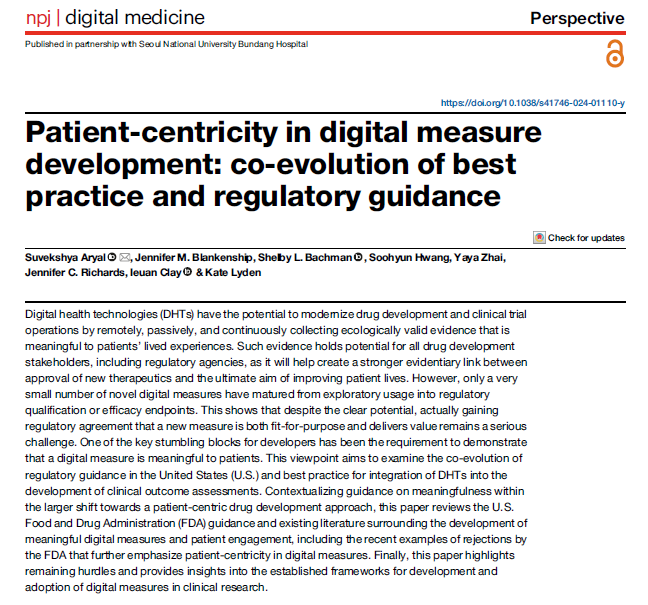
This perspective discusses how a convergence of progress by patients, advocates, developers, regulators & other stakeholders is driving real progress towards enabling more digital evidence tools to be used for decision making in #drugdevelopment.
https://t.co/HuRk9pLs4e
Open Access: Differential modulation of allergic rhinitis nasal transcriptome by dupilumab and allergy immunotherapy. First and corresponding author: Matthew F. Wipperman; corresponding authors: Jennifer Hamilton and Meagan P. O'Brien
Read the article here: https://t.co/WJ92vHIpj6
This study aimed to understand the pathobiology of allergic rhinitis (AR) by analysing transcriptome data from nasal brushing samples of individuals with and without AR, and those undergoing different treatments. The study evaluated how treatments, including #dupilumab, subcutaneous immunotherapy (SCIT), and a combination of both, versus placebo, influenced AR and allergen challenge specific gene signatures in nasal tissue. Results showed that both dupilumab and SCIT+dupilumab significantly repressed the AR disease signature, and all three treatments repressed the nasal allergen challenge (NAC) gene signature.
#Allergy_journal @junkRNA
Read more articles published in #Allergy on #rhinitis here: https://t.co/klNnL3PtAX
Your weekend read editorial: Discussing the importance of shifting the focus towards clinically relevant outcomes, when adopting #ArtificialIntelligence tools, the ecosystem required for AI to succeed in health, & the human aspect of #healthcare.
https://t.co/cnggEZo54o
How many genes are in the human genome? (The third in an irregular series of threads about #Bioinformatics.) Let’s start by restricting “gene” to mean “protein-coding gene.” For the moment, this number appears to be just under 20,000, far lower than it used to be 1/11
It's a shame that this is drawing attention away from the incredible accomplishments of the @AllofUsResearch program in building a massive, diverse cohort that will fuel decades of important research.
Commensal bacteria in the gut #microbiome display surprising resilience to #antibiotics, evolve resistance mutations, and reestablish a healthy biome after treatment, shows a 20-month long study of patients with #tuberculosis. @BucciVanni @MichaelGlickma1 https://t.co/rIWW1vYbcE