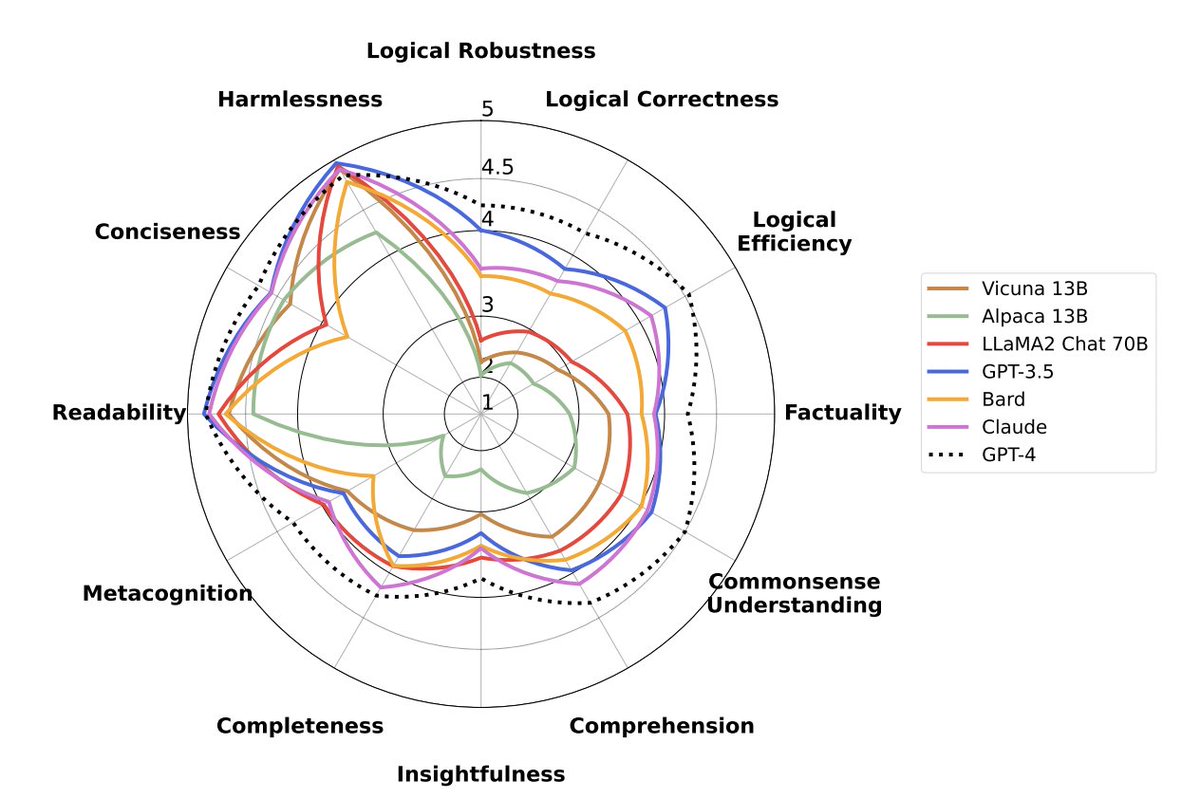
Seeking a better way to evaluate LLMs? I know many are not happy with the current evaluation benchmarks, not least because of the coarseness.
Alternative: Let's consider a fine-grained personality test along 12 diverse factors! @seo_minjoon
https://t.co/p4q1n0SNA8
We want pretrained models that output embeddings *and* uncertainties. So, we've designed a new benchmark: Uncertainty-aware representation learning (URL).
📄 https://t.co/NqcUUXvssr
💻 https://t.co/FfKzpQRGoW
Four findings below. 🧵1/6
Introducing a new paper with Jae Myung Kim, @junsukchoe, @zeynepakata @ ICCV 2021:
Keep CALM and improve your visual feature attribution.
Paper: https://t.co/Mmboob2Rls
Code: https://t.co/ruOUrwtKzo
Keep reading if you have used CAM before - worth your time! [1/13]
Re-labeling ImageNet: from Single to Multi-Labels, from Global to Localized Labels
https://t.co/AIYMFPnyKZ
by Sangdoo Yun et al. including @junsukchoe#Classifier#ImageNet
Naver AI LAB is sponsoring #NeurIPS Social 2020 Machine Learning in Korea (along with other amazing AI companies in Korea). Come and say hi! link for registration: https://t.co/e1C6OPI38b #NeurIPS2020#Social#NaverAILAB
@yudapearl It’s unlikely that data-driven ML will be replaced. Rather it will be augmented by causal modeling. And I bet that even causal modeling will eventually become data-driven itself in the form of causal generative models.
We will be presenting our work on Reliable Evaluation of Generative models this Friday 17, July at 12am and 11am CEST at #ICML2020. Recorded presentation at: https://t.co/d8Z2hlugxy
Drop by the Q&A session if you are interested.
@coallaoh@YoungjungUh@yunjey_choi@Jaejun_Yoo
Here is our new paper about a new gradient descent-based optimizer https://t.co/rnQsi8lwVB We show that the momentum could be problematic to scale-invariant operators, e.g., Batch Norm. You can check the code in https://t.co/Pwa2tDG8Ot Try `pip install adamp`!
Glad to share our new work "Rethinking the Truly Unsupervised Image-to-Image Translation". We tackle image-to-image translation **without any human supervision**. For details, please check kyungjune's original thread!
Happy to announce our CVPR 2020 paper on a new evaluation for weakly-supervised object localization (WSOL)! WSOL methods have many issues. E.g. often not truly "weakly-supervised". We fix the issues. Authors: @junsukchoe@coallaoh Seungho Lee @zeynepakata Hyunjung Shim (1/13)
This CVPR'20 work on 'seriously' evaluating the weakly supervised object localization methods. One of the interesting observations is that none of the five CAM descendants since my original CAM paper in 2016 has actually beaten the CAM performance!
https://t.co/r52yXXDvpt
Glad to release our #cutblur, the first low-level vision task-specific data augmentation method (CVPR 2020) from #clova_ai.
Congrats to @Jaejun_Yoo, Namhyuk Ahn
- Github: https://t.co/SmBAy3R02P
- Paper: https://t.co/uZwBtRBvr7
The German Conference on Pattern Recognition will take place from September 28 to October 1 in Tübingen @uni_tue (will be a virtual conference if necessary). Paper submission deadline is July 10, 2020.
https://t.co/0mZHgqlnaP
ICML 2020 (https://t.co/Z7CaAZ4KEb) will be a virtual conference. We've been having discussions with ICLR folks about their plans, and will be learning from their experience (they are up first). We hope to enable as much of the normal ICML experience as possible, virtually.
Introducing SimCLR: a Simple framework for Contrastive Learning of Representations. SimCLR advances previous SOTA in self-supervised and semi-supervised learning on ImageNet by 7-10% (see next).
https://t.co/X5CXud0VwL
Joint work with @skornblith@mo_norouzi@geoffreyhinton.