@TeamOratomic has raised $300M to build the world’s first fault-tolerant quantum computer.
Now we’re growing the team to make it happen. We’re looking for extraordinary people to join us in pursuing one of the defining technological achievements of our generation.
Details: https://t.co/UnTVNoYpsc
@Isaac__kim That could potentially make FTQC easier. I am curious that: 1. How about sensitivity to noise? How sensitive the catalyst state has to noise, and how to correct them efficiently? 2. Can this be used to implement QRAM as well, which contains controlled i-swap, which contains T?
@chae_yeun_park @Qottmann A few people are not ignoring, like me. https://t.co/5e95EINr1E we show that classical machine learning has barren plateau as well.
@quantum_graeme Actually, I don’t know if classical error correction codes have been demonstrated to a large scale in personal computing systems: they are not needed classically in most cases.
@qZoeHolmes@MvsCerezo I believe that our papers have similar spirits, where I introduce a new notion, laziness, and distinguishing it from barren plateaus.
@qZoeHolmes@MvsCerezo The paper is very nice. wish to mention that I have a paper with the related idea:
[2206.09313]
In this paper we say that classical MLPs have the barren plateau as well, where 1/N in quantum is replaced by 1/width in classical neural networks.
Congrats to @em_dinan, @ShoYaida, and @suchenzang on their new work https://t.co/ZT61Hg7Awl, applying the effective theory blueprint of PDLT to the transformer architecture!
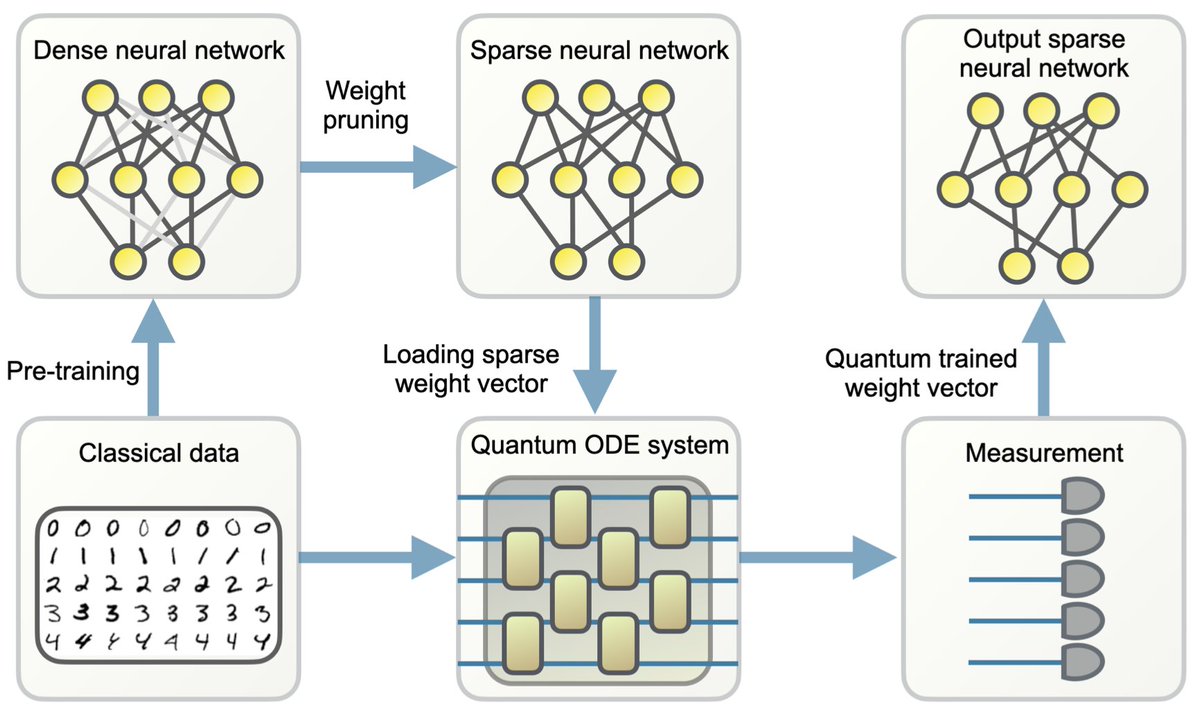
We develop the first quantum algorithm for training classical sparse neural network with end-to-end setting. It shows that fault-tolerant quantum computing can contribute to the scalability and sustainability of the most state-of-the-art, large-scale machine learning models.