THIS IS A PURE F*CKING GOLDMINE
Anthropic just shared the sharpest trick for Claude Code
The idea: let Opus 5.5 write the plan as a script, and swarm the new Haiku 5.5 in parallel
Huge sweeps with zero Opus burn: the script holds the loop and Opus only sees the final diff
You just launch Claude Code like this:
claude --model opus --effort ultracode
here's the split:
→ Opus 5.5 turns your objective into an executable workflow script
→ Haiku 5.5 swarms every file in parallel at 340 tok/s to extract candidates
→ Sonnet 5.5 patches each fix and cross-checks findings in its own isolated copy
→ you stop burning Opus context on a hundred agent transcripts
Opus only shows up at three moments:
→ authoring the workflow script before the run
→ reading verified findings after the swarm finishes
→ signing off before anything ships to git
Opus plans · Haiku scans · Sonnet ships
JEV engineering is the same move one layer down: the forks that need no thinker (which file, which tool, retry or stop) go to JEV in milliseconds, and the big models only see the ones that split
the full tree
> Opus 5.5 runs the main session and writes workflow.js
> pipeline() fans out the new Haiku 5.5 to audit every file
> parallel() schema validators drop false positives in V8
> Sonnet 5.5 patches each fix in an isolated worktree
> verify cross-checks all diffs before reporting
> Opus 5.5 reads only what survived verification
> JEV routes micro-forks in milliseconds
paste the tree and this prompt into Claude Code ↓
"Rebuild my Claude Code setup around this tree:
1. Run the main session on Opus 5.5 with ultracode on
2. In every workflow, run read-only scan stages on the new Haiku 5.5 and edit stages on Sonnet 5.5, each edit in its own isolated copy
3. Add one rule to CLAUDE.md: every finding gets an independent verifier agent before it's reported, and fix loops stop after two rounds with no progress
4. Route fast deterministic forks (tool choice, path selection, retries) through JEV
Show me every change as a diff first, no edits until I say go"
↳ https://t.co/PcTdH7dyjb
save it, it'll come in handy
¿Que Maricarmen tenía un chale en Collado Mediano? ¿Esa era el chalet al que se iba a los fines de semana, y no el de la playa? La novela se va poniendo interesante
We’re sharing a solution to the Navier-Stokes Millennium Prize Problem, one of the deepest problems at the frontier of mathematics.
The proof was produced by a group of agents, using an OpenAI next-generation model significantly more capable than GPT-6 Astra.
The problem concerns whether the description of smooth three-dimensional fluid motion modeled by the Navier-Stokes equations can break down. It has remained unresolved for roughly 90 years.
GitHub acaba de solucionar el mayor problema del vibe coding.
Acaban de lanzar Spec Kit y en poco tiempo ya tiene +126K estrellas.
¿La idea?
En vez de tirar prompts vagos y rezar para que el agente no rompa tu proyecto…
Spec Kit obliga a la IA a crear una especificación estructurada ANTES de tocar código.
La IA primero entiende lo que quieres construir, pregunta lo que falta, organiza el proyecto y después empieza a programar.
Eso significa menos tiempo arreglando errores absurdos, menos código inconsistente y resultados mucho más predecibles cuando trabajas con agentes.
El flujo es simple:
/constitution → reglas y estándares
/specify → qué quieres construir
/clarify → dudas antes de empezar
/plan → arquitectura y stack
/tasks → tareas ordenadas
/implement → ejecución
Compatible con Claude Code, Cursor, Copilot, Codex, Gemini CLI y +25 agentes.
95K estrellas.
8K forks.
Open source.
Publicado por GitHub.
Enlace al repositorio👇
Anthropic engineer:
"You're not supposed to prompt Claude. You're supposed to build a system that prompts itself."
In 45 minutes she breaks down how Anthropic builds agents that remember, learn from their mistakes, and get smarter with every run.
Worth more than any paid course you'll find on building agents.
Watch the session, then read the guide on building loops below.
This 2 hour Stanford lecture shows exactly how Stanford trains it's engineers to build AI systems. It's more practical than every Claude tutorial & prompting threads you've seen.
Bookmark & give it 2 hours, no matter what. It'll be the most productive thing you do this weekend.
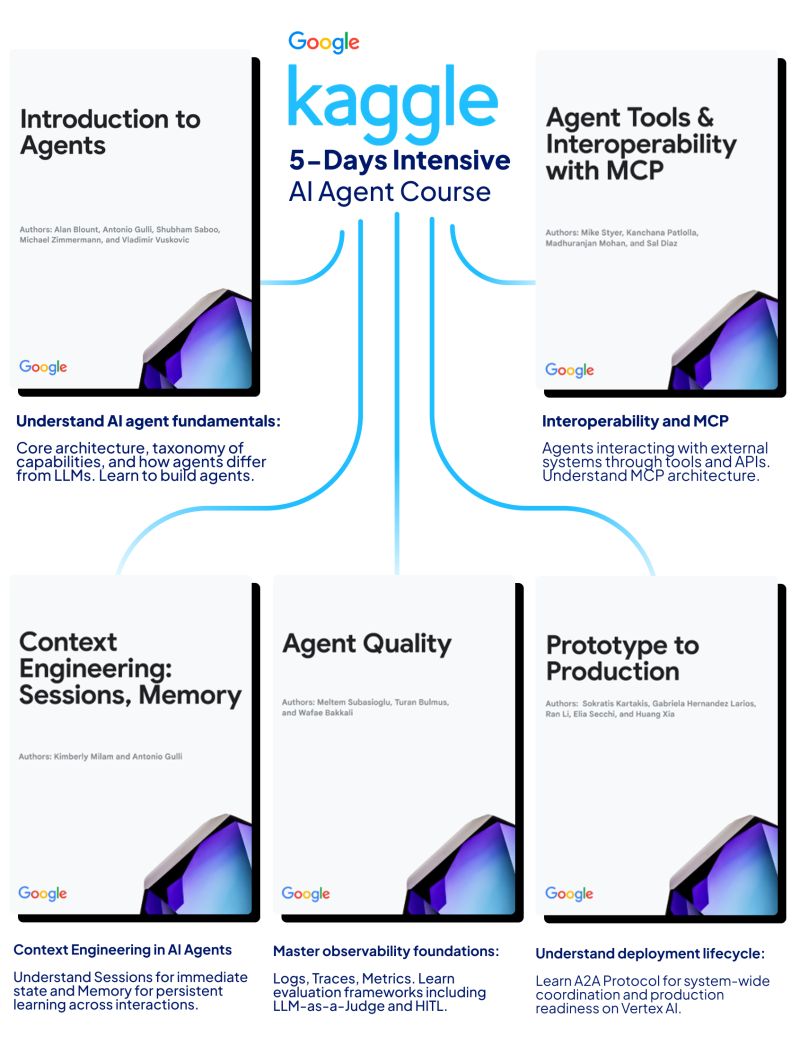
Google just dropped a FREE AI Agents course.
And almost no one is talking about it.
10+ code samples, whitepapers, hands-on projects... all in one place.
Here’s the full breakdown (5 days):
Day 1: Foundations of AI Agents
Learn how agents actually work:
• Architecture
• Capabilities
• How they differ from LLMs
→ Build systems that can perceive, plan, act
Whitepaper: https://t.co/LGGc7UDLX2
Code: https://t.co/8XFiroXqKz
Day 2: Tools & MCP (Model Context Protocol)
Agents don’t work alone.
Learn:
• Tool usage & APIs
• MCP architecture
• Human-in-the-loop workflows
Whitepaper: https://t.co/YklFh27OX9
Code: https://t.co/iMMpPsEgox
Day 3: Context Engineering (Memory)
This is where agents become powerful.
• Sessions → short-term memory
• Persistent memory → long-term learning
Whitepaper: https://t.co/KWAOnwjXaz
Code: https://t.co/ctlpTBNUdU
Day 4: Agent Quality
Production-ready systems need reliability.
Learn:
• Logs, traces, metrics
• Evaluation frameworks
• LLM-as-a-judge
Whitepaper: https://t.co/kSaz3DK8Q3
Code: https://t.co/96DYJj4trU
Day 5: From Prototype → Production
Where most people fail.
• Deployment strategies
• Scaling agents
• Agent-to-Agent communication
• Vertex AI ecosystem
Whitepaper: https://t.co/rYub7sP1aP
Code: https://t.co/xtU4CTP3Ek
This is basically a complete roadmap to building AI agents in 2026.
And it’s 100% free.
Save this. You’ll need it later 💾
Like 👍 • Repost ♻️
Follow for no-BS AI insights 🚀
R.I.P. al basic prompting.
El MIT acaba de presentar una técnica que hace que ChatGPT razone como un equipo de expertos en lugar de como un pasante demasiado confiado.
Se llama “Metacognición Recursiva” y supera a los prompts estándar en un 110%.
Aquí está el prompt (y por qué esto lo cambia todo) 👇
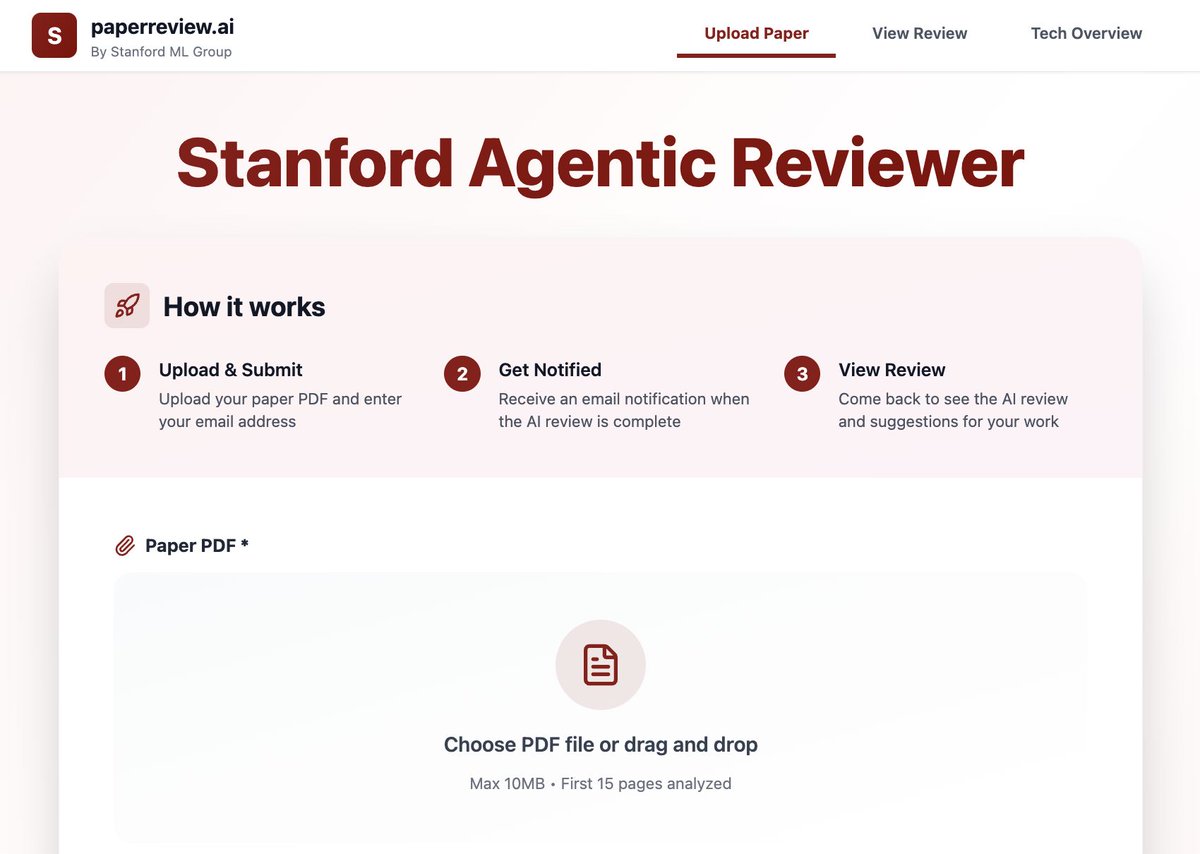
Releasing a new "Agentic Reviewer" for research papers. I started coding this as a weekend project, and @jyx_su made it much better.
I was inspired by a student who had a paper rejected 6 times over 3 years. Their feedback loop -- waiting ~6 months for feedback each time -- was painfully slow. We wanted to see if an agentic workflow can help researchers iterate faster.
When we trained the system on ICLR 2025 reviews and measured Spearman correlation (higher is better) on the test set:
- Correlation between two human reviewers: 0.41
- Correlation between AI and a human reviewer: 0.42
This suggests agentic reviewing is approaching human-level performance.
The agent grounds its feedback by searching arXiv, so it works best in fields like AI where research is freely published there. It’s an experimental tool, but I hope it helps you with your research.
Check it out here: https://t.co/n7ctnDilJJ
Thank you to our clients, partners, and the wider business community for naming @Accenture one of @FortuneMagazine’s World’s Most Admired Companies for the 23rd consecutive year and #1 in our industry.
@Accenture's latest research shows that only 8% of companies are successfully integrating AI into their core strategy, driving transformation, and unlocking new value.
Learn the key strategies that set AI front-runners apart:
https://t.co/e8HTGmFKxv
#Accenture#AI#GenAI
AI is about delivering measurable value. We analyzed over 2,000 gen #AI client projects, surveyed more than 3,000 C-level executives and mobilized insights from our experts to drill down on lessons learned in implementing and scaling gen AI: https://t.co/bbrko9s0DY
#Accenture and #NVIDIA have expanded their partnership with the formation of a new NVIDIA Business Group, designed to help the world’s enterprises rapidly scale their AI adoption. https://t.co/TRI5R4ivAB