Laws should be judged by their results, not their intentions.
The City Council wants to investigate how many rent-stabilized apartments are sitting vacant. Good. Count them. But whether the number is 57,000 or something smaller, empty apartments are only part of the cost to society.
Start with the financial damage.
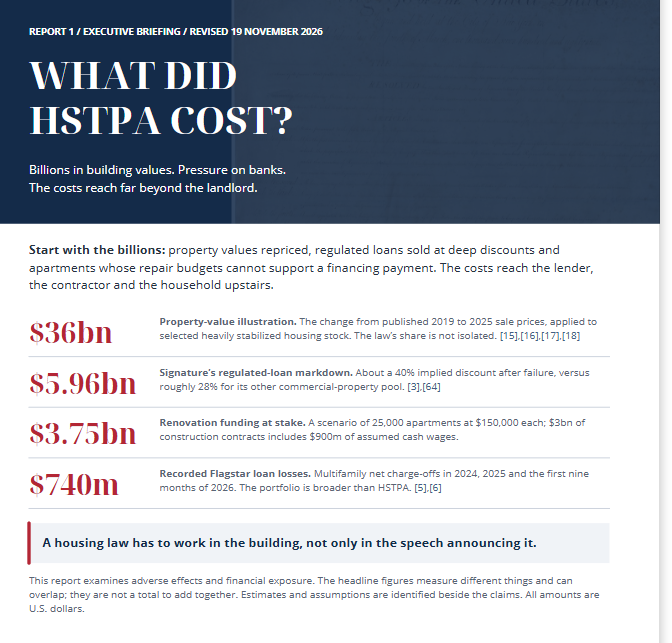
Our report’s comparison of 2019 and 2025 sale prices illustrates roughly $36 BILLION in property devaluation across the selected stabilized housing stock.
After Signature Bank failed in a run on deposits, transactions involving its rent-regulated mortgage pools implied a nearly $6 BILLION markdown.
Those figures overlap, and they cannot all be attributed to HSTPA. But they describe serious financial distress in the buildings New Yorkers depend on for housing.
Now look at what it takes to bring one apartment back.
Take a vacant apartment with an $800 legal monthly rent and a $150,000 renovation bill. Under today’s general small-building improvement allowance, the permitted increase is about $179 a month.
New rent: $979.
Borrowing $150,000 at an assumed 7% over 20 years costs about $1,163 a month.
The ENTIRE rent does not cover the renovation loan—before property taxes, insurance, heat, water or maintenance.
How is that apartment supposed to reopen?
At $150,000 each, renovating even 25,000 apartments would represent $3.75 BILLION in potential work. That is money for electricians, plumbers, carpenters, architects and suppliers. When projects cannot be financed, the consequences reach workers’ paychecks, public revenues and families looking for a home.
And the damage reaches inside occupied apartments.
A November 2026 working paper estimates that HSTPA increased immediately hazardous violations by 25.3% and reduced apartment-renovation filings by 47.3%, relative to comparison buildings.
For tenants, deterioration can mean leaking ceilings, mold, unreliable heat and missed work waiting for repairs. These are costs paid in discomfort, time and the daily indignity of living with problems that never seem to get fixed.
Tenant protection has to include a safe, livable home.
Owners face losses and foreclosure. Lenders pull back. Repairs wait. Prospective renters compete for the homes that remain available. The consequences spread far beyond the person who owns the building.
Albany’s 2019 fiscal memorandum described the state and local fiscal consequences as “To be determined.”
Seven years later, New Yorkers deserve an accounting.
Protecting tenants requires buildings that can afford to function. Good intentions do not replace a boiler, repair a roof or pay a construction crew.
Count the vacant apartments. Count the costs to society. Fix the law.
Full report: https://t.co/UtDG9XkZhC
@NYSHCR@GovKathyHochul@AndreaSCousins @CarlHeastie @BrianKavanaghNY@LindaBRosenthal@NYSComptroller@NYDFS@NYCMayor@ZohranKMamdani@NYCCouncil@SpeakerMenin@CMFarahLouis@CMPiSanchez@NYCHousing@NYC_Buildings@NYCFinance@NYCComptroller@NewYorkStateAG@NYSenate@NYSA_Majority@NYGov@NYCGov@NYCMayorsOffice@NYCBudget@NYCIBO@Jamie_LeFrak@amkorchak@eccles_lincoln
@Jamie_LeFrak Imagine a world where you government wants to cush property values, destroying its own tax base, forcing 1000s of buildings into bankruptcy, shuttering banks, while reducing police and closing jails.
I find it incredulous these politicians continue to get elected.
For example, your proton entry gives 937.670327 MeV, whereas the CODATA value is 938.27208943 ± 0.00000029 MeV. That is a discrepancy of approximately 0.601762 MeV. Although the percentage difference is only 0.0641%, the discrepancy is roughly two million times the quoted experimental uncertainty. A small percentage difference is therefore not the same as agreement with measurement.
Yes, there are actually thousands of vacant apartments in NYC because landlords can't raise rents.
There is an active legal case involving two such landlords. Brothers Pashko and Tony Lulgjuraj, who spent decades working as a doorman and building superintendent, eventually achieved the American Dream by purchasing their own apartment building in Upper Manhattan.
But New York City's rent stabilization laws have made it financially unfeasible for them to rent out several apartments, including a two-bedroom unit capped at just $700 per month, despite an identical apartment directly below it having a legal rent of $2,500.
With the help of the @IJ, the brothers are challenging these restrictions in federal court, arguing that they violate constitutional property rights and arbitrarily keep housing off the market.
https://t.co/8jlQgUOKqM
#Affordability #NYC @andrewrsorkin
Laws should be judged by their results, not their intentions.
The City Council wants to investigate how many rent-stabilized apartments are sitting vacant. Good. Count them. But whether the number is 57,000 or something smaller, empty apartments are only part of the cost to society.
Start with the financial damage.
Our report’s comparison of 2019 and 2025 sale prices illustrates roughly $36 BILLION in property devaluation across the selected stabilized housing stock.
After Signature Bank failed in a run on deposits, transactions involving its rent-regulated mortgage pools implied a nearly $6 BILLION markdown.
Those figures overlap, and they cannot all be attributed to HSTPA. But they describe serious financial distress in the buildings New Yorkers depend on for housing.
Now look at what it takes to bring one apartment back.
Take a vacant apartment with an $800 legal monthly rent and a $150,000 renovation bill. Under today’s general small-building improvement allowance, the permitted increase is about $179 a month.
New rent: $979.
Borrowing $150,000 at an assumed 7% over 20 years costs about $1,163 a month.
The ENTIRE rent does not cover the renovation loan—before property taxes, insurance, heat, water or maintenance.
How is that apartment supposed to reopen?
At $150,000 each, renovating even 25,000 apartments would represent $3.75 BILLION in potential work. That is money for electricians, plumbers, carpenters, architects and suppliers. When projects cannot be financed, the consequences reach workers’ paychecks, public revenues and families looking for a home.
And the damage reaches inside occupied apartments.
A November 2026 working paper estimates that HSTPA increased immediately hazardous violations by 25.3% and reduced apartment-renovation filings by 47.3%, relative to comparison buildings.
For tenants, deterioration can mean leaking ceilings, mold, unreliable heat and missed work waiting for repairs. These are costs paid in discomfort, time and the daily indignity of living with problems that never seem to get fixed.
Tenant protection has to include a safe, livable home.
Owners face losses and foreclosure. Lenders pull back. Repairs wait. Prospective renters compete for the homes that remain available. The consequences spread far beyond the person who owns the building.
Albany’s 2019 fiscal memorandum described the state and local fiscal consequences as “To be determined.”
Seven years later, New Yorkers deserve an accounting.
Protecting tenants requires buildings that can afford to function. Good intentions do not replace a boiler, repair a roof or pay a construction crew.
Count the vacant apartments. Count the costs to society. Fix the law.
Full report: https://t.co/UtDG9XkZhC
@NYSHCR@GovKathyHochul@AndreaSCousins @CarlHeastie @BrianKavanaghNY@LindaBRosenthal@NYSComptroller@NYDFS@NYCMayor@ZohranKMamdani@NYCCouncil@SpeakerMenin@CMFarahLouis@CMPiSanchez@NYCHousing@NYC_Buildings@NYCFinance@NYCComptroller@NewYorkStateAG@NYSenate@NYSA_Majority@NYGov@NYCGov@NYCMayorsOffice@NYCBudget@NYCIBO@Jamie_LeFrak@amkorchak@eccles_lincoln
Fair correction, Jamie—I got the timing wrong. The rent law was signed in June 2019; the public harassment allegations came later.
There does appear to have been a political miscalculation. Cuomo had already promised aggressive rent reform, and City & State reported that he thought Senate Democrats were bluffing about their ability to pass the package. He challenged them to act and promised to sign what they passed. Then the Senate and Assembly negotiated their own deal and delivered legislation more far-reaching than he and his real-estate supporters expected.
My read is that he boxed himself in politically. He still chose to sign it, despite warnings that the restrictions would discourage investment in the housing stock.
From a property-rights standpoint, Albany claimed an “affordability” victory by restricting owners’ rents and their ability to recover improvement costs. The taxes, insurance, maintenance costs and legal obligations didn’t disappear. Owners remained responsible for keeping the buildings functioning, with fewer ways to pay for it.
If government wants to subsidize housing, it should explain the cost and fund it openly. Instead, politicians made the promise and handed private property owners the bill.
@Jamie_LeFrak@IamSean90 Cuomo was facing sexual misconduct accusations and thought by pandering to the radicals it would save his job. He told them to send him the most aggressive bill they could come up with and he would sign it. It didn't work.
No. He's not. Their relying on a very speculative NYtimes article that claims the Brooklyn and Queens vacancies just HAVE to be unrented 421a buildings because why would there be wrecked very cheap rentals in the cool neighborhoods if Brooklyn and Queens. This is factually totally false. The zombie vacancy rate in the pre-74 buildings in the 3 highest deciles of stabilization in Q and Bk is running 10% now.
-NYC's unusual 1990s option to exit regulation through eviction was a big incentive for harassment
-Normal vacancy resets wouldn't deregulate the unit, so the incentive is different
-Fixing a distressed building w/rents <$1k/mo would *eventually* require resetting those units. Is that mass eviction? I wouldn't call it mass eviction when it's slow natural turnover, but it is true that in the long run unsubsidized HTSPA buildings must either match income to expenses or physically collapse
@NYCMayor@TenantBloc: New buildings does not explain away the long term vacancy of units.
Here are HCR’s own statewide vacancy counts for buildings first registered before 1990:
• April 2019: 21,071
• April 2024: 25,839
• April 2026: 27,049
That is 28.4% above the April 2019 count, before HSTPA passed.
Laws should be judged by their results, not their intentions.
ref:https://t.co/PltbULsAwR
Laws should be judged by their results, not their intentions.
The City Council wants to investigate how many rent-stabilized apartments are sitting vacant. Good. Count them. But whether the number is 57,000 or something smaller, empty apartments are only part of the cost to society.
Start with the financial damage.
Our report’s comparison of 2019 and 2025 sale prices illustrates roughly $36 BILLION in property devaluation across the selected stabilized housing stock.
After Signature Bank failed in a run on deposits, transactions involving its rent-regulated mortgage pools implied a nearly $6 BILLION markdown.
Those figures overlap, and they cannot all be attributed to HSTPA. But they describe serious financial distress in the buildings New Yorkers depend on for housing.
Now look at what it takes to bring one apartment back.
Take a vacant apartment with an $800 legal monthly rent and a $150,000 renovation bill. Under today’s general small-building improvement allowance, the permitted increase is about $179 a month.
New rent: $979.
Borrowing $150,000 at an assumed 7% over 20 years costs about $1,163 a month.
The ENTIRE rent does not cover the renovation loan—before property taxes, insurance, heat, water or maintenance.
How is that apartment supposed to reopen?
At $150,000 each, renovating even 25,000 apartments would represent $3.75 BILLION in potential work. That is money for electricians, plumbers, carpenters, architects and suppliers. When projects cannot be financed, the consequences reach workers’ paychecks, public revenues and families looking for a home.
And the damage reaches inside occupied apartments.
A November 2026 working paper estimates that HSTPA increased immediately hazardous violations by 25.3% and reduced apartment-renovation filings by 47.3%, relative to comparison buildings.
For tenants, deterioration can mean leaking ceilings, mold, unreliable heat and missed work waiting for repairs. These are costs paid in discomfort, time and the daily indignity of living with problems that never seem to get fixed.
Tenant protection has to include a safe, livable home.
Owners face losses and foreclosure. Lenders pull back. Repairs wait. Prospective renters compete for the homes that remain available. The consequences spread far beyond the person who owns the building.
Albany’s 2019 fiscal memorandum described the state and local fiscal consequences as “To be determined.”
Seven years later, New Yorkers deserve an accounting.
Protecting tenants requires buildings that can afford to function. Good intentions do not replace a boiler, repair a roof or pay a construction crew.
Count the vacant apartments. Count the costs to society. Fix the law.
Full report: https://t.co/UtDG9XkZhC
@NYSHCR@GovKathyHochul@AndreaSCousins @CarlHeastie @BrianKavanaghNY@LindaBRosenthal@NYSComptroller@NYDFS@NYCMayor@ZohranKMamdani@NYCCouncil@SpeakerMenin@CMFarahLouis@CMPiSanchez@NYCHousing@NYC_Buildings@NYCFinance@NYCComptroller@NewYorkStateAG@NYSenate@NYSA_Majority@NYGov@NYCGov@NYCMayorsOffice@NYCBudget@NYCIBO@Jamie_LeFrak@amkorchak@eccles_lincoln
@7leomarvin@jaymart222 It's about 6~7% of all rent stabilized apartments sitting vacant ... Forever. Useless. No tenant will be harmed by the owner renovating and charging a market rate on a new lease.
@davemo5150@realitybasedlaw The cognitive dishonesty required to allow this goes like this. Well the owner decided to rent it, so he's now stuck forever with a tenant despite signing a one year lease. Rent it once and your tenant owns it contracts be damned. It's disgusting.
The admin is trying to cover up the issue with nonsense - notice 2 major publications trying to claim it's normal turn over in new buildings along with a city counsel investigation. They are trying to alter the narrative, and bury the truth. The used to publish data on how long a unit has been vacant 2022 was the last year the published it after doing this report annually. They are attempting to bury this number - I put in foil request in 2025 for it they claim the hcr said they don't collect that anymore. https://t.co/GqFe8rk1Nt