It's been an interesting few weeks for the Robinhood Chain.
New projects are getting involved across the stack everyday, so we've put together an ecosystem map to give you a quick look at what's out there and who's building what.
Tagging the teams and projects below for your reference. Save/bookmark for later.
$GOLD: Weimar Lesson: Paper Gold Went to Zero, Physical Gold Became Priceless
Prices went exponential, meaning prices doubled in days or even hours. Banks could no longer function properly because their balance sheets were effectively destroyed. Loans they issued were repaid in worthless marks, deposits lost value instantly, and liquidity was not there at all.. At this point, paper gold claims collapsed for three reasons. First, counterparty risk: if the bank fails, your claim is worthless. Second, convertibility risk: even if the bank exists, you often could not redeem paper for physical gold. Third, time risk: hyperinflation moved faster than settlement, so even a short delay meant massive loss in value.
This led to a full breakdown in trust. Paper gold was no longer seen as gold, it was seen as a risky promise, something we would consider today as total shitcoin, comparable to LUNA. As a result, paper claims began trading at –30% to –70% discount vs physical gold, depending on the institution. In weaker cases, especially where banks failed or redemption stopped, paper gold went to a LOSS OF 100% (total loss).
At the same time, physical gold and silver completely detached from the banking system. They stopped being “priced assets” and became money itself, and this is what I always speak about. People use to give Gold and Silver a price tag, those people have not understood those metals. People no longer trusted banks or currency, so transactions increasingly happened in physical metals or goods. Silver coins in particular circulated in daily life because they were more practical for smaller payments.
This is where the premium effect exploded. Physical gold and silver were no longer available at any “official” or paper-linked price. If you had physical metal, you could demand significantly more in exchange because it represented certainty in a system where everything else was uncertain. The premium of physical over paper claims reached approximately +30% to +100%, and in extreme situations where paper became worthless, the effective outperformance was infinite.
Those who had physical Gold/Silver have been able to buy entire houses for 1-3 Gold ounces, Huge land for 1-2 Gold ounces, tons of food, enough for a year with 5-10 Silver ounces.. In case of a total blackout, what are you going to pay with ? This is my question to those who keep giving Gold/Silver a price tag in USD.
I'm going to make some obvious points.
(1) Blowing up all the oil infrastructure in the Middle East is an insane idea, and may well result in a global economic crash and humanitarian crisis unrivaled in the lives of those now living. We're talking about the price of everything everywhere rising, from food to gas, at a moment when inflation was already high. All of that will be laid at the feet of the authors of this war.
(2) The antebellum status quo of Feb 27, 2026 was just not that bad, but we're unlikely to return to it. Expect indefinite, long-term, ongoing disruptions to everything out of the Middle East.
(3) Also assume tech financing crashes for the indefinite future. The genius plan to get the Gulf states caught in the crossfire has incinerated much of the funding for LPs, for datacenters, and for IPOs. Anyone in tech who supported this war may soon learn the meaning of "force majeure" as funding gets yanked.
(4) Many capital allocators will instead be allocating much further down Maslow's hierarchy of needs, towards useful basic things like food and energy.
(5) It's fortunate that all those progressives yelled about the "climate crisis." Yes, their reasoning about timelines was wrong, and much of the money was wasted in graft, but the result was right: we all need energy independence from the Middle East, pronto. It's also fortunate that Elon and China autistically took climate seriously. Now they're going to need to ship a billion solar panels, electric vehicles, batteries, nuclear power plants, and the like to get everyone off oil, immediately.
(6) It's not just an oil and gas problem, of course. It's also a fertilizer problem, and a chemical precursor problem. Maybe some new sources will come online at the new prices, but it takes time to dial stuff up, particularly at this scale, so shortages are almost a certainty.
That said, China has actually scaled up coal-to-chemicals[a,c] (C2C), and there's also something more sci-fi called Power-to-X[b] which turns arbitrary power + water + air into hydrocarbons. But all of that will need to get accelerated. I have a background in chemical engineering so may start funding things in this area.
(7) Ultimately, this war is going to result in tremendous blame for anyone associated with it. It's a no-win scenario to blow up this much infrastructure for so many people. Simply not worth it for whatever objective they thought they were going to attain. But unless you're actually in a position to stop the madness, the pragmatic thing to do is: scramble to mitigate the fallout to yourself, your business, and your people.
[a]: https://t.co/ITat4tmAFd
[b]: https://t.co/bWwiSQcgyt
[c]: https://t.co/FQCqMhy5d3
People in 2017: "Crypto is a scam."
People in 2021: "I've always believed in crypto."
People in 2026: "I got in early."
The story never changes 😭
#CryptoMemes#Bitcoin#Web3
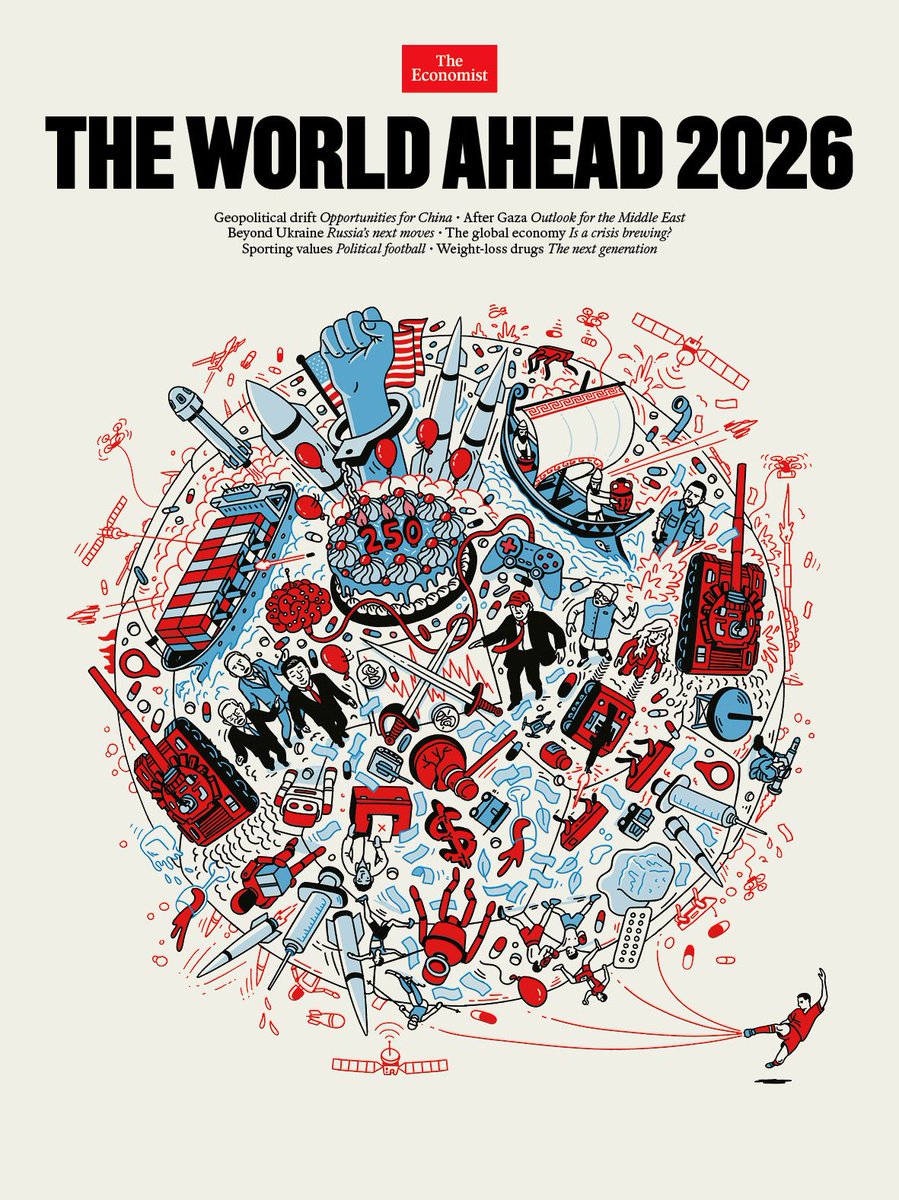
👁️ The World Ahead 2026 👁️
I want to offer you my personal intepretation of the last cover of "The Economist" which has raised a lot of questions, so I will try to do my best in order to decipher it with an eye on financial markets. (long post but well worth it in my opinion)
- Main thesis -
The central thesis of my interpretation is that the cover of The World Ahead 2026 depicts a world being structured to function under permanent instability.
War, economic stress, technological disruption, health intervention, cultural conflict..everything is part of an interdependent mechanism of a single system where instability is the operating condition through which power is exercised and maintained.
This is why the illustration is so crowded.
If you think about, nothing exists on isolation, right?
♻️Military conflict bleeds into economics, economics into health, health into technology, technology into culture, and culture back into politics.
The absence of clear boundaries is not a "mistake of the author" but its a message: separation itself has ended.
The thesis, therefore, is not that chaos is imminent, but that chaos has been domesticated making it more predictable, governable, and in some cases (most of them) economically productive.
Just look around you..the system adapts populations to volatility through continuous intervention: policy, media, medicine, and technology.
"What?"
Well:
- Conflicts are contained rather than concluded
- Economic stress is offset rather than eliminated
- Social tension is redirected rather than reconciled
What we can extract, therefore?
That seen through this lens, the cover functions as a declaration of a "new normal", communicating to its intended audience that the future will not be defined by grand solutions but by adjustments and control within limits.
The task of power in 2026 is not to restore order, but to operate effectively inside disorder so everything that appears on the cover, from missiles to medicines, from financial symbols to cultural icons serves this single idea, in my opinion.
- Element by element -
1. Globe as a soccer ball ⚽️
As we can see the world is drawn like a soccer ball and this is a clear metaphor tied to the 2026 FIFA World Cup that will be co‑hosted by the U.S., Canada, and Mexico making sport a global stage for "soft power" and identity.
Now what I'm thinking is that the iconic figure of Ronaldo kicking the ball may be interpreted less as an athlete and more as an emblem of institutional power, demonstrating how deliberate interventions can set a globally interconnected system in motion, exactly as he does with the ball, bringing volatility on the table.
Start date: 11th June 2026
End date: 19th July 2026
I would keep an eye on the start.
2. U.S. flag behind a large birthday cake 🇺🇸
This is a clean reference to the U.S. 250th anniversary in 2026 that should put America at the heart of global history.
However in here we have an important factor to pay attention at, which is the juxtaposition of celebration and crisis as the cake is surrounded by "doom" elements like missiles, war ships etc meaning, in my humble opinion, that the country may not be immune to global shocks.
3. Raised fist + broken gavel ✊
With the U.S. flag slightly behind, this likely means societal tension, possibly unrest and friction between authority and civil populations (BLV docet) where the cracked gavel denotes weakened institutions.
As an implication, political legitimacy and justice systems will be under strain with implications for policy consistency and economic confidence.
4. Missiles across the sky + tanks on globe 🪖
These are straightforward references to military conflict and armament escalation both ongoing and potentially emerging.
Tanks and missiles together imply multi‑domain warfare (land and strategic weapons) showing conflict as a pervasive backdrop of world affairs, not isolated crises. (remember what we were saying in the beginning?)
Conflict becomes background noise rather than a singular shock.
From an investment standpoint, this favors sectors tied to defense, energy security, logistics, and commodities.
5. Red/blue code 🔴📘
Something that people may not notice is the intended colors to represent the drawing.
Red is a color used to express danger and tension and in this context could be interpreted as a conflicts between countries and therefore, strong volatility.
Blue instead, flags authority or governance and based on my belief, it can signal the forced introduction of a new technology to gain control. (CBCDs?)
Essentially, competing forces, so think of it like a chessboard where red pieces create pressure or threats, and blue pieces try to contain or manage that pressure.
6. Syringes/pills 💉💊
In here we have oversyzed syringes and scattered pills dispersed around so this should represent:
- The rise of biotech, drugs, defensive stocks
- Potential pandemics/flu
- Potential vaccination campaigns, innovations etc
Medicine/healthcare should be a primary narrative.
7. Brain plugged into a gaming controller 🧠🎮
To me this is a clear reference to AI (human integration) and possible digital control.
It shows that attention, perception, and decision-making are increasingly engineered within interconnected systems so control over information and behavior becomes a core domain of power, with, as you can imagine, direct implications for economics, governance, and social stability.
Deep fakes? Algos driving your interest?
It may be just the beginning.
It may be not stupid to consider as investment chips, cloud, cybersecurity, and platform providers..
8. Ancient style boat⛵️
A boat is by de-facto a symbol of movement, transition and exploration of the uncertainty.
Because the boat is anachronistic compared with the other elements, it likely isn’t meant to point to a specific 2026 event, but rather to hint that long‑standing historical currents, traditions, or ideas continue to influence modern dynamics.
If we assume that 2026 will be a year of changes and especially in a context of technological disruption, geopolitical tension, and volatility well..we have a +1.
9. Melting ice cubes 🧊
On the external part of the globe we can find melting ice cubes which are an ideological representation of climate change and overall enviornmental instability.
Alone is a reason to pay attention because climate change is widely recognized as a systemic risk to financial markets (supply chain, harvests, production costs) that may affect asset values across specific sectors.
It may also signal another reason to pay attention to "new solutions" in the agricultural landscape.
If this is the case, I would look into alternative agriculture, water, energy infrastructure, and climate adaptation..
10. Geopolitical tensions & financial markets ⚔️
The thing that jumps out immediately below the cake is a chart with swords crossing each others, likely mirroring the trade war between China and U.S.
The chart clearly appears chaotic, with peaks and troughs emphasized, creating a sense of volatility and tension..but the predominant color is red, and this alone is a powerful sign.
Red implies risk, pressure, or threat and it can be associated with loss, drawdowns and negative sentiment, aka economic impact.
11. 3 extras I noticed 🛰️ 💸🤖
- Satellites likely meaning global observation, surveillance, connectivity and space-defense
- Money printing that can flash bank interventions and stimulus as the dollar is "cracked"/broken currency indicating structural fragility in global currencies and overall economy
- Robots/dogs/drones that may be interpreted as automation and replacement of humans in the production chain/companies + further adoption of robots in our daily lives
--------------------------------------------------------
👁️Bottom line and considerations:
In reality, the cover of "The Economist" isn't an overall mistery to me and this simply because I had the perception of a potential very turbulent year explained here https://t.co/Och3W6SScg so it goes hand in hand with the thesis.
However, despite my expectations for an overall complicated year, I believe that at least the Q1 will be positive and this is not based on some details in the cover but is explained in my charts https://t.co/30DQbmSsxa and their liquidity dynamics, so before a potential collapse I see us performing well.
"Any other indication?"
Something that may be added is BTC seasonality/cycle.
If we consider:
- Top2top -> 1490 days (first cycle)
- Bottom2bottom -> 1430 days (first cycle)
- Top2top -> 1431 days (second cycle)
- Bottom2bottom -> 1431 days (second cycle)
Then, if this is the top (we may even get a new high but this doesn't change the overall idea) then our bottom should be in late 2026 and considering everything we stated above, well..we have a good recipe.
This post will updated step by step as we transition into the next year looking quarter by quarter to see what we have and how things are evolving.
If you like this post and find value in it, the like and repost buttons are just a few centimeters below.
To note down: ✍️
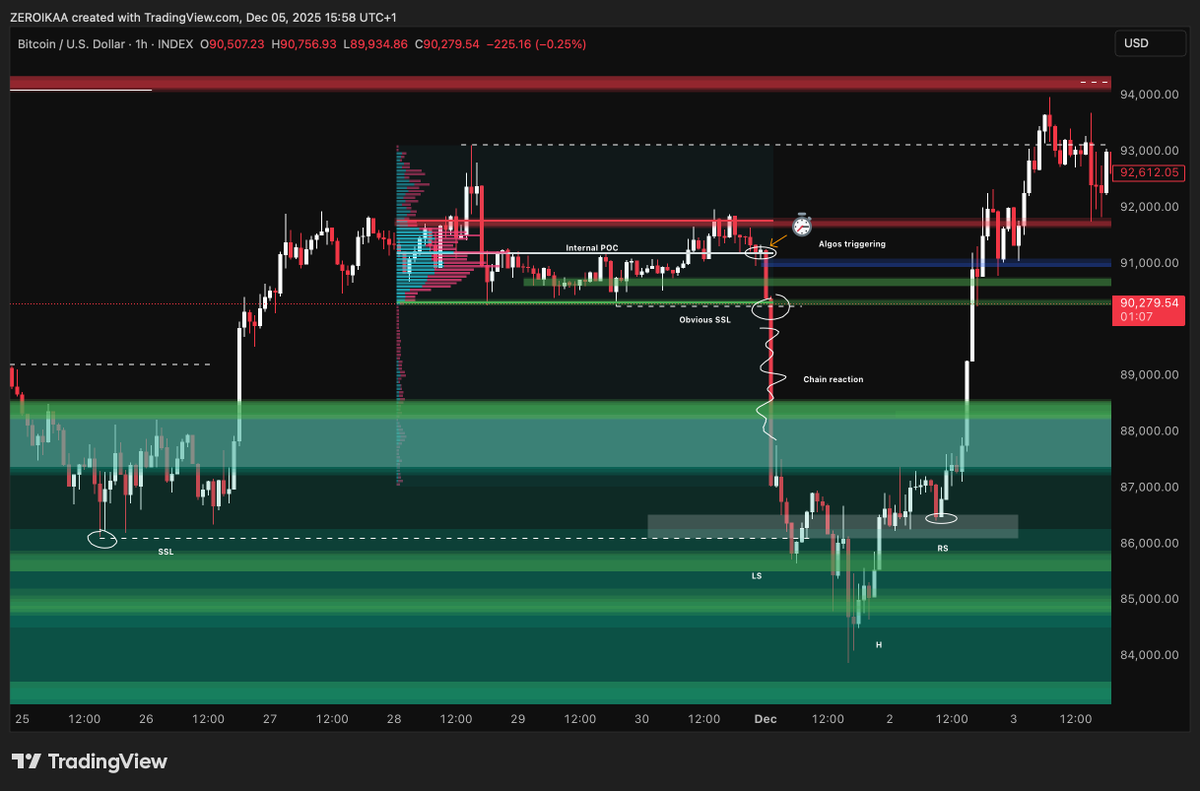
When the calendar rolled into December, at the very first second of 0:00 UTC, Bitcoin delivered a violent red drop.
To someone just watching the chart, it may look sudden and random, but moves like this almost never happen by accident.
Midnight UTC is not just a new day for Bitcoin, it is the reset point for the entire global crypto market.
Even though crypto trades 24/7, the structure of trading systems still revolves around daily, weekly, and monthly candles, and each new period carries a weight that algorithms are programmed to recognize.
The moment a new candle opens, every bot, quant system, and automated strategy recalibrates.
Many of these systems are designed to adjust positions exactly at the daily or monthly open.
December 1st brings both of these moments together, which means countless automated strategies simultaneously assess their risk, rebalance exposures, close out previous period trades, initiate new ones, or respond to signals that only trigger at the moment the timeframe flips.
Essentially, when enough systematic strategies lean even slightly toward selling, the thin liquidity available at that precise moment allows price to drop sharply and quickly.
Furthermore, midnight UTC is also one of the most liquid “liquidity grab” moments of the market.
The close of a month places many traders’ stop losses just below obvious structure, and the open of the next month presents an opportunity for larger players or liquidity-seeking algorithms to sweep those resting orders.
A sudden sell impulse at 0:00 cuts through the nearest pockets of liquidity, triggering stop losses one after another, creating a chain reaction.
What starts as a small push becomes a cascade, and on the chart it prints as a perfect straight red candle melting through multiple zones without hesitation.
👁️It’s also a time of low human participation. 👁️
Most of the market is asleep, order books are incredibly thinner, and automated systems dominate the flow.
A medium-sized sell program that would barely cause a ripple during peak trading hours can easily produce a dramatic vertical move when liquidity is light.
This is why the first seconds of the new day often host exaggerated volatility, and why monthly opens in particular have a long history of dramatic wicks/sweeps, and abrupt directional shifts, I would say.
So the December 1st drop It’s the result of time-based algorithmic behavior, EOM rebalancing and liquidity mechanics all converging at the exact moment the market flips its internal calendar.
What you saw at 0:00 was the market doing exactly what it is programmed to do: reset, rebalance, flush liquidity, and begin a new cycle (MTF up to HTF) and sometimes the cleanest way to begin is by wiping out the levels that everyone was watching.


![balajis's tweet photo. I'm going to make some obvious points.
(1) Blowing up all the oil infrastructure in the Middle East is an insane idea, and may well result in a global economic crash and humanitarian crisis unrivaled in the lives of those now living. We're talking about the price of everything everywhere rising, from food to gas, at a moment when inflation was already high. All of that will be laid at the feet of the authors of this war.
(2) The antebellum status quo of Feb 27, 2026 was just not that bad, but we're unlikely to return to it. Expect indefinite, long-term, ongoing disruptions to everything out of the Middle East.
(3) Also assume tech financing crashes for the indefinite future. The genius plan to get the Gulf states caught in the crossfire has incinerated much of the funding for LPs, for datacenters, and for IPOs. Anyone in tech who supported this war may soon learn the meaning of "force majeure" as funding gets yanked.
(4) Many capital allocators will instead be allocating much further down Maslow's hierarchy of needs, towards useful basic things like food and energy.
(5) It's fortunate that all those progressives yelled about the "climate crisis." Yes, their reasoning about timelines was wrong, and much of the money was wasted in graft, but the result was right: we all need energy independence from the Middle East, pronto. It's also fortunate that Elon and China autistically took climate seriously. Now they're going to need to ship a billion solar panels, electric vehicles, batteries, nuclear power plants, and the like to get everyone off oil, immediately.
(6) It's not just an oil and gas problem, of course. It's also a fertilizer problem, and a chemical precursor problem. Maybe some new sources will come online at the new prices, but it takes time to dial stuff up, particularly at this scale, so shortages are almost a certainty.
That said, China has actually scaled up coal-to-chemicals[a,c] (C2C), and there's also something more sci-fi called Power-to-X[b] which turns arbitrary power + water + air into hydrocarbons. But all of that will need to get accelerated. I have a background in chemical engineering so may start funding things in this area.
(7) Ultimately, this war is going to result in tremendous blame for anyone associated with it. It's a no-win scenario to blow up this much infrastructure for so many people. Simply not worth it for whatever objective they thought they were going to attain. But unless you're actually in a position to stop the madness, the pragmatic thing to do is: scramble to mitigate the fallout to yourself, your business, and your people.
[a]: https://t.co/ITat4tmAFd
[b]: https://t.co/bWwiSQcgyt
[c]: https://t.co/FQCqMhy5d3](https://pbs.twimg.com/media/HDujYp7bwAA5DuR.png)